
Spray Transfer vs Short Circuit MIG: Which to Use
Spray transfer vs short circuit MIG compared by heat, current, position, penetration, spatter, and gas. See which MIG transfer mode fits your welding job.

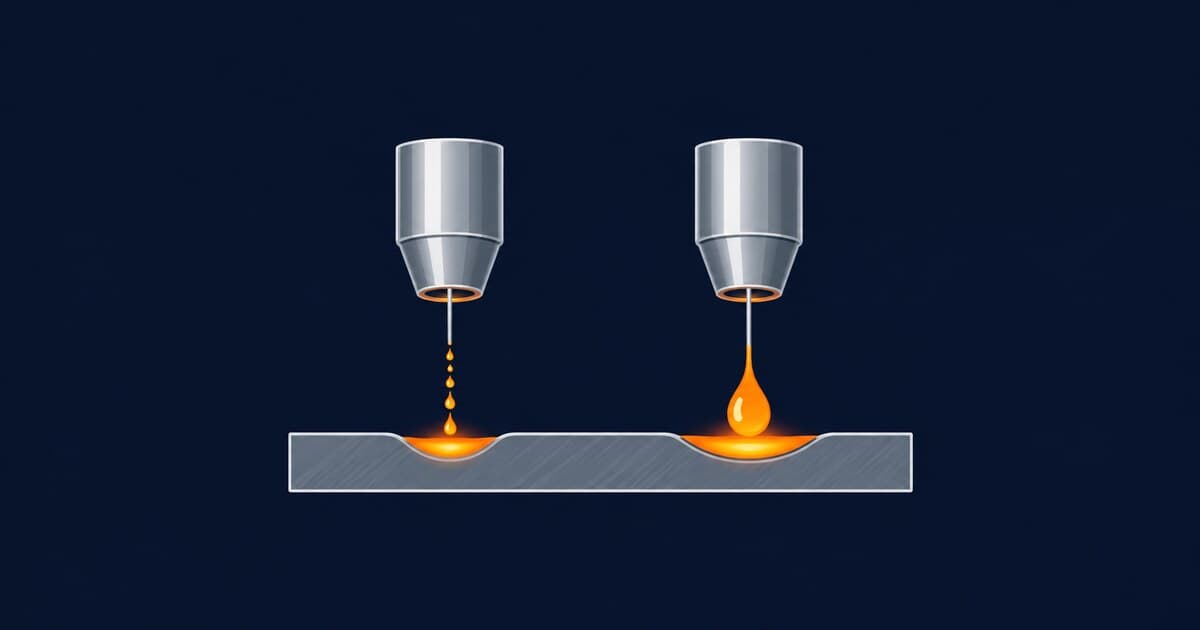
Spray transfer vs short circuit MIG is mainly a choice about current, heat and position. Short-circuit (dip) transfer runs at low current and gives the lowest heat input of the MIG transfer modes, so it suits thin sheet and positional welding. Spray transfer needs high welding current and a higher arc voltage, so it fits high-current, high-deposition work in the flat and horizontal positions. Pulsed spray sits between the two: it gives spray-type transfer at a lower average current.
Spray Transfer vs Short Circuit MIG at a Glance
GMAW has four metal transfer processes: short circuit, globular, spray and pulse. This article compares the first and third; pulsed spray is the variant that sits between them.
| Point | Short circuit (dip) | Spray |
|---|---|---|
| How metal moves | Wire touches the weld pool repeatedly | Wire does not touch the pool; metal crosses the arc as fine droplets |
| Welding current | Low | High (250 A and up for 1.2 mm wire, in the example ranges below) |
| Heat input | Lowest of the MIG transfer modes | Higher than short circuit |
| Welding positions | All positions | Mainly flat and horizontal |
| Spatter | High in conventional dip; varies with gas | Very little |
| Typical use | Thin sheet and positional welding | High-current, high-deposition work |
| Shielding gas | Low-CO2 argon mixes are generally chosen | Argon with O2 or CO2; pure CO2 cannot be used |
| Watch for | Spatter; lack of fusion with argon-rich gas | Needs high current and higher voltage |
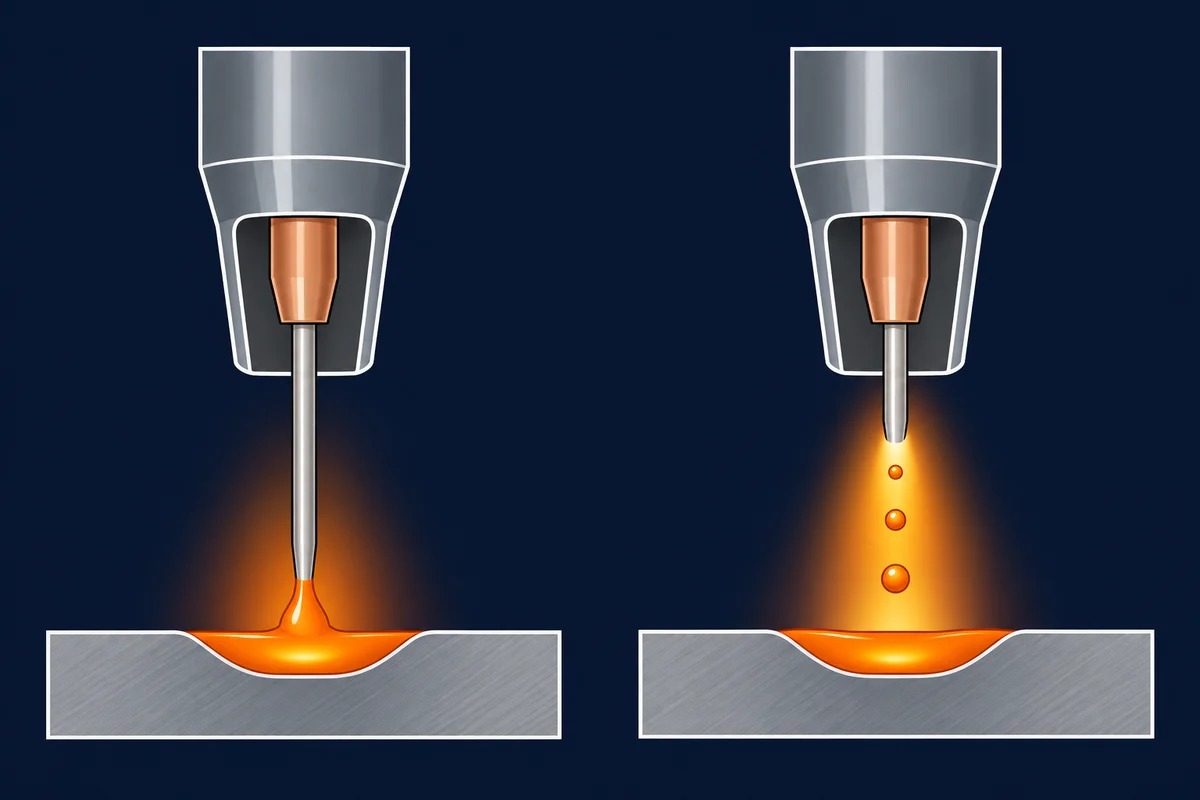
Figure 1: Short circuit and spray transfer compared at the wire and weld pool.
How Short-Circuit Transfer Works
Dip transfer combines low current and heat input with a small wire diameter. The wire short-circuits repeatedly against the weld pool. The process suits thin sheet and positional welding, where precise control of the weld pool is needed.
The main drawback is spatter. Conventional dip transfer has high spatter levels, linked to fluctuations in the current and voltage cycle. Spatter is tied to the current rise and droplet detachment, when a pinch force squeezes molten metal. Dip transfer is set with a low arc voltage: with 1.2 mm wire, about 17 V at 100 A and about 22 V at 200 A.
How Spray Transfer Works
Spray transfer is used only with high welding currents. The wire must not short to the pool, so the arc voltage is much higher. For 1.2 mm wire, it runs from about 27 V at 250 A to about 35 V at 400 A.
The move from globular to spray depends on energy input. In one stainless steel welding study, the team raised the wire feed speed to leave globular transfer and reach true spray transfer. That is a single result, not a rule for every wire and gas.
Welding Position: Where Each Mode Works
Position is one of the clearest differences between the two modes. Short circuit can be used in all welding positions. Spray transfer is used mainly in the flat and horizontal positions.
Spray transfer is hard to use out of position. In vertical and overhead work, drip is a serious limitation, so spray is a poor choice for those joints.
Pulsed spray covers the gap. It gives spray-type transfer with lower overall heat input, and it can be used in all positions. For spray-type transfer on a vertical or overhead joint, pulsed spray is the option to check first.
Penetration and Spatter
Penetration follows heat input. Short circuit gives the lowest penetration and fusion of the MIG modes, and spray gives the greatest. Short circuit is a poor choice where deep penetration is needed, and spray is the stronger option when penetration is the priority.
Spatter follows the transfer style. Spray transfer has no shorting and produces very little spatter. Short-circuit spatter depends on the shielding gas. Globular transfer produces the most spatter of the four processes.
Pulsed Spray as the Middle Option
Pulsed MIG/MAG is a variant of the conventional process in which the current is pulsed. It achieves spray-type metal transfer at average current levels below the spray threshold, so a plain spray setting is not needed to get that transfer style.
One study points to a benefit in thin stainless. On austenitic stainless steel sheet, pulsed GMAW at low heat input significantly reduced intergranular corrosion susceptibility compared with conventional GMAW, and the joints kept comparable mechanical properties.
Choosing by Thickness, Heat and Position
Use these points as a starting point. No single setting works for every job, so choose the mode first, then set current, voltage, wire and gas for your material and confirm them against your procedure.
- Thin sheet or out-of-position work: short circuit.
- High current in the flat or horizontal position: spray.
- Spray-type transfer at lower average current, or out of position: pulsed spray.
- Thin aluminum: MIG suits thinner gauges because less heat is needed. Wire feeding matters here too, as covered below.
Wire Diameter, Current and Voltage Ranges
The table gives example ranges for dip and spray transfer by wire diameter. They are reference values, not universal settings.
| Wire diameter (mm) | Short circuit current (A) | Short circuit voltage (V) | Spray current (A) | Spray voltage (V) |
|---|---|---|---|---|
| 0.6 | 30–80 | 15–18 | – | – |
| 0.8 | 45–180 | 16–21 | 150–250 | 25–33 |
| 1.0 | 70–180 | 17–22 | 230–300 | 26–35 |
| 1.2 | 100–200 | 17–22 | 250–400 | 27–35 |
| 1.6 | 120–200 | 18–22 | 250–500 | 30–40 |
For aluminum, wires 1 mm and smaller feed more reliably with a push-pull system. Gas flow is set by nozzle diameter and the gun-to-workpiece distance, and is typically between 10 and 30 L/min.
Shielding Gas Choice by Transfer Mode
Pure CO2 cannot be used in the open-arc pulsed or spray modes because of high back-plasma forces. Argon-based gases containing oxygen or CO2 are used instead.
Oxygen added to argon stabilizes the arc in GMAW. On carbon steel, CO2 is added to the shielding gas to increase heat input, which improves fusion and gives flatter weld beads.
Dip transfer is different. A mixture low in CO2 is generally chosen, and some manufacturers specify argon with 20% CO2. Argon-based gases are colder and carry a greater risk of lack of fusion in dip transfer than CO2 does.
Stainless Steel Gas
Austenitic stainless steel follows its own gas rules. In spray mode, argon with a small oxygen addition of 1–2% can be used. With short circuit, argon–oxygen blends tend to give poor bead appearance and poor melting characteristics. Argon with CO2 is the alternative, and CO2 is the most common addition for austenitic stainless steel short-circuit welding.
CO2 raises the carbon in the weld metal, so the amount matters. Argon-based blends with up to 5% CO2 can give good operational performance, but the carbon level may rise above 0.04%.
Power Source and Equipment
GMAW normally uses a constant-voltage power source with direct current electrode positive polarity. The wire comes off a spool or coil on a wire feeder, and the feeder connects to the constant-voltage supply.
The transfer mode is one of the main factors in choosing a power source. With a constant-voltage output and a fixed wire feed speed, the arc length corrects itself: a surplus of burn-off over wire feed is corrected as voltage and current settle back to the set arc length.
Pulsed spray needs more sophisticated equipment than conventional spray. Check that the machine has a pulse mode before you plan to use it.
Fume, Arc Light and Oxygen Safety
Arc energy can injure the eyes whatever the transfer mode. Use a filter lens with a shade number that provides the appropriate level of protection for the arc.
Fume levels differ by process and by metal. In one mild steel study, pulsed spray produced about 1.5 mg of electrode fume per gram of electrode, against about 13 mg for stick welding. In a separate stainless steel study, pulsed spray produced about 0.2 mg per gram. The two figures come from different metals and are not a fixed ratio.
Ventilation affects exposure. In one documented application, local exhaust ventilation brought welding fume levels to 3–13 mg/m³. That is one workplace result, not a general threshold.
Inert shielding gas can create an oxygen-deficient atmosphere, which can be fatal. Hot work such as welding calls for properly equipped fire watches. For confined spaces, fume exposure concerns or gas monitoring, ask a qualified safety or occupational health professional.
Code Work and Procedure Qualification
For structural steel, the D1.1 structural welding code defines how the steel is welded, qualified and inspected across buildings, bridges and other infrastructure. ISO 15614-1 covers welding procedure qualification for production welding, repair welding and build-up welding. Before you use either mode on code work, check which procedure the code requires and qualify it before production welding.
References
- MIG/MAG – Developments in Low Heat Input Transfer Modes - TWI, 2010
- Metal Inert Gas (MIG) Welding - Process and Applications - TWI, 2026
- Equipment for MIG Welding - TWI, 2026
- How do I choose a suitable power source for MIG welding? - TWI, 2026
- Power Source Characteristics - TWI, 2026
- Advantages of pulsed MIG/MAG welds over conventional MIG/MAG - TWI, 2026
- Shielding Gas Selection for Controlled Dip Transfer Welding - TWI, 2010
- How Do I Weld Aluminium? A Definitive Guide to the Welding Process - TWI, 2026
- Pulsed Current GMAW for Superior Weld Quality of Austenitic Stainless Steel Sheet - ISIJ / J-STAGE, 2007
- The Effects of Shielding Gas Composition on Stainless Steel Weld Metal Composition - AWS, 2026
- A Methodology for Shielding-Gas Selection in Wire Arc Additive Manufacturing with Stainless Steel - NCBI / PubMed Central, 2024
- Introduction to GMAW 251 - Purdue University
- Welding Participant Workbook: Laboratory Manual - FHWA
- Eye Protection During Welding - OSHA
- Engineering Controls Database - CDC/NIOSH, 2018
- Profiling Mild Steel Welding Processes to Reduce Fume Emissions and Costs in the Workplace - NCBI / PubMed Central, 2014
- Profiling stainless steel welding processes to reduce fume emissions, hexavalent chromium emissions and operating costs in the workplace - NCBI / PubMed Central
- Asphyxiation hazards in welding and allied processes - HSE, 2025
- Oil and Gas Well Drilling and Servicing eTool - OSHA, 2002
- AWS D1.1/D1.1M:2025-AMD1 - AWS, 2026
- ISO 15614-1:2017 - ISO
- Effects of Voltage and Wire Feed Speed on Weld Fume Characteristics - CDC/NIOSH