
MIG Welding Stainless Steel: Wire, Gas and Settings
MIG welding stainless steel depends on filler wire, shielding gas, transfer mode and back purging. Learn how 308L and 316L wire and argon blends fit together.

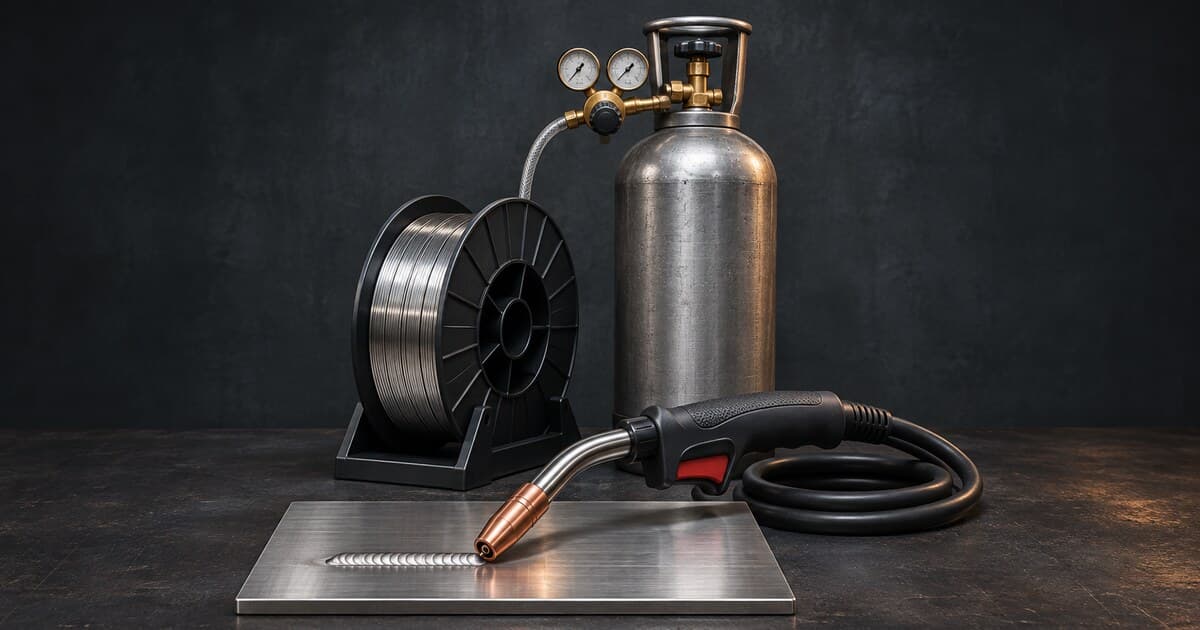
MIG welding stainless steel comes down to three choices: the filler wire, the shielding gas, and the transfer mode. Switching gas changes how the arc behaves, how the bead wets out, and how much carbon reaches the weld. If the root side of the joint sees air, you also need back purging on that side. Pick the wire for your base metal and service, and pick the gas for the transfer mode you run.
MIG welding stainless steel: choosing 308L, 316L and other filler wire
Stainless filler wire is classified by its chemistry. One standard covers bare stainless electrodes and rods and sorts them by filler metal composition. A second standard covers wire and rod for gas-shielded arc processes on stainless and heat-resisting steels. Designations such as 308L and 316L come from that chemistry, so the name tells you what the wire is made of. Classification is based on chemical composition, so the name does not by itself settle the base-metal pairing.
Matching the wire to the base metal
The right wire depends on the base metal grade and on the service the part will see. There is no single pairing rule that works for every joint, and the two examples below show how specific a pairing can be.
Low-carbon grades and sensitization
The L in grades such as 308L and 316L marks the low-carbon version of the alloy. Carbon matters because sensitization research focuses mainly on chromium carbide precipitation. Chromium carbides can form in austenitic stainless steel in the 500 to 900 °C range. Whether they form depends on the composition and on the thermal cycle the metal goes through.
Lower carbon slows carbide formation, and in most welding operations it prevents it. That is why low-carbon filler is the common choice for welded stainless. The grade alone does not settle the question, though, because the heat the joint sees still matters.
Dissimilar joints: stainless to carbon steel and between stainless grades
Dissimilar joints need their own procedure. In one naval procedure for carbon steel joined to austenitic stainless steel, the filler is ER309L. That procedure is written for a specific process, so it does not transfer to MIG on its own.
Joints between two stainless grades need the same care. A welding-code repair annex recommends ER308L for a 304L to 347 joint in a GTAW repair case. That is one example for one repair, not a rule for every 304 or 347 MIG job.
Why pure argon is not enough for stainless MIG
Pure argon is a poor choice for stainless MIG. It gives an unstable arc, the weld bead tends to wander, and the bead is too cold for short-circuit transfer.
What each gas component does
Oxygen added to argon stabilizes the arc. It also lowers the current at which transfer moves into spray, and it helps the weld metal wet out on the plate.
Carbon dioxide breaks down in the arc, and that releases oxygen and carbon into the weld. Carbon in the weld rises as CO2 content rises.
Helium adds heat to the weld pool while staying inert. Its higher ionization potential raises arc voltage, but helium is much more expensive than argon, and that cost is part of the choice.
Spray and short-circuit transfer on stainless
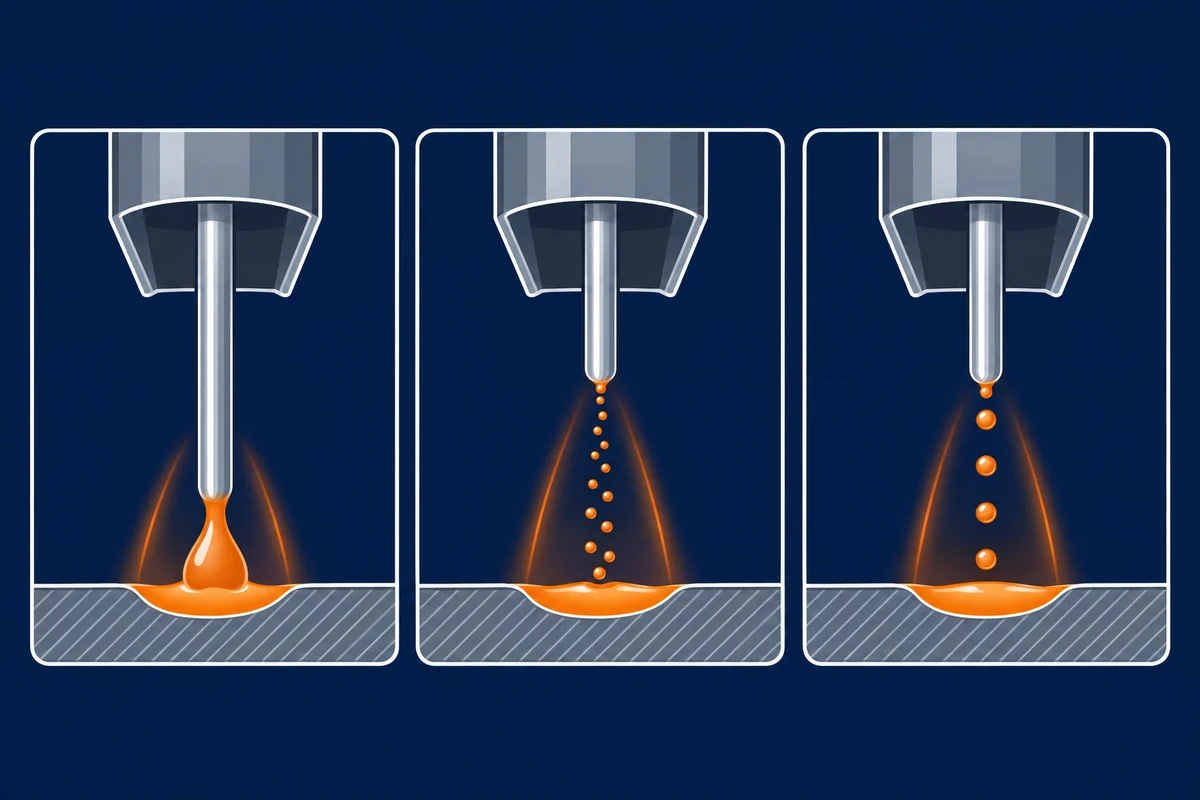
The transfer mode sets how metal crosses the arc, and the gas has to suit that mode. In spray transfer, wire feed speed is raised past the globular range before the metal moves into true spray. The two modes ask different things of the gas, as the table shows.
| Gas mixture | Spray | Pulsed | Short-circuit | Notes |
|---|---|---|---|---|
| 98% argon / 2% oxygen | Standard choice | — | — | Low carbon in the deposit |
| 98% argon / 2% CO2 | Suitable | Suitable | Too cold | Enough oxidation for wetting, with low carbon |
| 90% helium / 7.5% argon / 2.5% CO2 | — | — | Optimized for quality short-circuit transfer | Helium-rich blend |
Choose the mode and the gas together. A blend that works for spray can be too cold for short-circuit, and the helium-rich blend is the one recommended for short-circuit work.
Settings depend on the procedure
Voltage, current, wire feed speed and gas flow are not fixed values for stainless MIG. They depend on the procedure and the equipment data.
Start from the values in your procedure and the equipment manufacturer's data. Then adjust on test pieces that match the joint, and record what you changed.
Feeding, gas coverage and porosity
When the wire feed misbehaves
Poor wire feeding, bird-nesting, erratic arcs and burnbacks are all reasons to check the liner first. Confirm that the liner is cut to the correct length before you look at other causes.
Gas coverage and porosity
Using the wrong gas, or too little gas to cover the weld, can cause porosity, inclusions, cold cracking and a weakened weld. Each of these defects needs time-consuming rework, so check gas coverage before you start a repair.
Use the largest nozzle that still allows access to the joint. A larger nozzle helps the right amount of shielding gas flow over the weld, so reach and coverage have to be balanced for each joint.
Back purging and root color
In root-pass practice for pipe, welding-grade argon is the gas most often used for internal purging. Use the purge gas your procedure names.
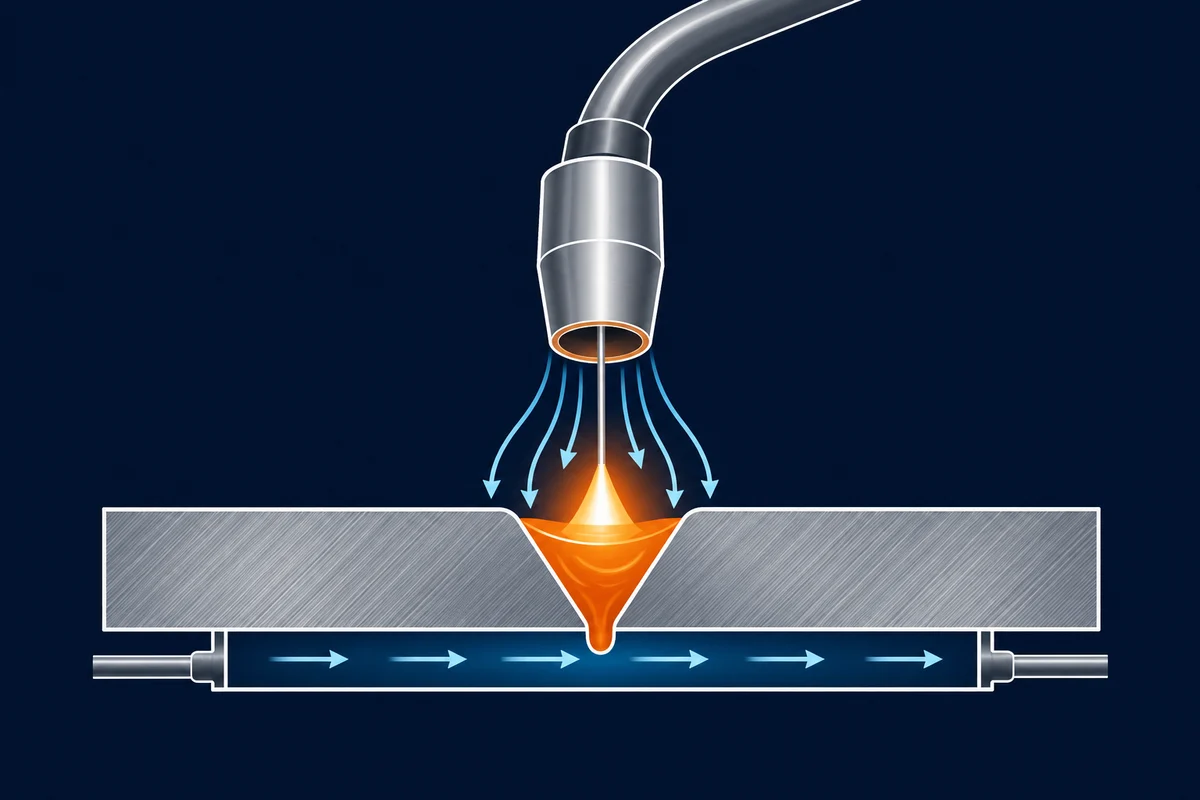
Reading the root color
Root discoloration is caused by oxide and hydroxide layers that form when hot stainless meets air. Thermal tinting, the thickening of the oxide layer by exposure to heat, produces these colors. The color comes from thin-film interference, so it depends on the thermal conditions the metal saw. Heat tint forms when stainless is exposed to high temperatures, such as welding heat, and it has been observed on welds, so it can show on the weld face as well as on the root. Those oxide and hydroxide layers can reduce corrosion resistance, so judge the root against the acceptance criteria in your procedure.
Safety in confined spaces and fume control
Stainless work has two hazards that need a plan before you strike the arc: shielding gas in a closed space, and hexavalent chromium in the fume. Treat any enclosed-space job as a controlled entry, not a routine weld.
Shielding gases can displace oxygen
Helium, argon and carbon dioxide can displace oxygen in air. In confined or enclosed spaces, that can lead to suffocation. The same gases that protect the weld carry the risk.
In a permit-required confined space, test the atmosphere in this order: oxygen first, then combustible gases, then toxic gases and vapors. Do not enter or weld until the test results fit your site's permit conditions.
Hexavalent chromium from stainless fume
Stainless steel welding generally produces higher chromium (VI) exposure than carbon steel welding. Engineering and work practice controls are often inadequate or impracticable in confined spaces, so respiratory protection is used to supplement them.
Where local exhaust is used, place the hood as close to the arc as practicable. For any confined-space or high-exposure job, involve a qualified safety professional before work starts.
Frequently asked questions
What is the exposure limit for hexavalent chromium from stainless welding?
The permissible exposure limit for chromium (VI) is 5 micrograms per cubic meter of air, measured as an 8-hour time-weighted average. Compare measured exposure against this limit.
What oxygen level makes a permit-required confined space hazardous?
Under the US permit-required confined space rule, an atmosphere with oxygen below 19.5 percent or above 23.5 percent is hazardous. This rule covers permit-required spaces, which are a specific category of enclosed space.
References
- The Effects of Shielding Gas Composition on Stainless Steel Weld Metal Composition - AWS Welding Digest
- Understanding the Ins and Outs of GMAW Consumables - AWS Welding Digest
- Stainless Q&A - AWS Welding Journal, 2026
- Stainless Q&A - AWS Welding Journal, 2024
- Specification for Bare Stainless Steel Welding Electrodes and Rods (A5.9/A5.9M:2022) - American Welding Society, 2022
- ISO 14343:2025 - ISO, 2025
- Recommended Practices for Root Pass Welding of Pipe Without Backing (ANSI/AWS D10.11-87R) - American Welding Society
- Standard Welding Procedure Specification SWPS-N (GTAW, carbon steel to austenitic stainless steel) - American Welding Society
- 29 CFR 1910.146, Permit-required confined spaces - OSHA
- 29 CFR 1910.1026, Chromium (VI) - OSHA
- Letter of interpretation on hexavalent chromium and stainless steel welding in confined spaces - OSHA, 2007
- Controlling Hazardous Fume and Gases during Welding (OSHA Fact Sheet FS-3647) - OSHA
- Atmospheric Testing for Permit-Required Confined Spaces - OSHA
- Health Hazard Evaluation Report HETA 85-046-1763 - NIOSH
- PWHT-Free Cast Stainless Steels - Lehigh University, 2024
- Producing a thin coloured film on stainless steels – a review. Part 2: non-electrochemical and laser processes - Taylor & Francis, 2023