
Welder Duty Cycle Explained
Welder duty cycle explained: the 10-minute rating, percentage-to-minutes chart, amperage pairs, torch limits, and how to log your own arc time.

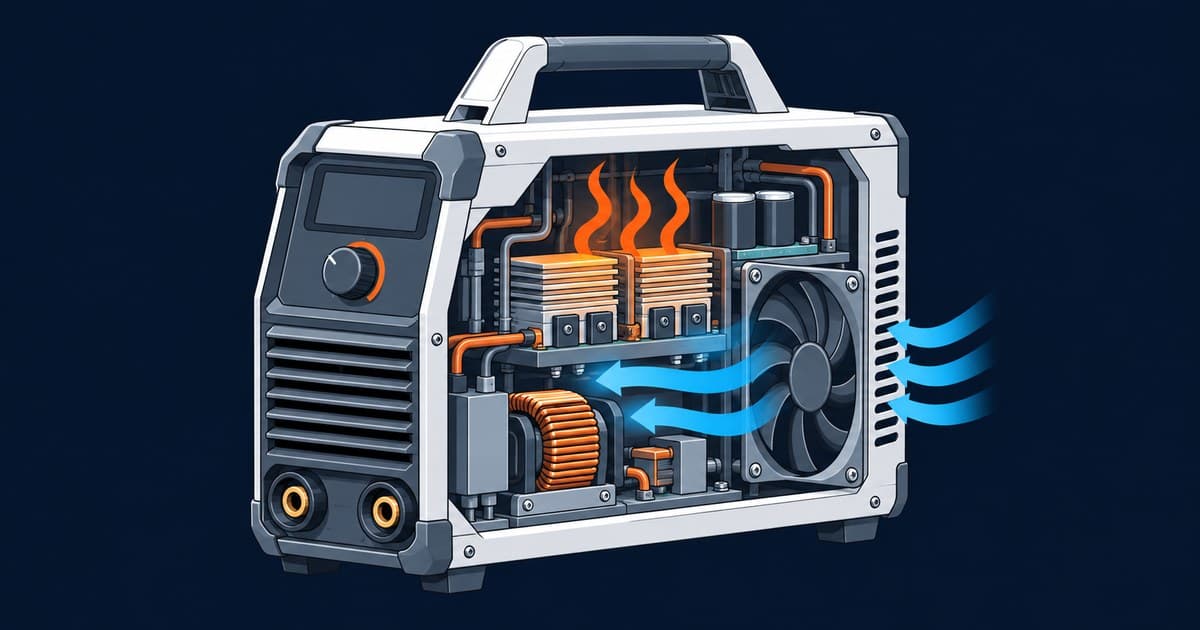
Welder duty cycle is the share of a 10-minute period during which a welder can run at its rated output before it needs to cool down. A 60 percent rating, for example, means six minutes of welding at that output followed by four minutes off. The phrase also has a second meaning: the share of a full working day that is spent actually arcing. This guide separates the two, explains how to read the current and percentage pairs on a rating, and covers how the duty cycle relates to the process, the torch, cables, and qualification.
Welder Duty Cycle: The 10-Minute Rating
Welding machines are rated on a 10-minute basis. The duty cycle is the percentage of that period during which the machine can operate at its rated output. The arithmetic is direct: a machine rated at 60 percent can carry its rated welding current for six minutes and must be off for the remaining four.
Two details matter. The time base is ten minutes, not one hour, so a rating says nothing about a full shift on its own. The rating also belongs to a specific current. The same power source can carry a different percentage at a different current, which is why a duty cycle figure should never be read alone.
The heating test behind these ratings has a fixed temperature. In the 2012 edition of the international standard for arc welding power sources, the heating test is carried out at an ambient temperature of 40 °C. Rating tables that state "10 min/40 °C" use this same basis. The 2021 edition of the same standard covers safety and performance requirements for welding power sources and plasma cutting systems, so the rating sits inside a wider set of requirements.
Duty Cycle Chart: Converting Percentage to Minutes
A duty cycle chart is simply the 10-minute rule written out. The table below converts common ratings into minutes of welding and cooling inside one 10-minute window.
| Duty cycle rating | Welding time in 10 minutes | Cooling time in 10 minutes |
|---|---|---|
| 20% | 2 min | 8 min |
| 30% | 3 min | 7 min |
| 40% | 4 min | 6 min |
| 60% | 6 min | 4 min |
| 100% | 10 min | 0 min |
A 30 percent rating means the unit can run at maximum output for three minutes of each 10-minute period before it needs to cool down.
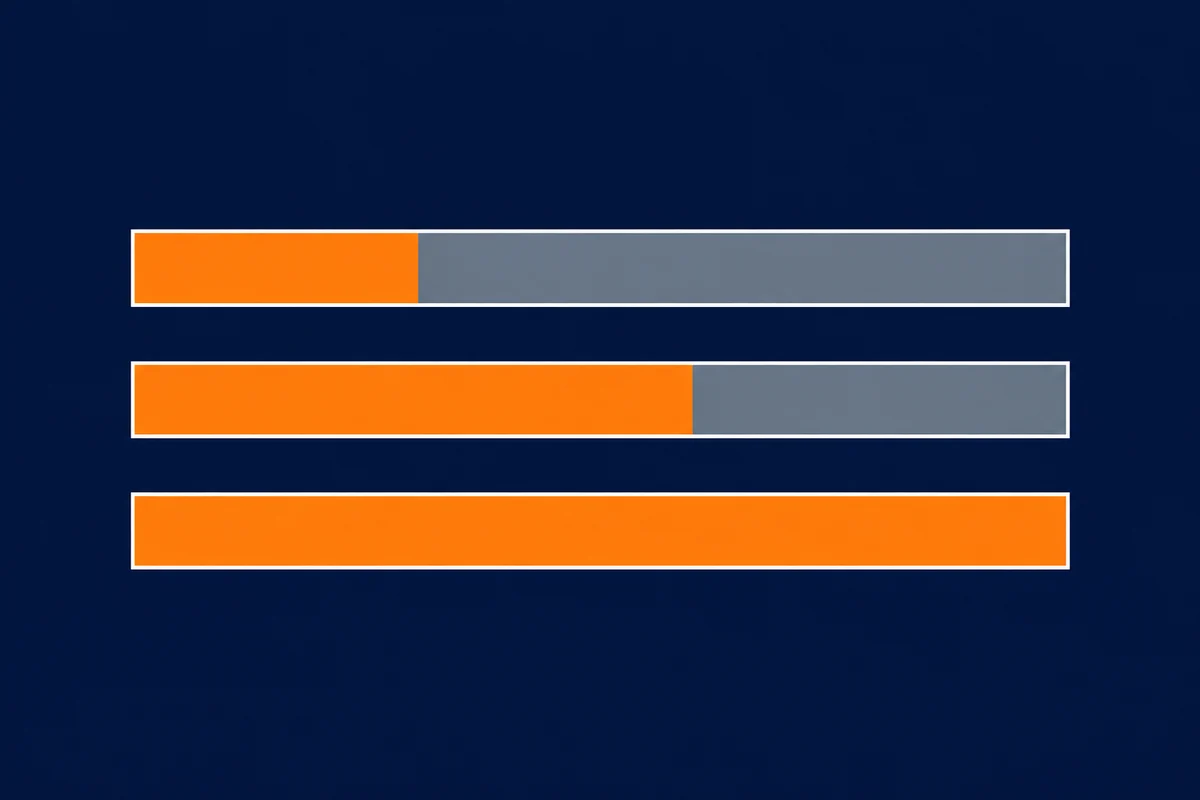
Figure 1: Three 10-minute bars for 30, 60, and 100 percent ratings; orange is time at rated output, grey is cooling time.
Two Meanings of Duty Cycle
The same term is used for a second, different measure. In that sense, duty cycle is the proportion of the working day that is spent arcing. A hypothetical welder who arcs for two hours in an eight-hour shift has an arc share of 25 percent, whatever the machine's rating says.
The two measures use different time scales and answer different questions. A machine rating states what the equipment is built to do within a 10-minute window. The working-day share states how much of a shift is spent with the arc on. Because the same label is used for both, check which meaning a source intends. Keep the two apart when you plan a job or compare machines.
Reading Amperage and Duty Cycle Pairs
A welding power source is rarely rated with one number. Its rating pairs a current with a duty cycle. One university tender specification for a welding power source lists 320 A at 40 percent and 220 A at 100 percent, both on the 10-minute, 40 °C basis. In that example, the 100 percent rating is lower in current than the 40 percent rating.
When you compare two machines, compare the pairs at the same duty cycle, or compare the current you actually plan to weld with. Read the pair as a whole.
Duty Cycle by Process: Stick, MIG, and TIG
The process changes the numbers. Typical figures vary with the equipment.
| Process | Typical figures | Why it differs |
|---|---|---|
| Stick (SMAW, MMA) | Most equipment is rated around 40 percent at maximum current. The average duty cycle rarely exceeds 50 percent, and 20 percent is typical. | Electrode changes and slag removal interrupt the arc. |
| MIG (GMAW) | Duty cycles can be considerably longer than for stick welding. | The wire is replaced only occasionally, and there is no slag to remove. |
| TIG (GTAW) | Most power sources used for TIG welding have a 60 percent duty cycle. | The figure is reported for most TIG power sources, not for every machine. |
For a particular machine, the rating printed on that machine is the reference, since a process does not fix one number for all models.
Torch Duty Cycle: The Second Limit
The power source rating does not cover the torch. Torches carry their own ratings. A typical air-cooled machine torch is rated at about 150 amps at 60 percent duty cycle. One air-cooled torch rated at 300 amps and 100 percent duty cycle was developed for a single project, so it should be treated as a special case rather than a standard.
Some torches are water-cooled, which allows continuous operation at high power. Check both ratings before you plan a job.
How to Log Your Own Arc Time
A rating tells you what the machine is built for. It does not show how you actually work. To measure your own pattern, log the arc time over a 10-minute window.
- Start a timer when you strike the arc in the window.
- Record each time the arc turns on and off.
- Add up the total arc-on seconds in the window.
- Divide the total by 600 and multiply by 100 to get a percentage.
- Repeat over several windows, including a full session with mixed tasks.
In a hypothetical window, you weld for 4 minutes and 30 seconds, which is 270 seconds of arc time. Divided by 600, that gives 45 percent. A log like this describes your work pattern. It is not a test, and it does not certify a machine rating.
Common Mistakes and Misconceptions
- Myth: Duty cycle and the working-day arc share are the same number. Reality: The term is the same, but the time scales differ.
- Myth: The machine's duty cycle applies to the torch. Reality: Torches have their own ratings.
- Mistake: Reading a percentage without the current. Reality: A rating is a pair. A percentage without its amperage is incomplete.
- Mistake: Comparing machines on different time bases. Reality: Compare ratings that state the same basis.
- Mistake: Treating a calculated value as a tested rating. Reality: Converting a rating into minutes is arithmetic on the stated basis. It does not replace a tested rating at another current.
Cables and Arc Screens: Basic Safety Rules
Two basic rules come from US federal workplace safety standards. Under 29 CFR 1910.254, cables with damaged insulation or exposed bare conductors must be replaced. Under 29 CFR 1926.351, which is the construction standard, arc welding operations must be shielded by noncombustible or flameproof screens where practicable, to protect nearby workers from the direct rays of the arc.
Duty Cycle and Welder Qualification
A duty cycle rating does not qualify a welder. A structural steel welding code defines how welders and welding procedures are qualified, and how welds are inspected and accepted. Those rules test skill and procedure. A percentage printed on a nameplate is not a certificate, and it does not replace a qualification test.
Choosing a Machine by Duty Cycle
Use the following order when you compare machines or plan a job, so that the rating, the torch, and your own arc time are checked together.
- Name the process and the current you expect to use most.
- Find the rating pair that matches that current, and confirm the time basis it states.
- Check the torch rating against the same current.
- Log arc time on a typical job and compare it with the on-time in the rating.
- Plan the cooling time of the rating into every long session, and check cables for damaged insulation before you start.
References
- NAVEDTRA 14250A - U.S. Navy
- Arc Welding Equipment - Part 1: Welding Power Sources (IEC 60974-1:2012) - International Electrotechnical Commission, 2012
- Arc Welding Equipment - Part 1: Welding Power Sources (IEC 60974-1:2021) - International Electrotechnical Commission, 2021
- Tender Notification for Multi Task Welding Power Source - National Institute of Technology Tiruchirappalli, 2013
- Welding Reference Guide - Kansas State University Research and Extension (4-H)
- Lecture 5 & 6: Manual Metal Arc Welding - NPTEL
- Chromium, Nickel and Welding - International Agency for Research on Cancer, 1990
- Yucca Mountain Waste Package Closure System - Idaho National Laboratory, 2006
- AWS D1.1/D1.1M:2025-AMD1, Structural Welding Code-Steel - American Welding Society, 2025
- 29 CFR 1910.254, Arc welding and cutting - Occupational Safety and Health Administration
- 29 CFR 1926.351, Arc welding and cutting - Occupational Safety and Health Administration