
Inverter vs Transformer Welders
Compare inverter and transformer welding machines on weight, energy efficiency, duty cycle, power factor, generator needs, and thin-material TIG performance.

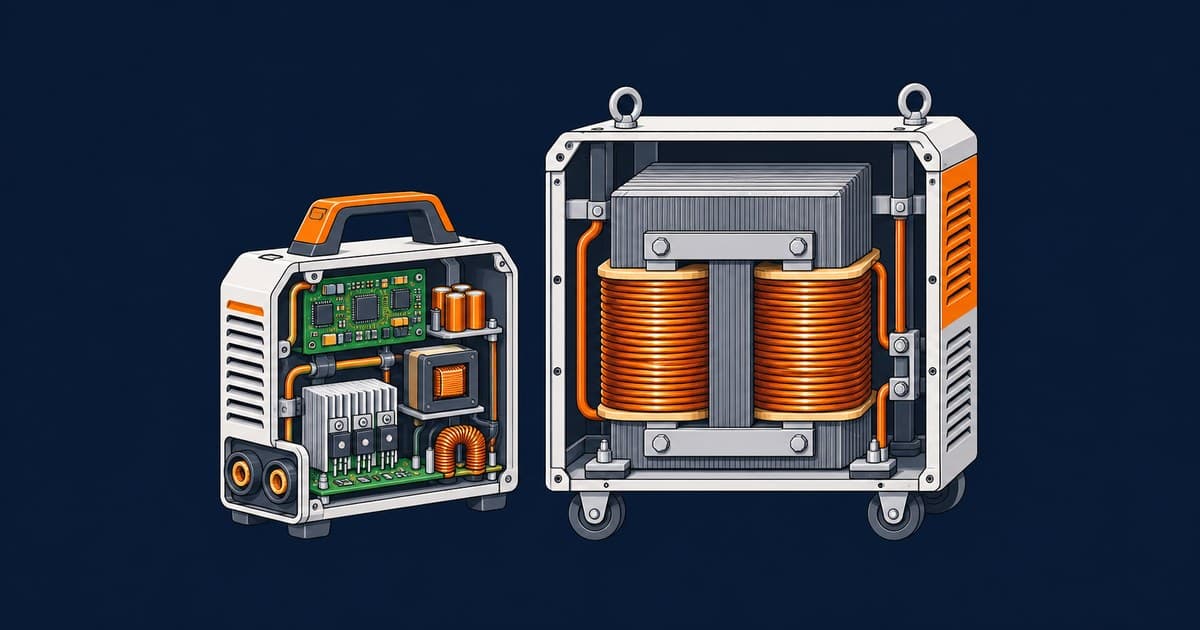
Inverter vs transformer welders is a comparison of two power conversion designs that can deliver the same kind of arc. The difference you notice first is weight and portability, but the design also shapes efficiency, how a duty cycle rating reads, how much current the machine draws, and what a generator must supply.
Inverter vs Transformer Welding Machines: How the Designs Differ
Traditional welding transformers used for typical AC and DC welding processes were very large and heavy. Many advances were made to reduce their size.
Inverter power sources operate at high frequency, so the transformer can be relatively small. That size and weight advantage matters most when the source has to be portable. Inverter power sources also offer all the advantages of thyristor control, with additional performance, weight savings, and efficiency.
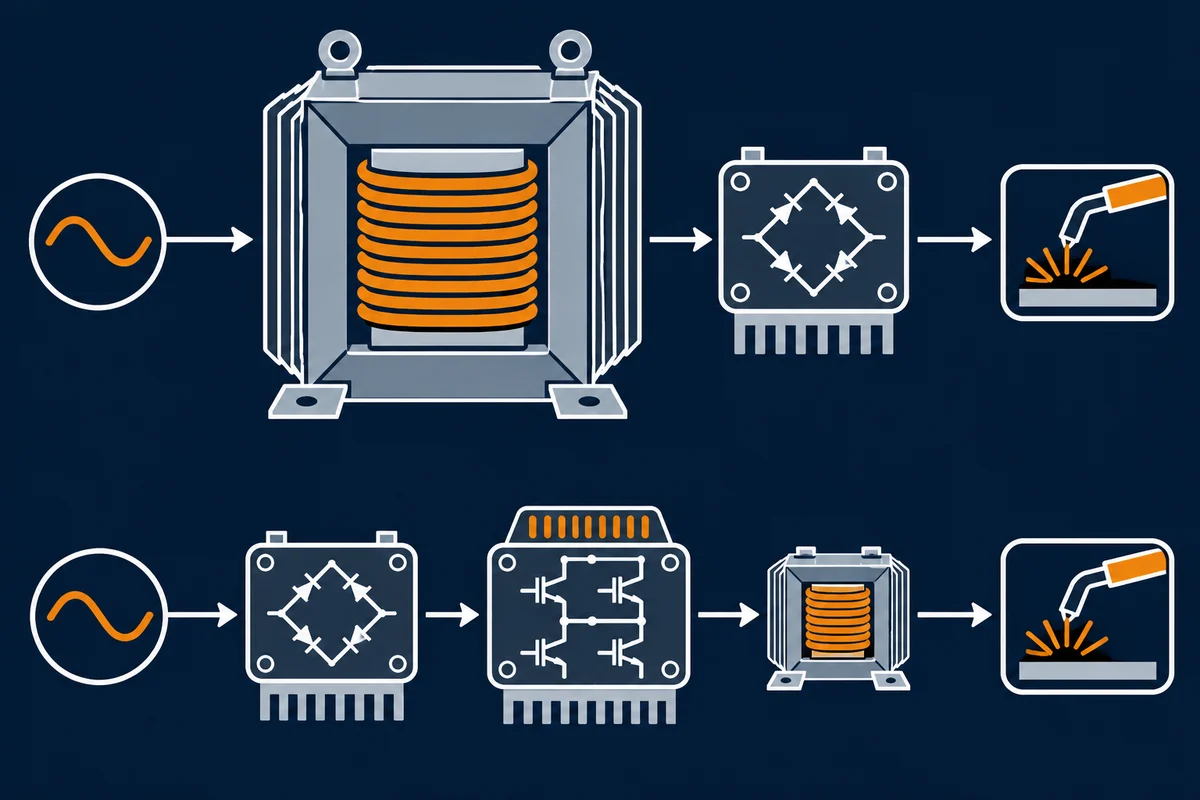 Figure 1: Transformer and inverter power paths side by side.
The weight gap was large on some older hardware. Some older TIG machines used transformers weighing over 150 pounds. Inverters instead switch the mains supply with semiconductors and use a much smaller high-frequency transformer.
Energy Efficiency
Typical efficiency is about 65 percent for conventional transformer welding equipment and about 90 percent for inverter equipment. Inverter welding machines are also described as having superior energy efficiency compared with conventional welding equipment.
Duty Cycle: What the Rating Means
Duty cycle is the share of a 10-minute period during which a welder can run at a stated output before it needs to cool. It is expressed as a percentage over that window.
 Figure 2: Run time and cooling time within a ten-minute period.
A duty cycle rating is tied to a stated output. The chart is read at the amperage you will use, so a percentage given at one current is not a direct comparison with a percentage given at another. Two machines can show the same percentage while referring to different outputs.
Power Draw and Power Factor
Rogue PRO models include power factor correction (PFC), so they draw less primary current. Power factor matters because the kilowatt draw of a welder is volts times amps divided by 1,000, adjusted for any power factor.
Generator Requirements
Running a welder from a generator depends on both the quality and the capacity of the generator's output. The Everlast 200DV welder manual requires that the generator's sine wave have total harmonic distortion (THD) of 5 percent or less and, when operating on 240 V single-phase, at least 9,000 W of surge.
Capacity is a separate requirement. For the WF-201T welder, the minimum recommended generator size for full output and duty cycle is 10 kVA.
TIG on Thin Material
A TIG welder with 60 Hz AC transformer output can make it more difficult to produce small welds on thin material, such as in aluminum welding, without over-welding and excess distortion. Advanced inverter power sources, by contrast, give more control over the arc.
Frequently asked questions
How do you calculate the kilowatt draw of a welder?
Multiply volts by amps and divide by 1,000. Any power factor should also be taken into account in the calculation.
How many minutes of welding does a 60 percent duty cycle allow?
Duty cycle is measured over a 10-minute period, so divide the percentage by 10. A 60 percent rating at its stated output allows 6 minutes of welding before the machine needs to cool down.
References
- What is a welding transformer? - CWB Group
- Equipment for Manual Metal Arc (MMA or SMA) Welding - TWI
- What are the basic power source designs for arc welding equipment? - TWI
- EuP Directive and Welding Equipment Energy Consumption - TWI
- All About Inverter Welding Machines - ESAB
- Duty Cycle: What It Is and Why It's Important - Miller Welds
- Welding Dictionary - Miller Welds
- Pro Tips for Understanding TIG Welding Waveforms and Controls - Miller Welds
- Guide to Industrial Aluminum Welding The Basics - Miller Welds
- ESAB Rogue ES 130i Pro stick/TIG inverter news release - ESAB
- 200DV welder manual - Everlast
- WF-201T welder brochure - Weldclass