
Self-Shielded vs Gas-Shielded Flux Core Wire
Compare self-shielded and gas-shielded flux core wire by shielding, field use, polarity, penetration, and fume control, with sourced guidance.

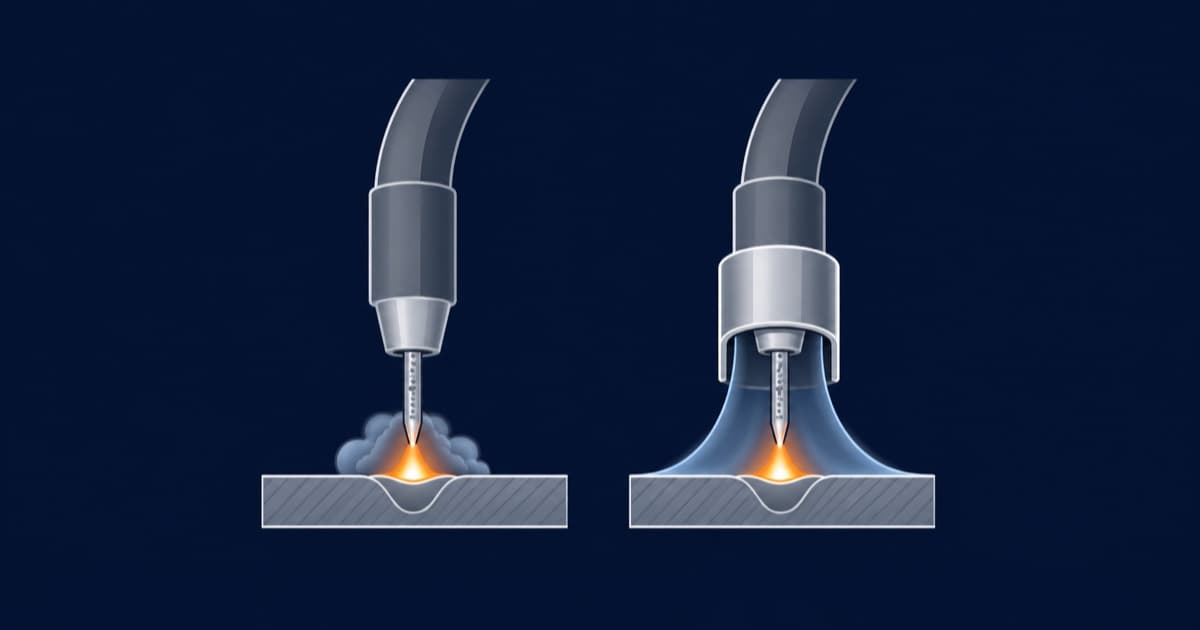
Self-shielded and gas-shielded flux core wire differ in how they protect the arc. The better choice depends on the job: wind, gas cylinder access, joint fit-up, polarity, and fume control can each change the answer.
Self-shielded vs gas-shielded flux core wire: shielding basics
With gas-shielded flux-cored welding (FCAW-G), protection comes from outside the wire. The process relies completely on an external shielding gas around the arc.
Self-shielded flux-cored welding (FCAW-S) works differently. The flux inside the wire introduces deoxidizing and denitriding agents, and the wire is designed to be used without shielding gas.
Gas-shielded wires use either 100 percent CO2 or an argon and CO2 mix. The exact gas depends on the wire. Published argon ranges run from 75 to 80 percent in one source and 75 to 85 percent in another, with the balance CO2.
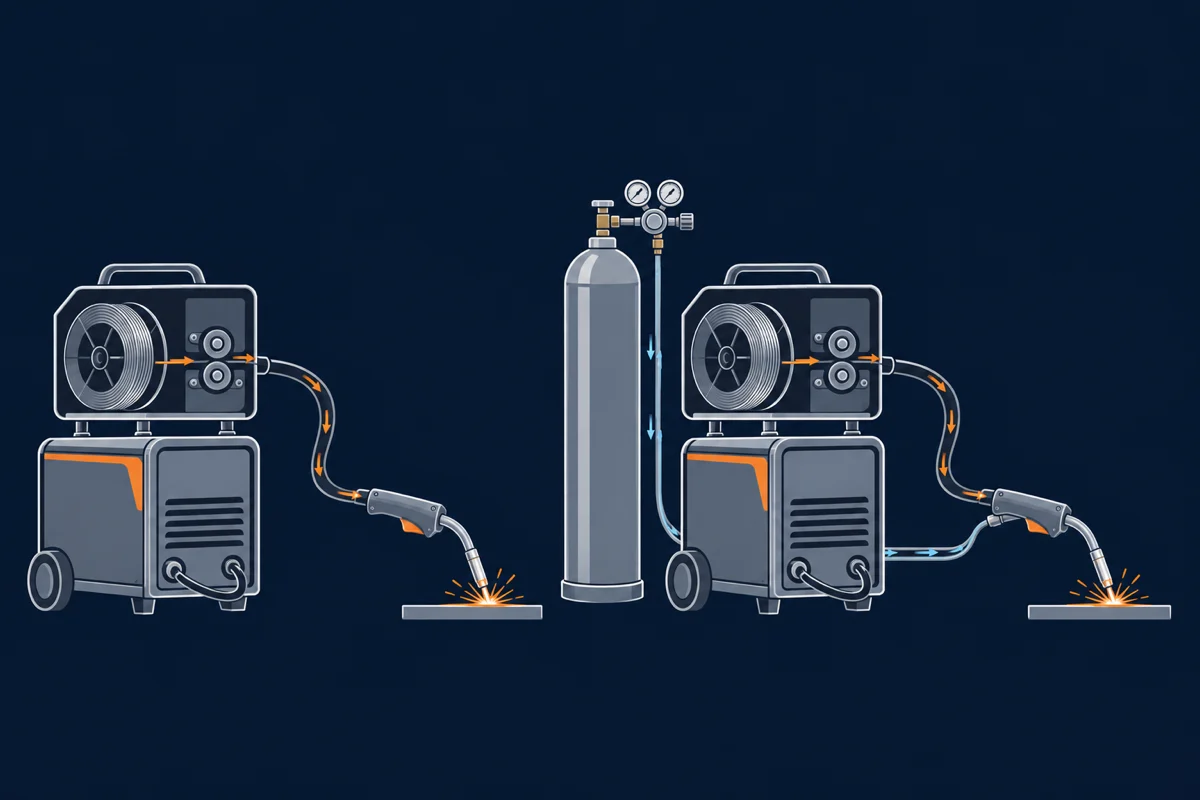
Figure 1: Self-shielded kurulum (solda) gaz tüpü olmadan çalışır; gazlı kurulum (sağda) tüp ve regülatör ekler.
Field work, wind, and repairs
Self-shielded wire is portable for field maintenance and repair. There is no gas tank, regulator, or hose to carry or set up.
Wind is a key factor for field work. Self-shielded FCAW is described as ideal for many types of field welding, especially under windy conditions.
Classification and polarity
Wire classification comes first. The A5.20 specification covers carbon steel flux-cored electrodes. The A5.29 specification covers low-alloy flux-cored electrodes used with or without shielding gas. A datasheet lists the classification of the exact product, such as E71T-11 for Fabshield 21B.
Gasless does not always mean the same polarity. The table below shows a gasless wire on direct current electrode negative (DCEN) and another on direct current electrode positive (DCEP), so the gas column does not predict polarity.
| Wire | Shielding gas | Polarity |
|---|---|---|
| Fabshield 21B (E71T-11) | None | DCEN |
| E70T-4 | None | DCEP |
| E70T-1C/M | CO2, or Ar/CO2 | DCEP |
Check the datasheet and set the machine to the polarity printed for the exact wire.
Penetration and joint fit-up
With self-shielded wire, a shallow-penetrating bead, made by preheating the electrode and lowering the welding current, can bridge gaps caused by poor fit-up on heavy, complex, or tubular pieces.
Gas-shielded wire can produce deeper penetration when electrode diameters greater than 3/32 inch are used with 100% CO2. That result does not apply to every gas-shielded wire.
Fume, gas, and ventilation
Both wire types produce welding fume. The flux and slag composition of flux-cored electrodes is the major source of fluorides in that fume.
The other fume components depend on the product. The safety data sheet (SDS) for one self-shielded wire lists complex oxides of iron, manganese, silicon, and copper as reasonably expected fume elements.
Carbon monoxide can form during welding and poses a serious asphyxiation hazard. Argon and CO2 shielding gases can displace oxygen, which may cause suffocation, especially in confined or enclosed spaces.
Both wire types may require additional ventilation in the shop. The welding ventilation rule in 29 CFR 1910.252 requires local exhaust or general ventilation to keep toxic fumes and gases below the maximum allowable concentration.
Warning: in a confined space, or where ventilation does not keep exposure below the threshold limit value (TLV), the same sheet recommends an approved fume respirator or equivalent.
Frequently asked questions
What positions does E70T-4 cover?
A distributor's parameter table lists E70T-4 for flat and horizontal positions, used for multi-pass welds. The same table lists the gas-shielded E70T-1C/M for flat and horizontal positions as well.
How can a welder check actual fume exposure?
The safety data sheet for one self-shielded wire recommends taking an air sample inside the welder's helmet or in the breathing zone. That sample shows the fumes and gases the welder is actually exposed to.
References
- AWS A5.20/A5.20M Carbon Steel Electrodes for Flux Cored Arc Welding - American Welding Society
- AWS A5.29/A5.29M Low-Alloy Steel Electrodes for Flux Cored Arc Welding - American Welding Society
- FCAW Cored Wires Overview - Lincoln Electric
- Self Shielded vs Gas Shielded Flux Cored Electrodes - Lincoln Electric
- Filler Metals for Equipment Repair: What to Know - Hobart Brothers
- Fabshield 21B Datasheet - Hobart Brothers
- Mild Steel Flux Parameters - Aufhauser
- Controlling Hazardous Fume and Gases during Welding (OSHA FS-3647) - OSHA
- Welding, Cutting, and Brazing (29 CFR 1910.252) - OSHA
- Health Effects of Welding - NIOSH
- Strongweld Material Safety Data Sheet: Self 71T-GS / 71T-11 - Strongweld