
Shielding Gas Comparison: 100% CO2 vs Argon Mix for MIG Welding
CO2 vs argon welding gas compared for MIG welding: penetration, spatter, transfer modes, cost and safety, plus how to choose for your steel and thickness.

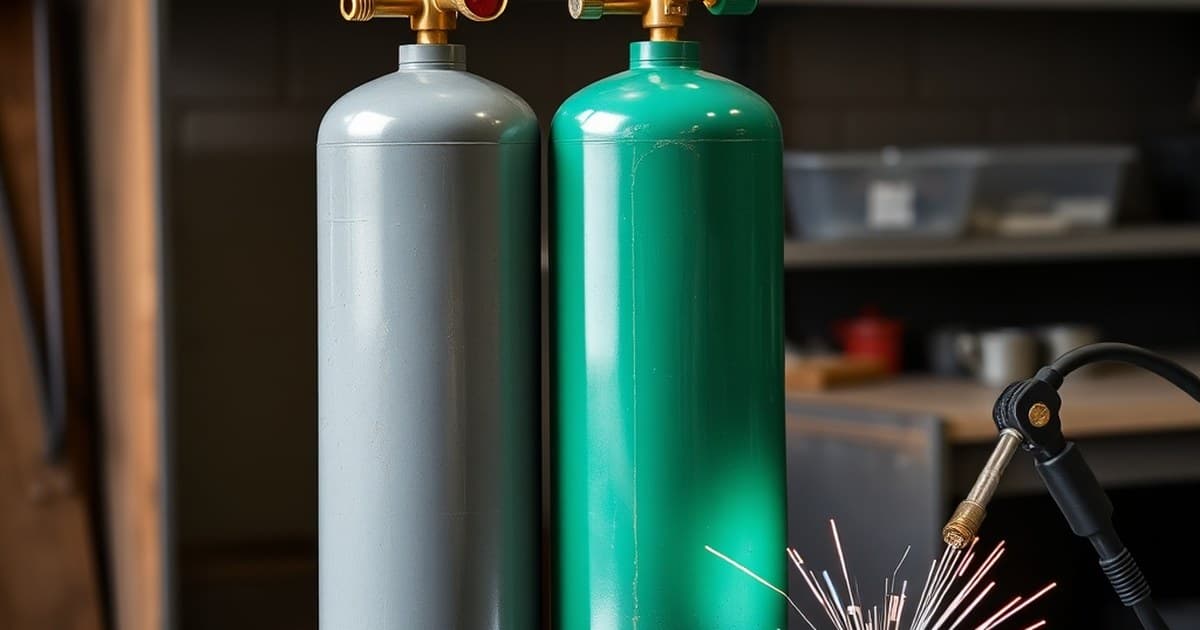
The co2 vs argon welding gas question comes up the moment someone buys a MIG machine and a gas cylinder has to be chosen. One camp swears by cheap, deep-penetrating straight CO2. The other pays more for an argon blend and gets a smoother arc. Both are right for some jobs and wrong for others.
This comparison explains what each gas actually does in the arc, how it changes penetration, spatter, bead shape and cost, and where each one belongs. The focus is carbon and low-alloy steel, because that is where the choice matters most. If you are new to the process itself, start with the overview of MIG/MAG welding, then come back here to settle the gas.
Quick answer: which gas should you use?
Short version, with the caveats in the sections below:
- 100% CO2 suits budget work on carbon steel where some spatter is acceptable and deep penetration is welcome, especially thicker sections and welds that will be cleaned up anyway.
- Argon/CO2 mixes (commonly around 75–90% argon with the balance CO2) suit most general fabrication, thin to medium material, visible welds and anywhere spatter cleanup costs time.
- Pure argon is not a good choice for steel in GMAW. It is the usual gas for aluminium and other non-ferrous metals.
The deeper reason is physical. Argon is a true inert gas. CO2 is a reactive, "semi-inert" gas that breaks down in the arc. That single difference drives almost everything else.
Why shielding gas matters at all
Molten steel reacts quickly with oxygen, nitrogen and moisture in the air. The result is porosity, brittle weld metal and a rough bead. The shielding gas pushes the air away from the arc and the weld pool while the metal is liquid.
But the gas does more than protect. It also influences:
- how easily the arc starts and how stable it stays
- how heat is delivered into the workpiece
- how the molten droplet leaves the wire (the metal transfer mode)
- bead profile, wetting and penetration
- the amount of spatter and fume
Choosing the wrong gas can give a porous, weak weld or heavy spatter, and spatter in particular costs productivity because someone has to grind or chip it off. That is why the gas decision belongs in the procedure, not just in the shopping list.
How CO2 behaves in the arc
CO2 is the least expensive common shielding gas for steel. In the arc's heat it dissociates into carbon monoxide and oxygen, then partly recombines nearer the cooler weld pool. This releases heat into the work and gives a hotter, narrower, more penetrating arc than argon-rich mixes.
Because CO2 is reactive, the wire has to compensate. Solid MIG wires made for CO2 carry extra deoxidisers, usually silicon and manganese, which end up as small glassy islands on the bead surface. That is normal, not a defect.
What you gain with 100% CO2
- Deep, wide penetration, useful on thicker plate and tight-fit joint preparations.
- Low gas cost, which adds up in high-volume production.
- Good tolerance of light mill scale and surface contamination compared with argon-rich gases, although clean metal is still better practice.
- Strong performance at high travel speed in short-circuit mode on suitable thicknesses.
What you give up
- A less stable arc and more spatter. The arc is harsher and droplets leave the wire less cleanly.
- A more convex, less well-wetted bead that can need more grinding where appearance matters.
- Limited transfer options. Pure CO2 works in short-circuit and globular modes, but it cannot produce true spray transfer.
- More fume and smoke in many setups, which raises the demands on ventilation and extraction.
Note: Spatter is mostly a productivity and appearance problem. The weld metal itself can be sound, but removing spatter adds labour that rarely shows up in a gas price comparison.
How argon mixes behave
Argon is chemically inert and has low thermal conductivity. In a steel MIG arc it gives a stable, narrow, bright plasma core and lets the droplet detach smoothly. On its own, though, argon is a poor match for steel. It tends to give a high, peaked bead with undercut and narrow penetration, which is why it is mixed with a reactive gas for ferrous metals.
Adding CO2 (or a little oxygen) to argon changes three things at once:
- It stabilises the arc root on steel so the bead wets out rather than balling up.
- It increases penetration and heat compared with argon alone.
- It keeps the arc far smoother than straight CO2, so spatter drops.
That balance explains why argon/CO2 blends are so widely used for general steel fabrication.
Common argon/CO2 mixtures
Mixture names vary by supplier and region, but the compositions below are the ones most people actually meet:
| Mix (approx.) | Typical use | Character |
|---|---|---|
| 75% Ar / 25% CO2 | Thin to medium carbon steel, short-circuit welding, all positions | Hotter than lean mixes, good control, moderate spatter |
| 80–90% Ar / 10–20% CO2 | General fabrication, mixed thicknesses | Flexible compromise between penetration and cleanliness |
| 90–98% Ar / 2–10% CO2 | Spray and pulsed transfer on thicker steel | Very low spatter, flatter and wetter bead, narrower penetration profile |
| 98% Ar / 2% O2 | Spray transfer on steel and some stainless | Good fluidity, oxidised bead surface |
The number of "right" mixes is smaller than marketing suggests. For most workshops a single blend near the 75–90% argon range covers the majority of carbon steel work. For a sense of how these gases are designated in standards, see the classification in ISO 14175, which groups gases and mixtures by their chemical behaviour rather than by brand.
Metal transfer: the real reason the gas matters
The most important practical difference between the two gases is which metal transfer modes they allow. GMAW has four primary modes: short-circuiting, globular, spray and pulsed spray.
Short-circuit transfer
The wire dips into the pool and the arc re-ignites repeatedly. It is used on thin and medium material, out-of-position welds and wide root gaps, at lower currents and with smaller wire. Both 100% CO2 and argon/CO2 mixes can run here.
With CO2 the short-circuit arc is more violent and spatterier. With a 75/25-type mix it is generally smoother and easier to control. Higher CO2 content also tends to add heat in this mode when voltage, current and wire are held the same, so a richer CO2 mix can help avoid lack-of-fusion on heavier sections.
Globular transfer
At higher currents with CO2-rich gas, the droplet grows larger than the wire diameter and falls irregularly. This is the characteristic CO2 mode at high settings. It gives good penetration and is usually limited to flat and horizontal work because the large droplets are hard to control. Expect noticeable spatter.
Spray transfer
Spray transfer produces a fine stream of tiny droplets and very little spatter. It needs a high argon content. A commonly quoted working rule is that argon-rich mixes with roughly 80% argon or more are needed to achieve it, and spray becomes increasingly problematic as CO2 rises over about 20%, especially on smaller wire.
Spray is typically used on thicker material in flat and horizontal positions, because the weld pool is large and fluid. 100% CO2 cannot do it at all.
Pulsed spray
Pulsed transfer switches between a high peak current and a lower background current, many times per second. It delivers spray-like droplet detachment at lower average heat input, which opens the door to all-position welding on suitable equipment. Argon-rich mixes are the normal choice. This is a power source feature, not a gas feature, but the gas has to support it.
If you are matching gas to wire and settings, work through the numbers in a guide to MIG welding settings rather than guessing, because the voltage window for a stable arc shifts with the gas you choose. The same wire speed on CO2 and on 75/25 will not need identical voltage.
Penetration, bead shape and weld quality
Penetration profile
CO2 produces a deeper and wider penetration profile, which helps on thicker plate and in joints where fusion into the root is critical. Argon-rich mixes produce a shallower penetration but with a more even, fluid bead. Very argon-rich blends in spray mode can show a distinctive "finger" penetration at the centre of the bead, which suits some joint designs and not others.
Do not read this as "CO2 is always stronger." Penetration is only one input. Bead shape, wetting at the toes and freedom from defects matter just as much, and a hot, spatter-heavy arc is not automatically a better weld.
Bead appearance and cleanup
Argon blends give flatter, smoother beads with better toe wetting, which usually means less grinding and a cleaner visible weld. CO2 beads are typically more convex with more spatter and surface slag islands. If the part will be painted, ground flush or hidden, that matters less. If it will be seen or finished by hand, the labour saved by an argon blend can easily outweigh the higher gas price.
Defect risks
Each gas has its own failure tendencies:
- Rich argon mixtures on heavy sections run cooler in short-circuit mode and can increase the risk of lack of fusion if the technique and settings are off.
- 100% CO2 can give more spatter, a rougher bead and more variation if settings drift.
- Poor gas coverage with either gas, from drafts, a blocked nozzle, leaks or low flow, causes porosity regardless of the gas chosen.
Gas selection is a tool for steering the process toward the result you need. It does not replace correct technique, joint preparation and a qualified procedure.
Cost: price per cylinder is not the real cost
CO2 is cheaper per cubic metre than argon blends, and that gap is real. But the total cost of a weld includes:
- Cleanup labour: grinding and chipping spatter
- Rework: defects from unstable arcs or poor wetting
- Consumables: nozzles and contact tips clogging faster with heavy spatter
- Deposition efficiency: how much of the wire ends up in the joint instead of on the plate
- Travel speed and productivity: which depend on arc behaviour and operator comfort
For a hobbyist doing occasional thick-plate repairs, CO2 can be the sensible, economical answer. For a shop welding visible thin-gauge parts all day, an argon blend often pays for itself through reduced finishing. Run the numbers for your own job rather than assuming either direction.
Safety and health considerations
Shielding gas choice interacts with safety in a few ways, and all of it should be treated conservatively.
- Gas displacement. Any shielding gas, argon and CO2 included, can displace oxygen in enclosed or poorly ventilated spaces, with a risk of hypoxia. CO2 has additional toxic effects at elevated concentrations. Use adequate ventilation, secure cylinders, and follow your site's confined-space rules.
- Fume. Welding fume composition depends on the wire, the base metal and the process. Gas selection can change fume generation, with some argon-rich mixes generating less visible fume than CO2 in some conditions. Do not rely on gas choice alone to control exposure; use local exhaust ventilation and appropriate respiratory protection where assessments call for it.
- UV and arc radiation. Argon-rich arcs can feel brighter and harsher on exposed skin and eyes. Correct helmet shade, covered skin and flame-resistant clothing remain mandatory either way.
- Cylinder handling. Cylinders are pressurised. Keep them upright, restrained, away from heat and fitted with the correct regulator for the gas.
This is general guidance, not a substitute for your workplace risk assessment, safety data sheets or local regulations.
Which gas for which job
Choose 100% CO2 when
- You are welding mild or low-carbon steel and cost is the priority.
- You need deeper penetration on thicker sections and spatter cleanup is acceptable.
- The weld will be painted over, ground or hidden.
- You are using wire designed for CO2, including many flux-cored wires.
Choose an argon/CO2 mix when
- Appearance and low spatter matter.
- You weld thin or medium material and want better control, particularly out of position.
- You want access to spray or pulsed transfer on thicker steel.
- You want to reduce post-weld grinding and nozzle cleaning.
Choose neither for
- Aluminium and magnesium: use argon or argon-helium mixtures.
- Stainless steel: use mixes designed for stainless, since high CO2 can affect corrosion resistance by adding carbon to the weld. Check the filler manufacturer's recommendations.
- Specified procedures: if a welding procedure specification calls out a gas, that gas is part of the qualification, so do not swap it casually.
Flux-cored wire is a special case
Many gas-shielded flux-cored wires are designed for either 100% CO2 or a 75% argon / 25% CO2 mix. CO2 gives deeper penetration with globular-type transfer, while the argon blend gives a smoother, more stable arc. The wire datasheet tells you which gases it was qualified with, and that listing matters more than general preferences. Using a gas outside the wire's rating can change mechanical properties and operability.
Common mistakes when choosing between CO2 and argon mix
- Using straight argon on steel. It gives poor wetting and a narrow, peaked bead.
- Expecting spray transfer from CO2. It cannot happen in the pure gas.
- Running CO2 settings on an argon blend. Voltage and wire speed need re-tuning for the new gas.
- Ignoring flow rate and coverage. Both too low and too high a flow cause problems. Draughts can undo any gas choice.
- Switching gas without checking the procedure. Qualified procedures and wire datasheets name the gas.
- Assuming a richer CO2 mix is always better on thick plate. It adds heat, but also spatter and sometimes more fume.
- Buying on price alone. The cheaper cylinder can be the more expensive weld.
Hypothetical example: two shops, two gases
Imagine two small fabrication shops, purely as an illustration.
Shop A welds 10 mm structural brackets that will be hot-dip coated afterwards. Appearance is irrelevant and penetration is important. It runs 100% CO2, accepts the spatter, and uses anti-spatter spray and a quick chip to clean up. The lower gas cost suits the budget.
Shop B welds 2 mm sheet-steel enclosures that go to the customer unpainted and visible. It runs a 75/25 blend in short-circuit mode, keeps spatter low and does almost no grinding. The higher gas price is smaller than the labour saved.
Neither shop is wrong. They solved different problems, which is the real lesson of the comparison.
Conclusion
Neither gas wins outright. 100% CO2 buys penetration and low gas cost at the price of a harsher arc, more spatter and limited transfer modes. Argon mixes buy a stable, clean arc, better bead appearance and access to spray and pulsed transfer, at a higher cylinder price.
Match the gas to thickness, position, appearance requirements and the wire in the machine, then check the total cost including cleanup. When a written procedure specifies the gas, follow it. When you are unsure, a mid-range argon/CO2 blend is the lower-risk starting point for general carbon steel work, and a test coupon will tell you more than any chart.
Frequently asked questions
Is CO2 or argon better for MIG welding?
Neither is better in every case. CO2 gives deeper penetration at lower gas cost, while an argon/CO2 mix gives a smoother arc, less spatter and a cleaner bead. For general carbon steel work, an argon/CO2 blend is the more forgiving choice.
Can I MIG weld steel with pure argon?
It is not recommended. Pure argon gives poor bead wetting, a peaked profile and narrow penetration on steel. It is used for aluminium and other non-ferrous metals, while steel normally needs CO2 or an argon blend.
Can I use 100% CO2 with solid MIG wire?
Yes, if the wire is designed for it. Common solid carbon steel wires are suited to CO2, argon/CO2 mixes or both, but you should check the wire datasheet for its approved gases.
Why does CO2 cause more spatter than argon mixes?
CO2 dissociates in the arc and produces a less stable arc with larger, less controlled droplets. Argon stabilises the arc and helps droplets detach smoothly, which reduces spatter.
What is the best argon/CO2 ratio for MIG welding?
There is no single best ratio. A 75% argon / 25% CO2 blend is widely used for thin to medium steel in short-circuit mode, while leaner CO2 content such as 2–10% supports spray transfer on thicker steel.
Can CO2 produce spray transfer?
No. Spray transfer needs a high argon content, so 100% CO2 operates in short-circuit or globular modes only.
Is CO2 gas cheaper than argon mix?
Per cylinder, yes, CO2 is usually cheaper. The total cost also depends on cleanup time, rework, consumable wear and productivity, so the cheaper gas is not always the cheaper weld.
Is CO2 or argon mix better for thin sheet metal?
An argon/CO2 mix is generally easier on thin material because the arc is smoother and heat input is easier to control. Straight CO2 can work but tends to be harsher and spatter more.
Does the shielding gas affect weld strength?
Gas influences penetration, bead profile and defect risk, which all affect weld quality. Strength itself depends on the filler, procedure, joint design and technique, so do not assume one gas makes a weld inherently stronger.
Can I switch gases without changing my settings?
You should re-check them. Voltage, wire speed and sometimes stick-out need adjusting when you change gas, and qualified procedures may not allow a substitution at all.
Is CO2 dangerous to use as shielding gas?
Like any shielding gas it can displace oxygen in confined spaces, and CO2 is harmful at elevated concentrations. Use ventilation, secure the cylinders, and follow your workplace risk assessment.
References
- What are some shielding gases that are used for welding? - CWB Group, accessed 2026-10-26. Explains GMAW gases, CO2 behaviour and common argon/CO2 mixtures.
- Gas metal arc welding - Wikipedia, accessed 2026-10-26. Overview of transfer modes and shielding gas effects.
- Shielding gas - Wikipedia, accessed 2026-10-26. Properties of argon, CO2 and helium as welding shielding gases.
- ISO 14175:2008 Welding consumables - Gases and gas mixtures for fusion welding and allied processes - ISO, 2008. Classification of shielding gases by chemical behaviour.
- Shielding Gas Selection for Controlled Dip Transfer Welding - TWI, accessed 2026-10-26. Comparison of shielding gases for dip transfer welding of thin sheet steel.