
What Is Flux-Cored Welding?
Learn what flux-cored welding (FCAW) is, how FCAW-S and FCAW-G differ, which wire and settings to use, and the mistakes that trip up beginners.

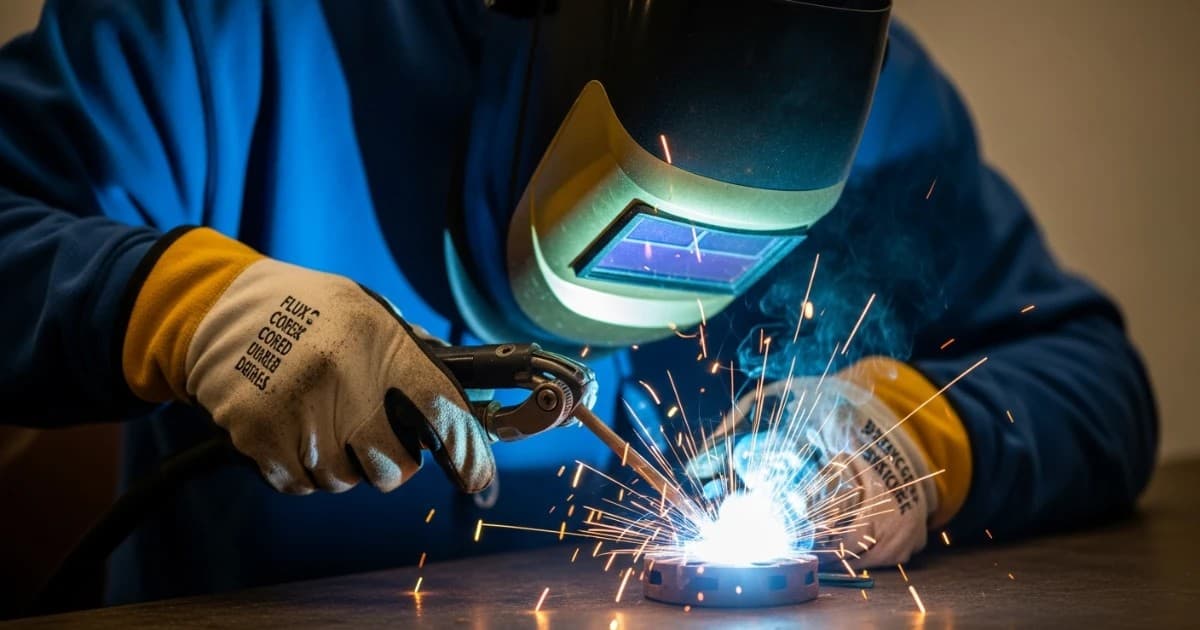
Walk onto almost any structural steel job site, into a shipyard, or up to a piece of heavy equipment being repaired outdoors, and there's a good chance the welder is running flux-cored wire. Flux-cored welding, formally called flux-cored arc welding (FCAW), is a wire-fed arc welding process that uses a hollow, tubular electrode packed with flux instead of a solid wire. That flux core is what makes the process genuinely different from MIG welding, even though the two look nearly identical from across the shop: it lets flux-cored welding shield the weld pool, burn through mill scale and light rust, and run outdoors in wind that would ruin a gas-shielded process entirely.
This guide walks through what flux-cored welding actually is, how the two main variants differ, the equipment and wire you need to get started, realistic machine settings, the mistakes almost every beginner makes, and the safety practices that matter more than most new welders expect. By the end, you'll know enough to choose the right wire, dial in a machine, and understand why a structural welder reaches for flux core when a MIG welder would reach for a jacket to block the wind.
What Flux-Cored Welding Actually Is
At its core, FCAW is a semi-automatic (or fully automatic) arc welding process where a continuously fed tubular wire electrode is melted by an electric arc to fuse two pieces of metal together. Instead of a solid wire like the kind used in MIG welding, the electrode is a thin metal sheath rolled around a core of flux, mineral compounds, and alloying elements. As the arc heats the wire, that core decomposes, releasing shielding gases, forming a protective slag layer over the molten weld pool, and in some formulations, adding alloying elements that improve the mechanical properties of the finished weld.[1]
The process was developed in the 1950s as manufacturers looked for a way to combine the deposition speed of a continuously fed wire with the environmental tolerance that flux-based shielding gives shielded metal arc welding (stick welding). Early flux-cored wires from the mid-1950s still needed an external shielding gas, but by the end of the decade, self-shielding formulations had been patented, giving welders a wire that needed no gas cylinder at all. That split, gas-shielded versus self-shielded, is still the fundamental way flux-cored wire is categorized today.
How the Arc, Flux, and Slag Work Together
Once the arc strikes, three things happen almost simultaneously inside that tubular wire. The metal sheath and the base metal melt and fuse, building the weld bead exactly as they would in MIG welding. At the same time, the flux core decomposes under the arc's heat, releasing gases, carbon dioxide, carbon monoxide, and others depending on the flux chemistry, that displace atmospheric oxygen and nitrogen away from the molten pool. And a portion of the flux forms a liquid slag that floats to the surface of the weld and solidifies as it cools, insulating the bead and pulling some impurities out of the metal as it does.
That slag layer is the detail that surprises people coming from MIG welding. Every pass of flux-cored welding leaves a glassy slag crust that has to be chipped and wire-brushed off before the next pass, or before the weld is considered finished. It's extra cleanup MIG doesn't require, but it's also part of why flux core tolerates dirtier, rustier, and less-prepared steel than a purely gas-shielded process can.
The Two Types of Flux-Cored Welding: FCAW-S vs FCAW-G
Almost everything about how a flux-cored weld behaves, its portability, its cost, its cleanliness, comes down to which of the two shielding variants is being used.
Self-shielded flux-cored welding (FCAW-S) relies entirely on the flux core to generate its own shielding atmosphere. No external gas cylinder is required, which makes the equipment lighter, more portable, and immune to wind blowing the shielding away. That's why FCAW-S is the default choice for outdoor structural erection, pipeline tie-ins, and field repair work where a gas-shielded process would be unreliable.
Gas-shielded flux-cored welding (FCAW-G) pairs the flux core with an external shielding gas, typically 100% carbon dioxide or a 75–85% argon/balance-CO2 blend. The flux still contributes deoxidizers, arc stabilizers, and slag formation, but the external gas takes over much of the shielding job. The result is generally a cleaner-looking weld with less spatter and a smoother arc than self-shielded wire produces, which is why FCAW-G dominates in shop and fabrication settings where wind isn't a factor.[2]
The tradeoffs go beyond appearance. Self-shielded wires typically run at a lower deposition efficiency, meaning more of the wire is lost to spatter, smoke, and slag rather than ending up in the finished weld, while gas-shielded wires generally deposit metal more efficiently. Self-shielded wire also tends to cost more per pound because it carries additional core material to do the shielding job the gas would otherwise handle, though that extra cost is often offset by not needing a gas cylinder, regulator, or hose at all.
| Factor | FCAW-S (self-shielded) | FCAW-G (gas-shielded) |
|---|---|---|
| Shielding gas | None; generated by the flux | External CO2 or Ar/CO2 blend |
| Best environment | Outdoors, windy job sites | Indoor shops, controlled environments |
| Portability | High — no gas cylinder needed | Lower — gas cylinder required |
| Weld appearance | More spatter, rougher bead | Cleaner, smoother bead |
| Typical deposition efficiency | Lower | Higher |
| Common use cases | Field erection, pipeline, repair | Shipbuilding, shop fabrication |
Why Flux-Cored Welding Matters
Flux-cored welding earns its place in structural, marine, and heavy-fabrication work because it solves a problem MIG welding can't: it keeps working when the environment doesn't cooperate. A breeze that would blow away MIG's shielding gas and cause porosity barely affects a self-shielded flux-cored weld, because the shielding is coming from inside the wire itself, right at the arc.
The other reason flux core shows up wherever speed and thickness matter is deposition rate. Because it's wire-fed and continuous, FCAW lays down weld metal significantly faster than stick welding, cutting the downtime spent swapping rods and chipping slag between short electrode stubs. On thick structural steel, that speed advantage compounds fast: a joint that would take a stick welder several passes and rod changes can often be completed in a fraction of the time with flux-cored wire.
Where Flux-Cored Welding Falls Short
None of that makes flux core the right choice everywhere. It produces noticeably more smoke and spatter than solid-wire MIG welding, which means more post-weld cleanup and a stronger case for fume extraction, especially indoors. The slag layer that protects the weld also has to be removed after every pass, adding labor that MIG doesn't require. On thin sheet metal, the heat and penetration of most flux-cored wires make burn-through a real risk, so thin-gauge auto body or light fabrication work is generally better served by MIG. And self-shielded wire in particular tends to produce a rougher, more spatter-heavy bead than either MIG or gas-shielded flux core, which matters when appearance is part of the spec.
The Equipment You Actually Need
A flux-cored setup is close to a MIG welder's, with a few important differences:
- A wire-feed welding machine. Many machines that run solid MIG wire can also run flux-cored wire, provided the polarity can be switched and the drive rolls suit a tubular electrode.
- A welding gun with a liner and contact tip sized for the wire diameter being used. Flux-cored wire is softer and more prone to feeding issues than solid wire, so keeping the liner clean and the contact tip in good condition matters more here than in MIG welding.
- A ground clamp making solid metal-to-metal contact with the workpiece, not just paint or rust.
- Flux-cored wire matched to the base metal, thickness, and position.
- An external shielding gas cylinder and regulator, only if running gas-shielded (FCAW-G) wire.
- A chipping hammer and wire brush for slag removal after each pass.
- Personal protective equipment: a welding helmet with an auto-darkening lens, welding gloves, flame-resistant clothing, and, given the fume volume FCAW produces, a real plan for ventilation or respiratory protection.
Entry-level 110V/120V machines capable of running self-shielded flux-cored wire are widely available and comfortably handle sheet and light structural steel up to roughly 1/8–3/16 inch, while 230V machines extend that range into thicker structural material.
Understanding Flux-Cored Wire: The AWS Classification System
Flux-cored wire is classified under the American Welding Society's A5.20 specification for carbon steel electrodes, and the code stamped on a spool tells you almost everything about how that wire is meant to be used.[3] Take E71T-1C-H8 as an example:
- E — electrode.
- 7 — 70,000 psi minimum tensile strength.
- 1 — all-position capability (a "0" would mean flat and horizontal only).
- T — tubular, confirming it's a flux-cored electrode rather than solid wire.
- 1 — the T-1 designator, indicating a rutile-type flux designed for DCEP (electrode positive) polarity with high deposition and good operator appeal.
- C — requires 100% CO2 shielding gas (a "M" designator would indicate an argon/CO2 blend).
- H8 — a diffusible hydrogen designator, capping hydrogen content in the deposited weld to limit the risk of hydrogen-induced cracking.
Two wires come up constantly for beginners. E71T-11 is a general-purpose, all-position, self-shielded wire that runs on DCEN (electrode negative) polarity and needs no external gas, making it the default choice for a first spool. E71T-1 and related T-1 wires are gas-shielded, run on DCEP polarity, and produce the smoother, cleaner bead associated with shop fabrication work. Getting the polarity wrong for a given wire is one of the most common early mistakes: self-shielded wires generally call for DCEN, while most gas-shielded wires call for DCEP, and running the wrong polarity produces poor penetration, excessive spatter, and an unstable arc no matter how well everything else is set up.
Machine Settings and Basic Technique
There's no single "correct" voltage and wire speed for flux-cored welding; the right numbers depend on wire diameter, material thickness, and the specific wire's data sheet, which should always be the final word. As a general starting point for common self-shielded 0.030–0.045 inch wire on light-to-medium mild steel, voltage in the high teens and wire feed speeds in the low-to-mid hundreds of inches per minute are typical starting points, adjusted up or down based on how the bead sounds and looks.
A few technique habits matter more in flux-cored welding than in MIG:
- Contact-tip-to-work distance (stickout) typically runs longer than in MIG welding, often around 3/4 to 1 1/4 inch, to give the flux core time to fully react in the arc.
- Gun angle is usually held at a slight drag angle, 5 to 15 degrees from vertical, with the arc kept on the leading edge of the weld pool rather than pushed ahead of it.
- Travel speed needs to stay consistent; too fast starves the weld of fill and shielding, while too slow builds excess heat and can cause burn-through on thinner material.
- Slag removal between passes isn't optional. Welding over unremoved slag traps it inside the joint as a slag inclusion, one of the more common defects in multi-pass flux-cored welds.
Flux-Cored vs. MIG vs. Stick vs. TIG
Every arc welding process makes a different tradeoff between speed, cleanliness, portability, and skill required. Here's how flux-cored welding stacks up against the other three most common processes:
| Process | Shielding | Best for | Learning curve | Outdoor/windy use |
|---|---|---|---|---|
| Flux-cored (FCAW) | Self-generated flux, sometimes plus gas | Thick steel, structural, outdoor/field work | Moderate | Excellent (FCAW-S) |
| MIG (GMAW) | External shielding gas | Thin-to-medium steel, clean shop welds | Easiest | Poor |
| Stick (SMAW) | Flux coating on the rod | Dirty/rusty steel, field repair, low equipment cost | Moderate-to-hard | Excellent |
| TIG (GTAW) | External shielding gas | Precision, thin material, aluminum/stainless | Hardest | Poor |
For a beginner deciding where to start, the honest answer is that MIG is usually the gentler on-ramp because it produces the least spatter and requires no slag removal, but flux core isn't a large step up in difficulty, it uses the same gun-handling fundamentals, just with a longer stickout and a chipping hammer added to the routine. Where flux core pulls ahead of MIG is any job that's outdoors, on less-than-clean steel, or on material thick enough that deposition rate starts to matter.
Common Mistakes and How to Fix Them
Porosity shows up as small pinholes in the finished weld, usually from contamination (rust, oil, mill scale, or moisture) boiling into the weld pool, or from stickout that's too long or too short for the shielding gas to protect the arc properly. Clean the joint before welding and keep stickout within the wire manufacturer's recommended range.
Burnback, where the wire fuses into the contact tip instead of arcing cleanly, typically happens when wire feed speed is too slow relative to the gun's distance from the work. Increasing wire speed slightly and maintaining proper stickout usually resolves it.
Excessive spatter is often a voltage or wire-speed mismatch: too much heat for the wire diameter and thickness produces a harsh, spattery arc. Dialing settings back toward the wire manufacturer's chart, and rechecking polarity, is the first troubleshooting step.
Worm tracks or whiskers on the surface of a self-shielded weld, small trails of wire that failed to fully melt into the puddle, usually point to travel speed that's too fast or an arc length that's inconsistent.
Slag inclusions happen when slag from a previous pass isn't fully chipped away before the next pass is run over it. Thorough slag removal between every pass is non-negotiable on multi-pass welds.
Safety: Fumes, Ventilation, and Manganese Exposure
Flux-cored welding produces more smoke and fume than MIG welding, and that fume is a real occupational hazard, not just a nuisance. Welding fume typically contains fine particulate along with metal compounds, including manganese, which is present in most carbon steel welding wire and flux as an alloying and deoxidizing agent.
Manganese exposure specifically has drawn sustained research and regulatory attention. Studies of welders have found breathing-zone and blood manganese concentrations well above background levels compared to non-welding workers, along with measurable neurobehavioral effects: reduced attention, slower reaction times, and more errors on cognitive testing in welders with higher manganese exposure than in matched controls.[7] The U.S. Centers for Disease Control and Prevention's National Institute for Occupational Safety and Health identifies manganese in welding fume as a driver of neurological risk and recommends keeping exposure as low as feasible, since no fully safe threshold has been established.[6]
On the regulatory side, OSHA's general industry standard for welding, cutting, and brazing (29 CFR 1910.252) requires ventilation, whether general, local exhaust, or supplied-air respiratory protection, sufficient to keep welders' exposure to fumes and gases below applicable limits, with stricter requirements for confined spaces and certain base metals.[5] In practice, that means flux-cored welding indoors or in an enclosed space should never happen without either strong mechanical ventilation, a fume extraction gun or hood positioned near the arc, or a properly fitted respirator, particularly given how much more fume FCAW generates compared to TIG or solid-wire MIG.
Where Flux-Cored Welding Is Used
FCAW's combination of speed, penetration, and environmental tolerance makes it the backbone of several heavy industries. Structural steel erection relies heavily on self-shielded flux core because most of that welding happens outdoors, often several stories up, where a gas cylinder and hose would be impractical. Shipbuilding uses gas-shielded flux core extensively for hull and structural welding, where high deposition rates matter across miles of cumulative weld seam.[4] Pipeline construction and heavy equipment repair both lean on flux core's tolerance for imperfect joint preparation and outdoor conditions, and general fabrication shops often keep a gas-shielded flux-cored setup on hand specifically for thicker material where MIG would be too slow.
Who Should Choose Flux-Cored Welding
Flux-cored welding is a strong fit if your work happens outdoors, on steel that isn't perfectly clean, or on material thick enough that deposition speed becomes the limiting factor. It's also a sensible process to learn if you're aiming at structural, pipeline, or shipyard welding professionally, since FCAW shows up constantly in those trades and the skills transfer directly from MIG fundamentals you may already have.
It's a weaker fit for thin sheet metal, where burn-through risk is higher than with MIG, and for any job where a clean, spatter-free cosmetic finish matters more than raw deposition speed, TIG or solid-wire MIG will generally get there with less grinding and cleanup afterward. If your shop welding happens exclusively indoors with clean material, the added smoke and slag removal of flux core may not be worth the tradeoff over MIG.
The Bottom Line
Flux-cored welding exists because MIG welding has a weakness, wind and dirty metal, that stick welding solves but at a much slower pace. FCAW splits the difference: it keeps the speed and continuous-wire convenience of a wire-feed process while borrowing flux-based shielding to handle the outdoor, less-than-pristine conditions that make up most of structural, pipeline, and shipyard work. Learn to read a wire's AWS classification, match polarity to the wire type, keep stickout and travel speed consistent, and take fume ventilation as seriously as your helmet lens, and flux-cored welding becomes one of the most versatile processes you can put in a welding cart.
Frequently asked questions
What does FCAW stand for?
FCAW stands for flux-cored arc welding, the formal name for what's commonly called flux-cored welding or flux core welding. It describes a wire-fed arc welding process using a tubular electrode filled with flux.
Is flux-cored welding the same as MIG welding?
No, though the equipment looks similar. Both feed a continuous wire electrode through a gun, but MIG uses a solid wire shielded entirely by external gas, while flux-cored welding uses a tubular wire whose core generates shielding, slag, or both. Flux-cored welding tolerates wind and dirtier metal better; MIG generally produces a cleaner weld with less cleanup.
Do I need shielding gas for flux-cored welding?
It depends on the wire. Self-shielded flux-cored wire (FCAW-S) needs no external gas at all, since the flux core generates its own shielding. Gas-shielded flux-cored wire (FCAW-G) requires an external gas, typically CO2 or an argon/CO2 blend, in addition to the flux.
What is the best flux-cored wire for a beginner?
E71T-11 is a common starting point because it's an all-position, self-shielded wire that needs no gas cylinder, runs on DCEN polarity, and handles a wide range of mild steel thicknesses. It's forgiving enough for practice while still being genuinely used in field and repair work.
Can flux-cored welding be used outdoors?
Yes, and it's one of the process's biggest advantages. Self-shielded flux-cored wire generates its own shielding gas from the flux core itself, so wind that would ruin a MIG weld's shielding has little effect on it. This is why FCAW-S is the standard choice for structural erection and outdoor field repair.
Why does flux-cored welding produce more smoke than MIG?
The flux core itself decomposes to generate shielding gas and slag, and that chemical reaction produces significantly more fume than a solid MIG wire shielded purely by external gas. Ventilation and fume extraction matter more with flux-cored welding as a result.
What polarity does flux-cored welding use?
It depends on the specific wire. Most self-shielded (FCAW-S) wires run on DCEN (electrode negative), while most gas-shielded (FCAW-G) wires run on DCEP (electrode positive). Always check the wire's data sheet, since using the wrong polarity produces poor penetration and an unstable arc.
Is flux-cored welding stronger than MIG welding?
Neither process is inherently stronger; weld strength depends on the wire or filler metal classification, joint design, and technique, not the shielding method alone. Flux-cored wire is often chosen for thick structural material because of its higher penetration and deposition rate, not because the resulting weld metal is fundamentally superior.
How thick of metal can flux-cored welding handle?
With the right wire, machine, and multi-pass technique, flux-cored welding comfortably handles material from roughly 1/8 inch up through several inches of structural steel. It's generally not the best choice for thin sheet metal below about 1/8 inch, where burn-through risk rises and MIG welding is usually the better fit.
Do I have to remove slag after flux-cored welding?
Yes. Every pass leaves a layer of slag that must be chipped and wire-brushed off before running another pass or considering the weld finished. Leaving slag in place risks trapping it inside the joint as a slag inclusion, which weakens the weld.
Is flux-cored welding safe to do indoors?
It can be, but it requires real ventilation planning because FCAW produces more fume than MIG or TIG welding. OSHA's welding standard requires ventilation or respiratory protection sufficient to keep fume exposure below applicable limits, and that requirement is more likely to come into play indoors or in confined spaces than outdoors.
References
- Flux Core Arc Welding (FCAW) — What It Is, How It Works & How to Fix Common Issues - American Welding Society, Welding Digest, 2025.
- Flux Cored Arc Welding: Principles, Applications and Common Challenges - American Welding Society, Welding Digest, 2025.
- A5.20/A5.20M: Specification for Carbon Steel Electrodes for Flux Cored Arc Welding - American Welding Society, 2021.
- D1.1/D1.1M: Structural Welding Code - Steel - American Welding Society, 2025.
- 1910.252 - General Requirements (Welding, Cutting, and Brazing) - Occupational Safety and Health Administration, accessed 2026-07-15.
- Welding Fumes and Manganese - Centers for Disease Control and Prevention, National Institute for Occupational Safety and Health, accessed 2026-07-15.
- Mehrifar, Y., Bahrami, M., Sidabadi, E., and Pirami, H., The effects of occupational exposure to manganese fume on neurobehavioral and neurocognitive functions - EXCLI Journal, 2020.