
Tungsten Electrode Types and Grinding Angles Explained
Learn tungsten electrode types, AWS color codes, and the grinding angles that control arc shape, penetration, and weld quality in TIG welding.

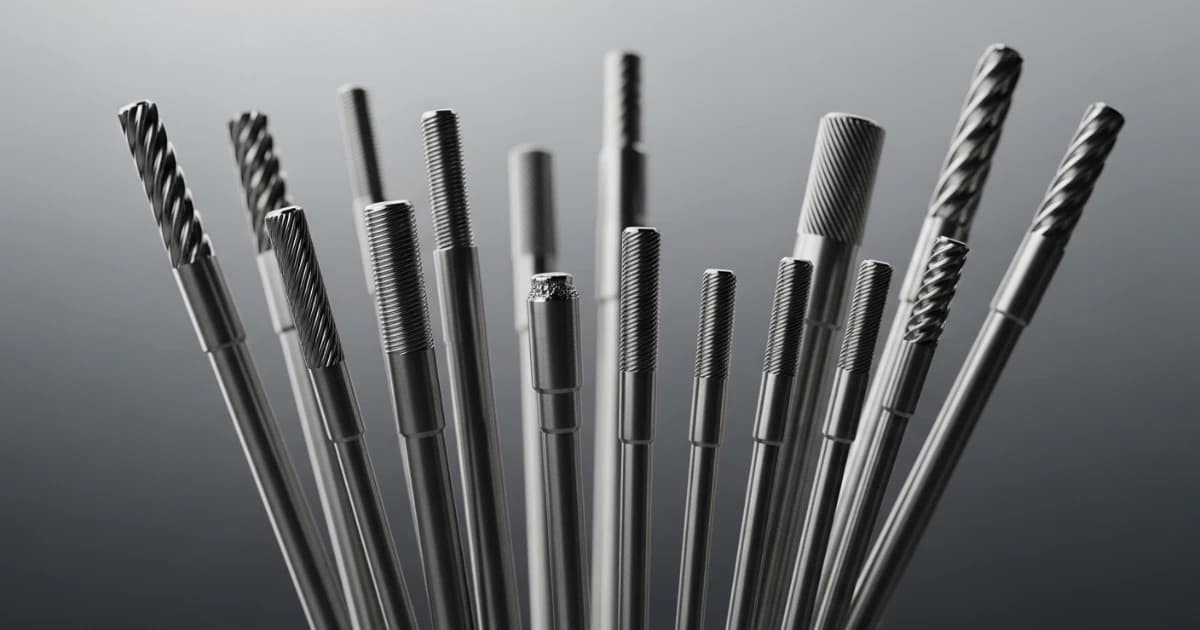
Ask five experienced TIG welders how they grind their tungsten, and you'll often get five slightly different answers. That's not because the physics is unsettled — it's because tungsten electrode types and grinding angles both depend heavily on the metal, the current, and the joint in front of you. Get either one wrong and the symptoms show up immediately: a wandering arc, a blown-out weld pool, or a tungsten inclusion buried in an otherwise clean bead.
Tungsten electrodes don't melt into the weld the way a stick or MIG electrode does. They carry the arc and stay largely intact, which means their composition and the shape of their tip do almost all the work of controlling how the arc behaves. This guide walks through the electrode families, what the color bands actually mean, how to size an electrode to your amperage, and — the part most tutorials rush through — exactly how tip geometry changes penetration, arc stability, and electrode life.
What Makes Tungsten Electrodes Different From Other Welding Consumables
In gas tungsten arc welding (GTAW/TIG), the electrode is non-consumable. Tungsten was chosen for this role because it has the highest melting point of any metal used in industrial applications, around 3,400°C (6,150°F), well above the temperatures reached in the arc column. A pure tungsten rod can hold an arc, but manufacturers rarely stop there.
Small amounts of metal oxides — thorium, cerium, lanthanum, zirconium, or blends of several — are added during sintering to change how easily the electrode emits electrons. This single property, called electron emissivity, is why some electrodes start easier at low amperage, some tolerate higher current without melting, and some hold up better on alternating current. The oxide content doesn't change the melting point much; it changes how the arc roots itself to the tip, which shows up as differences in starting reliability, arc stability, and how long the electrode keeps its ground shape before it needs attention.
Because the electrode itself barely wears down under correct use, the two variables a welder actually controls are which alloy to buy and how to grind the tip — and those two decisions interact more than most people expect.
Reading the Color Code: AWS A5.12 and ISO 6848
Every tungsten electrode ships with a color band on one end, and that band isn't cosmetic — it identifies the alloy under a shared international system. In the United States, that system is AWS A5.12/A5.12M, which is harmonized with ISO 6848. The classification is based on the electrode's chemical composition, not its diameter or intended amperage, so two electrodes with the same color but different diameters are still the same alloy family.
| AWS Classification | Common Name | Oxide Addition | Color Band |
|---|---|---|---|
| EWP | Pure tungsten | None | Green |
| EWTh-1 | Thoriated | ~1% thorium oxide | Yellow |
| EWTh-2 | Thoriated | ~2% thorium oxide | Red |
| EWCe-2 | Ceriated | ~2% cerium oxide | Orange (sometimes gray) |
| EWLa-1 | Lanthanated | ~1% lanthanum oxide | Black |
| EWLa-1.5 | Lanthanated | ~1.5% lanthanum oxide | Gold |
| EWLa-2 | Lanthanated | ~2% lanthanum oxide | Blue |
| EWZr-1 | Zirconiated | ~1% zirconium oxide (approx.) | Brown |
| EWG | Rare-earth / hybrid blend | Manufacturer-specific mix | Gray, purple, or other (varies by brand) |
The EWG designation is worth flagging separately: it's a catch-all AWS category for electrodes whose oxide blend doesn't fit a single-element class. Because the exact recipe is left to the manufacturer, the color band for EWG electrodes is not standardized the way it is for the single-oxide types — always check the supplier's data sheet rather than assuming a color means the same thing across brands.
The Main Tungsten Electrode Types and When to Use Them
Pure Tungsten (EWP)
Pure tungsten has the lowest current-carrying capacity and the weakest arc starting of the group, but it forms a smooth, stable ball on AC and resists contamination reasonably well. It remains a traditional choice for AC welding of aluminum and magnesium on older transformer-based (sine wave) machines, though alloyed electrodes have largely displaced it in modern shops.
Thoriated Tungsten (EWTh-1, EWTh-2)
Thoriated tungsten built its reputation on excellent DC arc starting, high current capacity, and a tip that resists erosion at high heat, which is why it became the default for decades on carbon steel, stainless steel, and nickel alloys. The tradeoff is that thorium oxide is a low-level radioactive material. The risk during normal welding is minimal, but grinding creates fine dust that can be inhaled — a genuinely different exposure pathway than arcing. That risk profile is significant enough to deserve its own section below, and it's the main reason many shops have shifted away from thoriated electrodes even where they remain legal to buy and use.
Ceriated Tungsten (EWCe-2)
Ceriated electrodes start easily at very low amperage and are a strong choice for thin-gauge sheet metal, orbital tube welding, and precision work below roughly 50 amps. They're commonly recommended as a non-radioactive substitute for thoriated tungsten on DC, though they lose some of the high-current durability thoriated electrodes offer.
Lanthanated Tungsten (EWLa-1, EWLa-1.5, EWLa-2)
Lanthanated tungsten is the closest general-purpose replacement for thoriated electrodes. It starts reliably, resists tip erosion well across a wide current range, and works on both AC and DC — which matters for shops running inverter machines that switch between processes throughout the day. Many welders who moved off thoriated tungsten for health reasons settled here because the performance gap is small.
Zirconiated Tungsten (EWZr-1)
Zirconiated electrodes are built for AC. They hold a stable balled tip, resist contamination from the molten aluminum or magnesium weld pool better than most alternatives, and are the standard recommendation when balling the tip is part of the technique. They're a poor choice for DC work, where a pointed tip is what you actually want.
Rare-Earth and Hybrid Blends (EWG)
Newer hybrid electrodes combine two or more rare-earth oxides — commonly lanthanum, cerium, and yttrium — to chase a middle ground: broad AC/DC versatility without thorium's handling concerns. Performance varies more by manufacturer here than in the single-oxide classes, since the AWS EWG category doesn't pin down an exact formula.
Matching Electrode Diameter to Amperage
Undersized tungsten overheats, sheds tiny particles into the weld pool, and can degrade into a rounded, uncontrollable blob. Oversized tungsten struggles to start cleanly at low amperage and produces a wider, less-focused arc than the joint needs. Diameter selection also depends heavily on current type, because DC electrode-negative (DCEN), DC electrode-positive (DCEP), and AC all put very different heat loads on the tip.
| Electrode Diameter | Typical DCEN Range | Typical Use |
|---|---|---|
| 0.020 in (0.5 mm) | 5–30 A | Foil-thin sheet, precision work |
| 0.040 in (1.0 mm) | 15–80 A | Light-gauge fabrication |
| 1/16 in (1.6 mm) | 70–150 A | General-purpose steel and stainless |
| 3/32 in (2.4 mm) | 150–250 A | Medium to thick sections |
| 1/8 in (3.2 mm) | 225–400 A | Heavy fabrication, structural work |
These ranges are starting points, not hard limits — actual capacity shifts with shielding gas, duty cycle, and equipment. As a rule of thumb, DCEP electrodes need a much larger diameter than DCEN for the same current, since electrode-positive operation concentrates far more heat at the tip. AC falls between the two, because the tip alternates between heating and cooling half-cycles; AC current maximums typically run below DCEN values for the same diameter. If you're unsure, undersizing slightly and watching for tip degradation is safer than guessing large and fighting a sluggish arc start.
Grinding Angles: How Geometry Shapes the Arc
This is where electrode selection and electrode preparation meet. The angle you grind onto the tip changes three things simultaneously: how concentrated the arc is, how much penetration you get, and how long the tip survives before it needs re-grinding.
Simulation-based research on GTAW arcs has shown that a sharper tip angle raises arc temperature and current density right at the electrode point, and increases arc pressure and gas shear stress in the arc column. As the tip angle opens up — moving from a sharp point toward a blunter cone — heat flux becomes less concentrated at the electrode but more focused where the arc lands on the workpiece, spreading the anode spot and changing the shape of the weld pool. In plain terms: a sharper point gives you a tighter, more focused arc column, while a blunter angle trades some of that focus for a wider, more stable footprint that tolerates higher current without melting back.
That tradeoff is the entire logic behind angle selection:
- A sharp point (roughly 15–30 degrees) concentrates the arc for precise, low-amperage work — thin material, tight joints, orbital tube welds — where you want control more than raw heat.
- A moderate angle (roughly 30–45 degrees) is the common middle ground for general-purpose DC welding on steel and stainless, balancing arc focus with tip durability.
- A blunter angle or a flat-ground truncation (45–60 degrees, often with the tip flattened rather than left needle-sharp) suits higher current, where a fine point would simply overheat, round over, or shed material into the weld.
A frequently repeated field guideline is to grind the taper length to roughly 1.5 to 2.5 times the electrode diameter — a longer taper for a sharper effective point at low current, a shorter, stubbier taper for high-current work. There's no single universal number that fits every machine and joint, so treat these as a starting range to dial in against your own results, not a fixed rule.
Grinding by Current Type: DC, Conventional AC, and Inverter AC
Current type changes the grinding target as much as amperage does.
DC welding (steel, stainless, nickel alloys, and most non-aluminum work) almost always calls for a ground, pointed conical tip. The point concentrates the arc for deep, controlled penetration, and because DCEN keeps most of the heat in the workpiece rather than the electrode, a sharp tip can survive without rounding over.
Conventional AC on transformer-based, sine-wave machines traditionally uses a balled tip, particularly with pure or zirconiated tungsten. The ball forms naturally: run the recommended AC amperage for that diameter and let the tip melt into a rounded end. The balled diameter shouldn't exceed about 1.5 times the electrode's original diameter — beyond that, the larger sphere starts to destabilize the arc rather than help it.
AC on modern inverter, square-wave machines behaves differently, and this trips up welders who learned on older equipment. Inverter AC output has a higher percentage of electrode-negative time and a much steeper polarity switch than a sine wave, so a pointed or lightly truncated tip generally starts and runs better than a full ball. Many welders now grind a point and just knock the very tip flat rather than melting a large sphere, keeping the focus of a DC-style point while still being stable on AC.
The practical takeaway: match the grind not just to AC-versus-DC, but to what kind of AC your machine actually outputs. A ball optimized for a 1990s transformer box can genuinely underperform on a modern inverter, and vice versa.
The Right Way to Grind Tungsten
Technique matters as much as the angle number.
- Grind lengthwise, never around the circumference. Longitudinal grinding leaves fine lines running parallel to the electrode's axis, which electrons can follow smoothly to the tip. Radial or circumferential grinding leaves ridges that run across that path, and the arc has to jump those ridges — a common, underappreciated cause of arc wander that looks like a tungsten or gas problem but is actually a grinding-direction problem.
- Use a dedicated grinding wheel for tungsten only. A wheel that's also been used on steel, aluminum, or other metals can transfer contamination straight into the tip, and that contamination then transfers into the weld pool. A cheap, dedicated wheel is far less costly than a contaminated weld.
- Keep the tip cool while grinding. Excess heat during grinding can create micro-cracks, and a tungsten with internal cracking is prone to splitting or shedding fragments into the weld the moment it sees arc current.
- Wipe the finished tip with a clean, lint-free cloth before use to remove loose grinding dust that would otherwise contaminate the first few seconds of the arc.
Common Mistakes That Undermine Tungsten Preparation
- Grinding radially instead of lengthwise — the single most common cause of a wandering, erratic arc that welders misdiagnose as a bad ground or dirty gas.
- Sharing a grinding wheel between tungsten and other metals — introduces contamination that shows up as black or gray inclusions in the weld.
- Using a sharp DC-style point on high AC amperage — the point overheats, balls unpredictably, or sheds material mid-weld.
- Using a full balled tip on modern inverter AC — often produces a wider, less controllable arc than the machine is capable of.
- Ignoring tip length-to-diameter ratio — an overly long, thin taper on high current will simply melt back regardless of the angle chosen.
- Skipping dust control during grinding — a housekeeping issue that becomes a genuine health issue with thoriated tungsten specifically.
Thoriated Tungsten and the Radiation Question
Thorium oxide is weakly radioactive, decaying mainly by alpha emission. Alpha particles can't penetrate skin, and technical assessments generally treat the radiation exposure from arcing with thoriated tungsten as very low. The distinction that matters is grinding: mechanical grinding generates fine particulate that can be inhaled or ingested, and that internal exposure pathway is treated far more seriously than the external radiation risk during welding itself.
Occupational health reviews of thoriated tungsten have generally concluded that the added lifetime cancer risk for a full-time welder is small but not zero, and regulatory bodies in several countries treat thorium-containing grinding dust as a controlled material requiring specific handling — including local exhaust ventilation at the grinder, respiratory protection during heavy grinding, and routine housekeeping to avoid dust accumulation. Some national frameworks classify the dust generated from grinding thoriated tungsten as a regulated "source material," which is a stricter standard than how the intact electrode itself is typically handled.
None of this means thoriated tungsten is unsafe to use outright — many shops still run EWTh-2 successfully with basic precautions. But it does explain why so many welders and safety officers now default to ceriated or lanthanated tungsten for DC work and zirconiated for AC: the performance gap is small, and it removes the radioactive-dust question entirely. If you do keep thoriated tungsten in the shop, treat the grinding station — not the welding booth — as the point that needs the real safety attention.
Choosing Between Types: A Practical Decision Guide
Rather than memorizing every classification, most selection decisions come down to three questions:
- What current type am I running? DC favors thoriated, ceriated, or lanthanated; AC favors zirconiated or pure tungsten (or a lightly truncated point on inverter AC).
- What amperage range is typical for this work? Very low current (under ~50 A) favors ceriated for its easy starting; broad, mixed-current shop work favors lanthanated for its versatility; sustained high current favors thoriated or zirconiated for tip durability.
- Does radioactive dust exposure matter for this shop? If grinding volume is high or ventilation is limited, lanthanated or ceriated tungsten removes that variable without a significant performance tradeoff for most jobs.
For a shop that only stocks one electrode type, lanthanated tungsten is the most common compromise choice today — it isn't the single best performer in any one category, but it's competent across DC and AC, low and high current, without the thorium question attached.
When to Re-Grind or Replace a Tungsten Electrode
A tungsten doesn't need to be replaced every time it's contaminated — most issues can be ground out. Signs that it's time to re-grind rather than keep welding include a visibly rounded or blackened tip, a green or blue tint near the point (oxidation from lost shielding gas coverage or a burned-back tip), a split or forked end, or an arc that suddenly starts wandering after previously running clean. Full replacement, rather than re-grinding, makes sense once the electrode has shortened enough that it no longer seats properly in the collet, or once repeated splitting suggests internal cracking from overheating during a previous grind.
Bringing It Together
Tungsten electrode type and grinding angle aren't two separate decisions — they're one decision made in two steps. The alloy determines how the electrode behaves under a given current type and amperage; the grind determines how that behavior gets focused onto the joint. Get the alloy right and grind it wrong, and you'll still fight arc wander or premature erosion. Get the grind right on the wrong alloy, and you'll still struggle with starting or tip life.
TIG welding depends heavily on how well the tungsten electrode is prepared: choosing the right alloy for the current type and amperage matters, but the angle it's ground to is what actually determines how focused and stable the arc will be, since a sharp point concentrates the arc for precise, deep penetration on thin material while a blunter or lightly truncated tip resists overheating and holds up better under higher current, so when either the electrode type or the grinding angle is mismatched to the job, the result is usually a wandering arc, tungsten contamination in the weld pool, or inconsistent penetration.
The most reliable path is the boring one: match the electrode family to your current type and amperage range, grind lengthwise to a taper suited to that same amperage, use a dedicated tungsten-only wheel, and re-grind at the first sign of contamination rather than pushing through it. None of that requires exotic equipment — it just requires treating tungsten prep as part of the weld setup, not an afterthought before striking an arc.
Choosing the right tungsten diameter starts with a reliable amperage settings chart, since running current outside the recommended range for a given electrode size is one of the fastest ways to ruin a TIG weld: too little diameter for the amperage causes the tip to overheat, shed fine particles into the puddle, and lose its ground shape, while too much diameter for the amperage makes arc starting sluggish and spreads the arc wider than the joint actually needs. A typical amperage settings chart pairs 0.040 in tungsten with roughly 15–80 A, 1/16 in with 70–150 A, 3/32 in with 150–250 A, and 1/8 in with 225–400 A on DCEN, with AC and DCEP shifting those ranges lower or higher depending on polarity — so keeping that chart on hand, rather than guessing by feel, is one of the simplest ways to protect both weld quality and electrode life.
Frequently asked questions
What color is a 2% thoriated tungsten electrode?
A 2% thoriated tungsten electrode is classified as EWTh-2 under AWS A5.12 and carries a red color band. A 1% thoriated electrode (EWTh-1) is coded yellow instead.
Can I use the same tungsten electrode for both AC and DC welding?
Lanthanated tungsten is the most versatile choice across both current types and is commonly kept as a single all-purpose electrode in shops that run mixed work. Pure tungsten and zirconiated electrodes are better reserved for AC, while thoriated and ceriated electrodes are generally better suited to DC.
What grinding angle should I use for thin sheet metal?
A sharper point, typically in the 15–30 degree range, concentrates the arc for the low amperage and precise control that thin sheet metal welding requires.
Why does my TIG arc keep wandering even after I clean the tungsten?
Wandering arcs are frequently caused by grinding direction rather than contamination. If the electrode was ground radially (around its circumference) instead of lengthwise, the resulting ridges disrupt electron flow to the tip regardless of how clean the surface looks.
Is thoriated tungsten illegal to use?
Thoriated tungsten remains legal to purchase and use in most countries, though some jurisdictions have introduced restrictions or reporting requirements due to its radioactive content. The main practical concern is inhaling grinding dust, not the intact electrode itself, so ventilation and dust control matter more than avoiding the material outright.
Should I ball the tip or grind it to a point for AC welding?
It depends on your machine. Traditional transformer-based (sine wave) AC machines generally perform well with a balled tip on pure or zirconiated tungsten. Modern inverter square-wave machines usually run better with a pointed or lightly truncated tip rather than a full ball.
What happens if I use too small a tungsten diameter for my amperage?
An undersized electrode overheats, can shed small particles into the weld pool as tungsten inclusions, and may round over or degrade unpredictably during the weld, reducing arc control.
How often should tungsten electrodes be re-ground?
There's no fixed interval — re-grind whenever the tip shows contamination, discoloration, rounding, or splitting, or as soon as the arc starts wandering or becomes harder to start. Frequent short welds on clean material may need re-grinding far less often than high-current work on dirty or oxidized base metal.
What is the difference between ceriated and lanthanated tungsten?
Both are considered safer alternatives to thoriated tungsten. Ceriated tungsten tends to excel at very low-current starting and fine work, while lanthanated tungsten holds up better across a broader current range and performs well on both AC and DC, making it the more general-purpose option of the two.
Does grinding tungsten produce hazardous dust for every electrode type?
Grinding dust is a health concern specifically because of thorium in thoriated tungsten. Ceriated, lanthanated, and zirconiated electrodes do not carry the same radioactive dust concern, though general grinding dust and any fine particulate should still be controlled with proper ventilation as standard shop practice.
References
- AWS A5.12M/A5.12 Specification for Tungsten and Oxide Dispersed Tungsten Electrodes for Arc Welding and Cutting - American Welding Society, harmonized with ISO 6848.
- The use of thoriated tungsten electrodes - TWI Ltd, accessed 2026-07-25.
- Effect of different electrode tip angles with tilted torch in stationary gas tungsten arc welding: A 3D simulation - Journal of Materials Processing Technology, Elsevier.
- Occupational Safety and Health Administration, 1910.134 - Respiratory Protection - U.S. Department of Labor, accessed 2026-07-25.
- U.S. Nuclear Regulatory Commission, 10 CFR Part 20 - Standards for Protection Against Radiation - NRC, accessed 2026-07-25.
- Guidelines for tungsten electrode and color types - The Fabricator, Fabricators & Manufacturers Association.