
Back Purging Stainless: Why and How
Learn what back purging stainless steel does, why root oxide matters, how purge gas is chosen, and why oxygen and purge limits belong in your procedure.

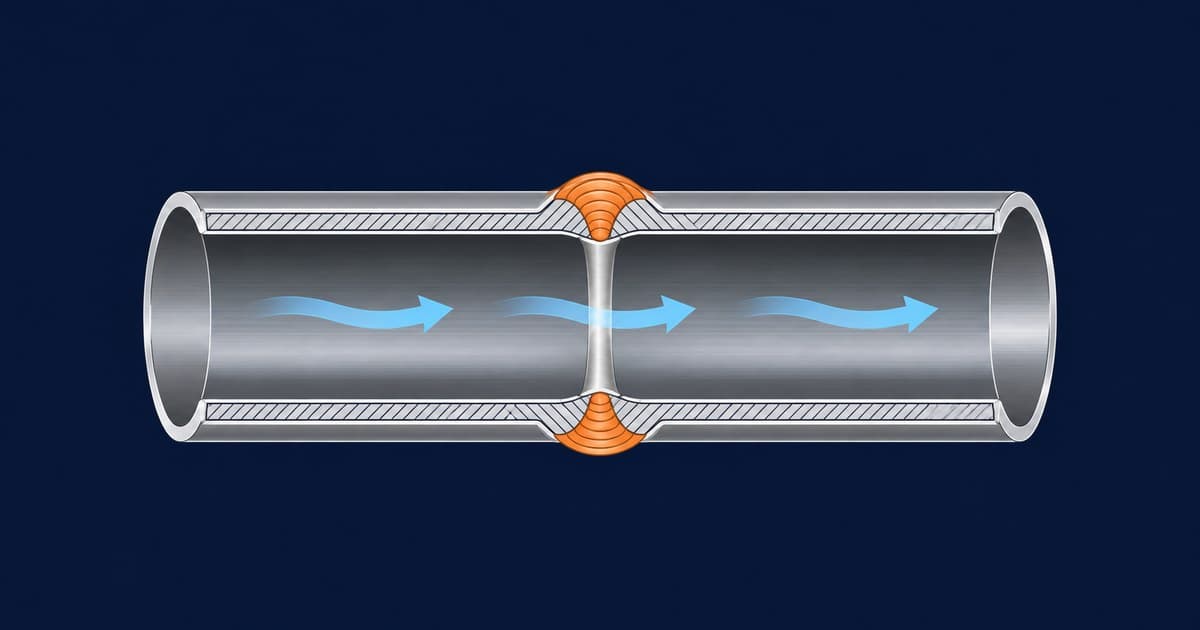
Back purging stainless steel means filling the root side of a joint with inert gas before the root pass. The gas pushes air out of the space you cannot see, so less oxygen reaches the hot metal. The back side is part of the weld, not an afterthought.
The oxygen acceptance limit and the purge time belong in your welding procedure, not in a rule of thumb.
Back purging stainless steel: what it does
The back side of a stainless root is hidden while you weld. Back purging replaces the air in that space with inert gas, so the root forms in a low-oxygen atmosphere you cannot see but can control.
Why the root side needs protection
Oxygen on the inside of a stainless joint forms an oxide, and the color you see inside the pipe is the visible result. A stainless GTAW course teaches back purging as a way to prevent "sugaring" oxidation on the back of stainless joints and pipe.
Oxygen in the purge gas
In one 316L stainless weld joint test (50 to 5,000 ppm oxygen in the protective gas), a higher oxygen concentration promoted a thicker oxide layer on the surface. The widest discoloration appeared at 5,000 ppm oxygen. As oxygen content rose, the differences in discoloration width between the levels got smaller.
These figures are the conditions of one test. They are not an acceptance limit and not a setting to aim for.
Surface oxide and sensitization
Surface oxide and sensitization are different conditions. For austenitic stainless steel, sensitization is the harmful intergranular precipitation of chromium carbide. It occurs when the metal is exposed to temperatures in the approximate range of 800 to 1500 °F (about 425 to 815 °C).
| Surface oxide | Sensitization | |
|---|---|---|
| Where it forms | On the metal surface | At the grain boundaries |
| What it is | A layer of oxidation, seen as color | Precipitation of chromium carbide |
Oxide level has a separate role in corrosion. When the oxidation level of the root bead matches the inside surface of the pipe, no galvanic action results when an electrolyte is introduced. The point is the match between the two surfaces, not the color on its own.
Measuring oxygen in the purge gas
Oxygen in the purge gas can be measured. ASTM D7607 describes an electrochemical sensor method for oxygen in gaseous fuels, and its scope lists argon among the gases it can measure. Its range runs from 0.1 ppm(v) to 25 percent by volume.
The standard is a measurement method. It does not say how much oxygen is acceptable for your joint.
Choosing the purge gas
One specification for vacuum systems and components lists argon, nitrogen, or a mixture of the two as the cover and purge gas. It requires commercial grade 99.98 percent.
That is one specification's list, not a general rule for stainless steel, so do not choose a gas from habit alone. Check the gas named in your welding procedure before you connect the cylinder.
Setting up the purge
Root-pass practice gives the sequence for the entrance side of a pipe joint. Figure 1 is a schematic of that layout.
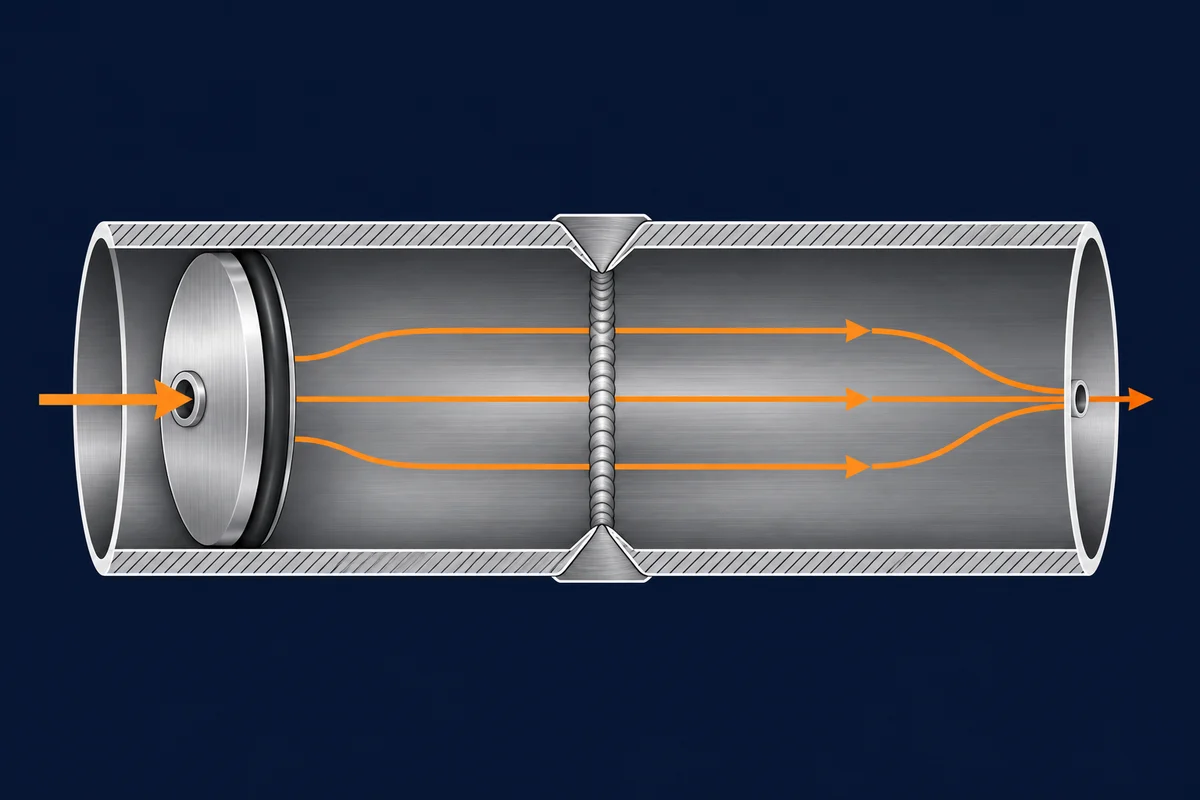
Figure 1. Purge layout on the entrance side of a pipe joint. Schematic, not to scale.
- Fit a purge cap on the entrance side. The cap needs a hole to admit the purge gas.
- Run the preweld purge and evacuate the air from the joint.
- Weld the root after the preweld purge step is complete.
Flow rate and purge time depend on the joint, so set them in the welding procedure for the job.
Purge dams
Some purge dams are made from water-soluble material. An information notice on inert gas welding reports that this dam material can lose its solubility in water when it decomposes at elevated temperatures.
Check the dam material and the heat it will see before welding. The notice gives no temperature limit, so confirm the material's heat tolerance in your procedure.
Purge volume and time
An idealized model helps explain why purge time matters. In a chamber with ideal mixing, purging one volume of gas leaves about 36.8 percent of the original air.
The ideal-mixing curve gives the lowest purge efficiency expected in a pipe, so it is a conservative bound, not a measured purge time or flow rate for your joint.
A purge reference for chambers uses two related terms. V/Q is a purge-flow time constant. Q/V is the number of volume changes per unit time. Both describe how a volume is refreshed with gas.
Acceptance and discoloration standards
Several documents deal with discoloration or imperfections. Each covers a different thing.
- ISO 5817:2023 sets quality levels for imperfections in fusion-welded joints, except beam welding, in steel, nickel, titanium, and their alloys. It covers the joint, not the purge gas.
- D18.2:2020 is a guide to weld discoloration levels on the inside of austenitic stainless steel tube.
- ASME BPE 2026 lists discoloration acceptance criteria for welds and heat-affected zones on mechanically polished UNS S31603 (316L) tubing.
Use these documents to name the levels your job requires. The project specification sets the actual limit.
Safety in purged pipe
A purged pipe is a confined space, and its atmosphere can go wrong. A published incident report documents a welder's helper who was asphyxiated in an argon-inerted pipe in Alaska.
Welding itself can reduce oxygen in a confined space, and another gas such as nitrogen can displace it. The permit-required confined space rule (1910.146) treats an atmosphere with less than 19.5 percent oxygen, or more than 23.5 percent, as hazardous. Leaks of inert gas from some welding operations inside a tank can also create an oxygen-deficient atmosphere.
These atmospheric limits are safety limits, not weld acceptance limits. Check the atmosphere and ventilate the space before anyone enters, following your site's procedure.
When to bring in an engineer
Do not start the root pass on a purge setup you cannot explain. If the cap, the dam material, the gas supply, or the oxygen target is unclear, ask a qualified welding engineer or inspector to review the procedure first.
Pickling and passivation are separate steps in some procedures. Follow the cleaning method in the project specification.
References
- Recommended Practices for Root Pass Welding - American Welding Society
- D18.2:2020 Guide to Weld Discoloration Levels on Inside of Austenitic Stainless Steel Tube (Large) - American Welding Society
- ISO 5817:2023 - ISO, 2023
- Information Notice No. 81-07: Potential Problem with Water-Soluble Purge Dam Materials Used During Inert Gas Welding - U.S. Nuclear Regulatory Commission
- Influence of Oxygen Content in the Protective Gas on Pitting Corrosion Resistance of a 316L Stainless Steel Weld Joint - National Library of Medicine (PMC)
- A Manual of Stainless Steel Data for Meat and Poultry Processing Equipment - National Bureau of Standards (NIST)
- The Answer Is - American Welding Society
- Inert Atmospheres in Non-Vacuum Chambers for Welding Applications - U.S. Department of Energy (OSTI)
- SSRP User Specifications for Vacuum Systems and Components - SLAC National Accelerator Laboratory
- Welder's Helper Asphyxiated in Argon-Inerted Pipe - Alaska: Report AK-94-12 - Centers for Disease Control and Prevention (CDC)
- OSHA 1910.146: Permit-required confined spaces - Occupational Safety and Health Administration (OSHA)
- 1915 Subpart B App A - Compliance Assistance Guidelines for Confined and Enclosed Spaces and Other Dangerous Atmospheres - Occupational Safety and Health Administration (OSHA)
- A Guide to Safety in Confined Spaces - Centers for Disease Control and Prevention (CDC), 1987
- Preventing molecular and particulate infiltration in a confined volume - NASA
- ASTM D7607: Standard Test Method for Analysis of Oxygen in Gaseous Fuels (Electrochemical Sensor Method) - ASTM International
- Stainless Steel GTAW/TIG Welding (MFG-285) - CGCC
- ASME BPE-2026 Bioprocessing Equipment - ASME