
Welding Gas Cylinder Safety and Storage
Learn how to store, separate, move, and check welding gas cylinders safely, with clear rules on distances, valves, colour codes and leak checks.

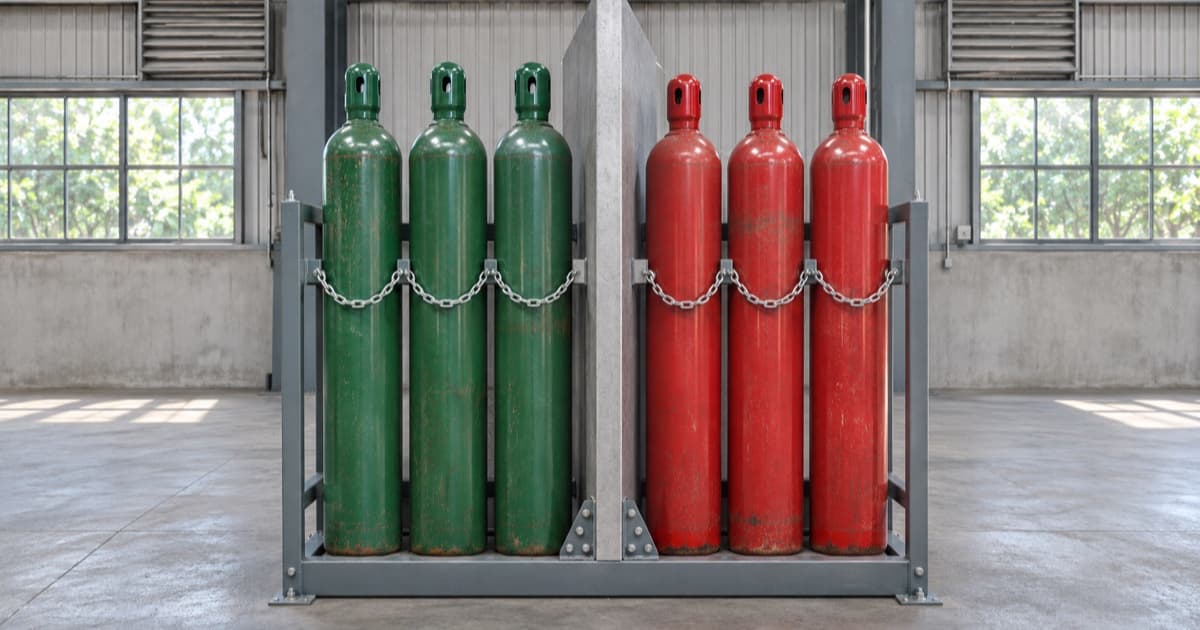
Welding gas cylinder safety and storage comes down to a few clear rules: keep cylinders upright and secured, keep oxygen apart from fuel gas, keep cylinders away from heat, and never look for a leak with a flame. Exact distances and requirements depend on the rule that applies where you work.
Welding gas cylinder safety and storage: upright and secured
Cylinders must always be secured upright so they cannot fall or roll. Use a strap or chain as the restraint device. Acetylene has its own rule: in the US, acetylene cylinders must be stored and used only in a vertical, valve-end-up position.
Storage location and heat
Indoor cylinders must be kept in a well-protected, well-ventilated, dry location. They must not be kept in unventilated enclosures such as lockers and cupboards, and they must be kept away from radiators and other heat sources. A university safety guide for compressed gas cylinders also advises against exposing them to temperatures above 125°F (52°C).
Separating oxygen from fuel gas
The US storage rule says oxygen cylinders must be separated from fuel-gas cylinders by at least 20 feet (6.1 m). A noncombustible barrier can replace that distance if it is at least 5 feet (1.5 m) high and has a fire-resistance rating of at least one-half hour. Canadian guidance gives the same distance and barrier. The UK leaflet on gas welding gives no fixed distance, so confirm the figure that applies where you work.
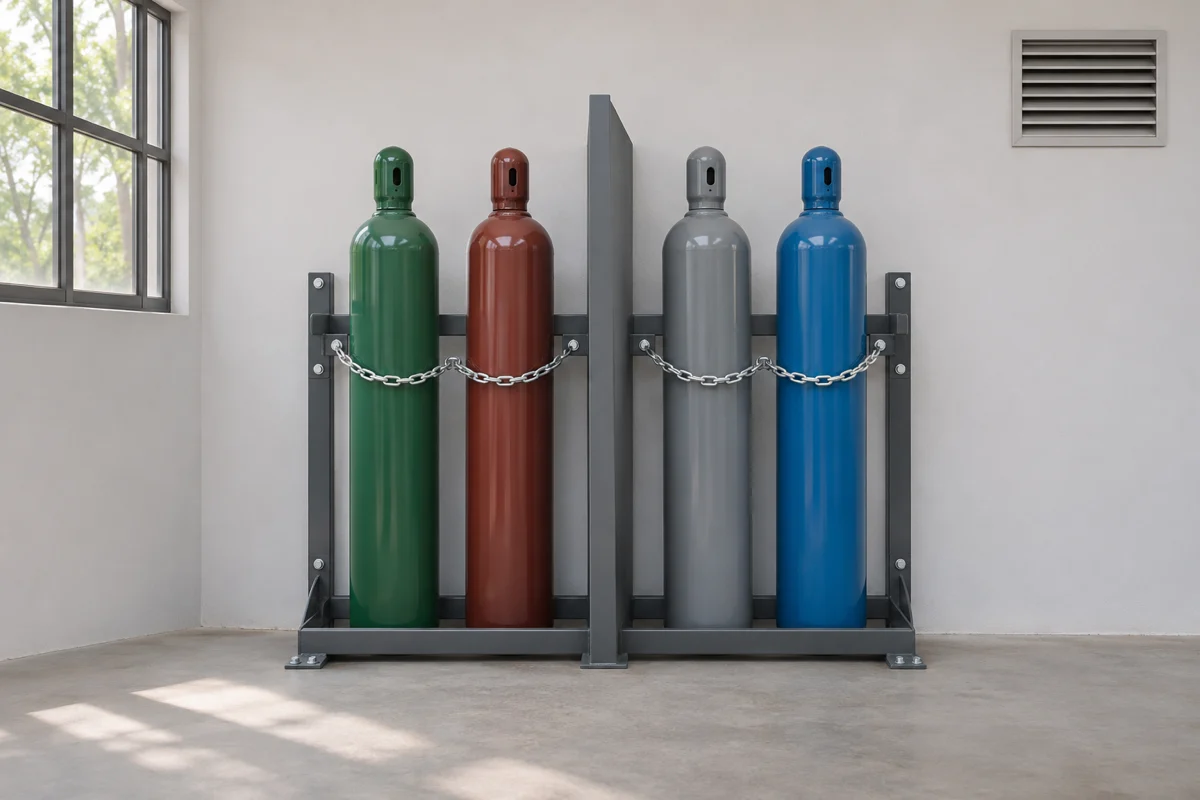
Indoors, the US rule also requires cylinders to be kept at least 20 feet from highly combustible materials such as oil. Oil and grease need extra care too. The US construction standard requires oxygen cylinders and fittings to be kept away from oil or grease. Oil or grease must never touch a cylinder, its valve, or its fittings, especially on oxygen cylinders.
Moving cylinders
In a powered vehicle, cylinders must be transported upright. For road vehicles, UK guidance adds that cylinders should be secured so they do not come loose in an accident.
Valves, caps and empty cylinders
- Valve caps: Where a cylinder accepts a cap, the cap stays on, hand-tight, except when the cylinder is in use or connected.
- Acetylene valve: Open it no more than one and one-half turns of the spindle, and preferably no more than three-fourths of a turn.
- Acetylene pressure: Never use acetylene above 15 psi.
- Empty cylinders: Close the valves.
Labels and colour codes
US rules require each cylinder to be legibly marked with the chemical or trade name of the gas. Colour is a different matter. The colour code is a secondary means of identification, and cylinder colours are generally not mandatory, apart from acetylene. The gases industry has harmonised colours across Europe in line with BS EN 1089-3.
Leak checks and flashback
Never look for a gas leak with a naked flame. On oxygen systems, do not use soapy water or solutions containing grease or oil; use a leak-detecting solution suitable for oxy/fuel systems.
A non-return valve will not stop a flashback once it has occurred.
Damaged cylinders and emergencies
A damaged cylinder must be returned to the supplier immediately. Fire and rescue services have specific procedures for dealing with acetylene cylinders. If an acetylene cylinder has been involved in a flashback or fire, or it becomes warm or starts to vibrate, evacuate the building and call the fire and rescue service.
Frequently asked questions
What does the DOT identification number on a cylinder show?
It identifies the cylinder material and the service pressure, which is given in pounds per square inch (psi).
Can an inert gas cylinder be used in an enclosed space?
Inert gases can displace oxygen and create an oxygen-deficient atmosphere. They should not be used in enclosed or confined spaces without proper ventilation and/or respiratory protection.
References
- Oxygen-fuel gas welding and cutting - OSHA
- General Industry Digest (OSHA 2201) - OSHA
- Gas welding and cutting - OSHA
- Safety in gas welding, cutting and similar processes - HSE
- Safe use of Acetylene - HSE
- Chapter 7 – Compressed Gas Cylinders - Washington State University
- Welding - Storage and Handling of Compressed Gas Cylinders - CCOHS
- Oxy-Fuel Cutting Safety Checklist - ESAB
- BCGA TIS 6, Revision 4 - BCGA
- Compressed Gas Cylinders - Virginia Tech EHS
- Welding and flamecutting - HSE