
Flux-Cored vs MIG Welding: When to Use Each
Flux cored vs MIG welding compared: shielding, wind tolerance, deposition, spatter, fume, cost, and clear rules for choosing the right wire process.

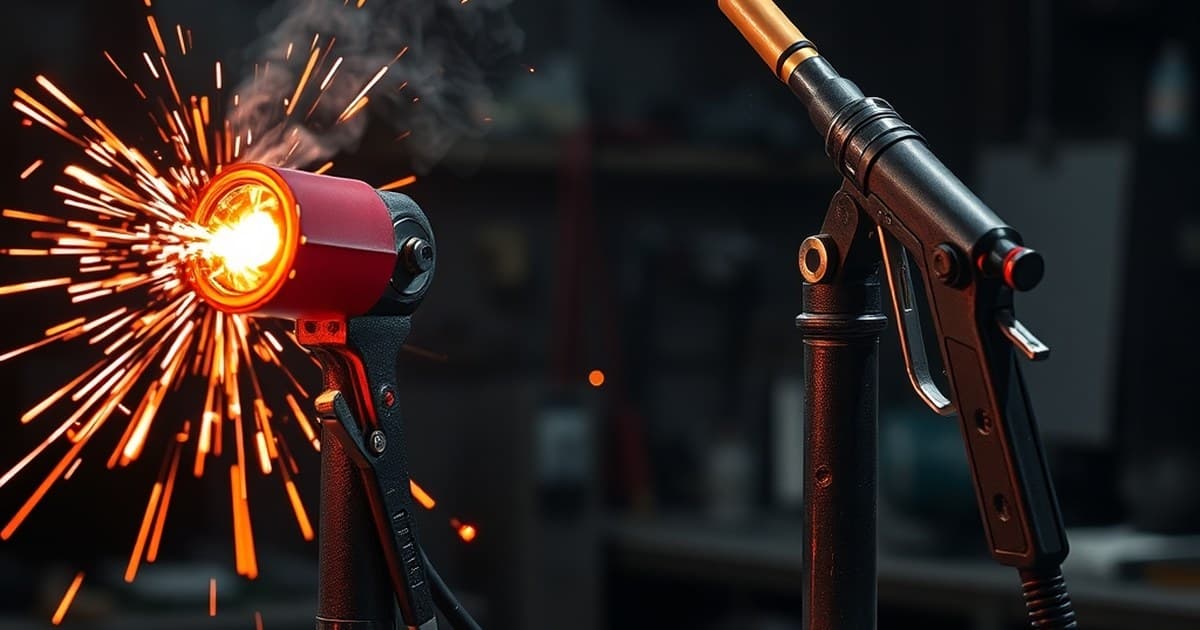
The flux cored vs MIG welding question comes up whenever someone buys a wire-feed machine, bids a field repair, or tries to figure out why a weld that looked fine in the shop falls apart outdoors. The two processes share the same hardware idea: a continuously fed wire, a constant-voltage power source, and a gun you pull a trigger on. Yet they behave very differently once an arc is struck.
This guide explains where the real differences lie, which one fits which job, and where the common advice ("flux-core for thick and dirty, MIG for clean and thin") is too simple to trust. It is written for hobbyists moving into fabrication, apprentices, and shop owners choosing a process for a specific task.
The Short Answer
Neither process is better in general. Each trades something for something else:
- MIG gives cleaner welds, little slag, less spatter cleanup, and a forgiving feel on thin steel, but it needs a gas cylinder and stops working well in moving air.
- Flux-cored gives high deposition, good penetration, and, with self-shielded wire, the ability to weld outdoors without gas, but it produces slag, more smoke, and more cleanup.
If the weld happens indoors, on clean steel, and appearance matters, start with MIG. If it happens outdoors, in wind, on thick or rusty steel, start by considering self-shielded flux-cored wire.
The rest of this article explains why, and what can change the answer.
How Each Process Works
MIG welding (GMAW)
Gas metal arc welding, usually called MIG welding, strikes an arc between a solid consumable wire and the workpiece. A shielding gas flows through the gun nozzle and displaces the surrounding air so the molten pool is not contaminated by oxygen and nitrogen. Depending on the gas, the process is called MIG (inert gas, such as argon) or MAG (active gas, such as CO2 or argon-CO2 mixes), and both fall under GMAW.
Because the protection comes entirely from the gas, anything that disturbs the gas envelope damages the weld. A fan, an open door, or a breeze across the work can pull air into the pool and cause porosity.
Flux-cored welding (FCAW)
Flux-cored welding (FCAW) uses a tubular wire whose hollow core is filled with flux and other ingredients. When the arc heats the core, it produces shielding vapours and a layer of liquid slag that covers and protects the cooling weld metal. The slag later solidifies and must be chipped or brushed away.
There are two main variants:
- Self-shielded (FCAW-S): the core generates all the protection, so no external gas is needed.
- Gas-shielded (FCAW-G), often called dual-shield: the core still provides slag and alloying, while an external gas, commonly CO2 or an argon-CO2 blend, adds extra protection.
This split matters because "flux-core" is not one process in practice. Comparing MIG with self-shielded wire and comparing it with gas-shielded flux-cored wire lead to quite different conclusions.
Side-by-Side Comparison
| Factor | MIG (GMAW, solid wire) | Self-shielded flux-cored | Gas-shielded flux-cored |
|---|---|---|---|
| External gas | Required | Not required | Required |
| Slag | None to minimal silica islands | Heavy, must be removed | Moderate, usually easier to remove |
| Outdoor or windy work | Poor | Good | Poor |
| Spatter | Low to moderate, depends on setup | Often higher | Generally lower than self-shielded |
| Fume and smoke | Lowest of the three | Typically highest | Higher than MIG |
| Typical use | Shop fabrication, thin to medium steel | Field work, repair, structural erection | Heavy fabrication, out-of-position welds |
| Portability | Needs cylinder | Very portable | Needs cylinder |
Treat the table as a tendency, not a guarantee. Wire brand, diameter, power source, and operator technique can shift any single entry.
Shielding and Wind Tolerance
Shielding is the single biggest practical difference.
A MIG or gas-shielded flux-cored arc relies on a gas blanket a few centimetres wide. Moving air disturbs it, and the result is typically scattered porosity, sometimes visible as small pinholes and sometimes hidden inside the weld. Windscreens help, and a welder can sometimes shelter the work with a tent or panel, but this adds setup time and never fully removes the risk.
Self-shielded wire has no gas to blow away. Its protection is created at the arc and in the slag, which is why it became popular for outdoor construction and field repair. That does not make it immune to defects. It simply moves the main risks from lost gas coverage to technique, wire storage, and slag handling.
Takeaway: if you cannot control airflow, remove the gas dependency or control the environment.
Deposition Rate, Speed, and Penetration
Flux-cored wires are widely valued for high deposition rates, particularly on thicker material and in the flat and horizontal positions. The flux core allows higher current density in the wire, and many structural applications use the process for that reason. Self-shielded wires often also give good penetration, which helps on joints that are hard to fuse completely.
MIG can be very productive too, especially in spray transfer on thicker plate or with pulsed power sources. What it does best is steady, smooth welding at moderate heat, which makes it forgiving on sheet metal and light fabrication.
A fair summary:
- Thin material (roughly sheet gauge): MIG is usually the more controllable choice. Many flux-cored wires are too hot and too aggressive for very thin sections, although small-diameter wires exist.
- Medium thickness: both work; shop conditions and finish requirements decide.
- Thick plate and structural work: flux-cored wires are commonly preferred, with gas-shielded types often used for position welding.
Always confirm the figures for your wire and machine from the manufacturer's data sheet rather than relying on a generic chart. Settings differ between wire classifications, and a mismatch is a common source of defects.
Weld Appearance, Slag, and Cleanup
MIG welds typically leave a clean bead with little to remove. Light spatter and occasional glassy silicon islands appear on steel, and they can be cleaned off quickly before painting.
Flux-cored welds leave a slag layer. This is a feature as well as a chore: the slag supports the bead profile, shapes the pool in vertical and overhead positions, and shields the metal while it cools. The price is labour. Slag has to be removed between passes in multi-pass welds, and missed slag can become a slag inclusion, a recognised defect.
Self-shielded wires usually throw more spatter than gas-shielded wires. If a part will be painted, coated, or visually inspected, factor in the extra grinding and brushing time when comparing "fast" processes.
Fume, Smoke, and Health Considerations
All arc welding creates fume. What differs is the composition and the amount.
Welding fume is a mixture of metal oxides, silicates, and fluorides, and its makeup depends on the base metal, the filler, coatings, and process. Fluxes that contain silica or fluoride can add amorphous silica, silicates, and fluoride fume to the mix. That is one reason flux-cored processes are generally described as producing more fume and smoke than solid-wire MIG, and self-shielded wires tend to be the smokiest. Smoke can also hide the weld pool and make joint tracking harder.
Gases matter too. Carbon dioxide is released from flux decomposition, carbon monoxide can form from CO2 shielding gas in the arc, and ozone and nitrogen oxides form around the arc. Confined spaces raise the stakes because gases and fume can accumulate.
Practical, conservative measures include:
- Using local exhaust ventilation close to the arc where possible
- Keeping your head out of the fume plume
- Removing paint, galvanizing, and oil before welding, because coatings add their own hazards
- Using respiratory protection as determined by a workplace risk assessment
- Following the safety data sheet and the exposure limits that apply in your jurisdiction
Welding fume exposure limits and health effects vary by metal and region, so treat this section as orientation, not occupational health advice. If you weld stainless steel, galvanized material, or in enclosed spaces, get proper guidance and ventilation first. For a deeper view of the limits themselves, see the dedicated safety material on this site, starting from the basics in our welding safety coverage.
Metallurgy, Hydrogen, and Quality-Critical Work
Process choice also affects the weld metal itself.
Hydrogen is the main concern on steels that are prone to hydrogen cracking, also called cold cracking, because it can appear hours after welding. Solid MIG wires generally add little hydrogen when the wire, gas, and joint are clean and dry. Flux-cored wires can carry moisture in the core, so storage and handling matter, and some wires are designated for low diffusible hydrogen. If a code or procedure limits hydrogen, choose consumables classified for it and follow the manufacturer's storage guidance.
Other points worth knowing:
- Flux-cored consumables must match the required mechanical properties, as with any filler metal. Impact toughness, strength, and alloy content differ between classifications.
- Operator skill, machine setup, and electrode manipulation strongly affect porosity in both processes.
- Polarity is different: gas-shielded flux-cored wire typically runs electrode positive, while many self-shielded wires run electrode negative. Check the wire's data sheet before connecting the cables.
- For code work, the welding procedure specification governs. A preferred process cannot replace a qualified procedure.
Cost and Equipment
Costs depend on what you count.
Equipment: A basic wire-feed machine can often run both solid and flux-cored wire if the drive rolls, liner, and polarity are set correctly. Self-shielded flux-cored welding needs no gas cylinder, regulator, or hose, which lowers startup cost and makes the kit easier to carry. MIG and gas-shielded flux-cored welding need a cylinder, a regulator and flow control, and a refill arrangement.
Consumables: Flux-cored wire usually costs more per kilogram than solid wire, but it can deposit more metal per hour. Judge the cost per unit of weld metal placed, not the price of the spool.
Labour: Slag removal and spatter cleanup consume time. Rework from porosity or lack of fusion is the most expensive item of all.
Drive rolls and liners: Tubular wire is softer than solid wire. Knurled drive rolls are commonly used for flux-cored wire, while smooth or V-groove rolls suit solid wire, and excessive roll pressure can crush the tube. Mixing these up is a common reason for erratic feeding.
Joint Preparation and Base Material Condition
Flux-cored wire is often described as more tolerant of mill scale, light rust, and imperfect surfaces than MIG. There is truth in this, because the flux contains deoxidisers and cleaning agents. But "more tolerant" does not mean "clean is optional." Paint, oil, heavy rust, and moisture still cause porosity, poor fusion, and fume.
MIG with solid wire is more sensitive to surface contamination, so it benefits from grinding or wire-brushing to bright metal at the joint. In a shop with clean steel this is not a problem. In a field repair on weathered structure, it becomes a limit.
Whichever process you choose, a few minutes of preparation costs less than reworking a rejected weld.
Position, Thickness, and Skill Level
Out-of-position welding: Flux-cored wires, especially those designed for vertical-up and overhead, are often favoured because the slag supports the pool. MIG can work out of position with short-circuit or pulsed transfer, but it demands more care with heat input.
Thin sheet: MIG short-circuit transfer with a small-diameter wire gives a more controllable arc for thin sections. Flux-cored welding on thin sheet is possible with the right wire, but burn-through is a risk.
Learning curve: Both are semi-automatic and are easier to learn than stick or TIG for many people. MIG tends to be the more forgiving process for a beginner working on clean steel indoors, while flux-cored welding asks the beginner to manage slag, smoke, and stickout.
Common Mistakes
- Using MIG outdoors without a windbreak. Gas coverage fails and porosity appears, sometimes invisibly.
- Choosing self-shielded wire for a visible, painted part without allowing for spatter and slag cleanup.
- Ignoring wire storage. Flux-cored wire left open in damp conditions can pick up moisture, which can affect weld quality.
- Running the wrong polarity. Flux-cored wires are polarity-specific, and wrong connection gives a harsh, unstable arc.
- Setting stickout too long or too short. Electrode extension and contact-tip-to-work distance directly change current and shielding behaviour.
- Skipping slag removal between passes. Trapped slag is a classic defect in multi-pass flux-cored welds.
- Underestimating ventilation. Flux-cored smoke is heavier, and confined spaces make it worse.
- Assuming one chart fits all wires. Settings differ by classification and diameter.
Decision Guide: Which One Should You Choose?
Choose MIG when
- Welding is indoors or in controlled airflow
- The material is thin to medium and clean
- Appearance and low cleanup matter
- Fume and smoke should be as low as practical
- You are learning and want the gentlest process
Choose self-shielded flux-cored when
- Work is outdoors or in wind
- Gas cylinders are impractical to transport
- Steel is thick, dirty, or weathered
- Portability matters more than appearance
- The wire's classification meets the job's mechanical requirements
Choose gas-shielded flux-cored when
- You need high deposition on thicker steel in a shop or sheltered site
- Out-of-position welding is frequent
- Better arc stability and lower spatter than self-shielded wire are wanted
- The extra cleanup of slag is acceptable
A hypothetical example
Imagine a small fabricator who builds trailer frames from medium-thickness steel in a covered workshop, then occasionally repairs gates on customers' farms. A reasonable split would be MIG or gas-shielded flux-cored wire in the shop, where gas is easy to control, and self-shielded wire for the farm visits, where wind and portability dominate. This is an illustration, not a case study, and a real operation should verify the choice against its own procedures and customer requirements.
When both are the wrong answer
If the weld needs very high precision, thin non-ferrous metal, or critical cosmetic quality, TIG welding may be the better route. If it needs maximum field simplicity with minimal equipment, stick welding might fit. The question "flux-cored or MIG?" assumes a wire-feed process is the right family to begin with, and that assumption deserves a quick check.
Conclusion
The best answer to flux cored vs MIG welding depends on environment, material, position, appearance, and health controls, not on which process is "stronger." MIG is typically the cleaner, calmer choice for indoor work on clean steel. Flux-cored welding earns its place where wind, thickness, dirt, or deposition rate decide the outcome, and self-shielded wire in particular removes the gas cylinder from the equation.
Choose the process that matches the conditions you actually have, qualify the procedure when the work is code-governed, and give ventilation the same attention as machine settings. A few minutes of honest assessment before striking the arc is cheaper than any amount of grinding afterwards.
Frequently asked questions
Is flux-cored welding stronger than MIG welding?
Not inherently. Weld strength depends on the filler metal classification, joint design, heat input, and technique. Both processes can meet structural requirements when the correct consumable and a qualified procedure are used.
Can I use flux-cored wire in a MIG welder?
Often yes, if the machine is a wire-feed unit with enough output. You may need to change polarity for self-shielded wire, switch to knurled drive rolls, and confirm the liner suits tubular wire. Check the machine manual and the wire data sheet first.
Does flux-cored welding need shielding gas?
Self-shielded wire does not. Gas-shielded (dual-shield) flux-cored wire does, and it is typically used with CO2 or an argon-CO2 mixture as the wire manufacturer specifies.
Which process is better for welding outdoors?
Self-shielded flux-cored welding is generally the better fit, because there is no external gas to be blown away. MIG can be used outdoors with effective windbreaks, but gas coverage remains a risk.
Which one is better for thin sheet metal?
MIG with a small-diameter solid wire is usually more controllable on thin sheet. Some fine flux-cored wires exist, but burn-through is more likely if settings are not carefully tuned.
Why does flux-cored welding make more smoke than MIG?
The flux core vaporises and reacts in the arc, producing additional fume and smoke, and self-shielded wires are especially noticeable. Good ventilation and fume extraction are important with either process.
Is flux-cored welding harder to learn?
It is not necessarily harder, but it asks for different habits: managing slag, stickout, and smoke. Many beginners find MIG easier on clean, flat steel indoors.
Why does flux-cored welding leave slag?
The flux in the core forms a protective layer over the cooling weld metal. It supports the bead and keeps air out until the metal solidifies, then must be removed.
Is flux-cored wire more tolerant of rust and mill scale?
Generally somewhat more tolerant than solid MIG wire, because of the deoxidising ingredients in the flux. It is still best to remove heavy rust, paint, and oil, since contamination can cause porosity and poor fusion.
Do both processes need the same safety precautions?
The basics are the same: eye and skin protection, fire precautions, and fume control. Flux-cored welding often calls for extra attention to ventilation because it typically generates more fume, and enclosed spaces need specific controls.
References
- Flux-cored arc welding - Wikipedia, accessed 2026-10-27. Describes self-shielded and gas-shielded variants, advantages, and typical defects.
- Gas metal arc welding - Wikipedia, accessed 2026-10-27. Overview of GMAW, shielding gas use, and its sensitivity to moving air.
- Controlling Hazardous Fume and Gases during Welding - U.S. Occupational Safety and Health Administration, 2013. Fume and gas hazards and controls.
- Welding - Fumes And Gases - Canadian Centre for Occupational Health and Safety, accessed 2026-10-27. Fume composition, flux-related fumes, and exposure factors.
- Welding, Cutting, and Brazing - Overview - U.S. Occupational Safety and Health Administration, accessed 2026-10-27. Applicable standards and hazard resources.
- Welding processes and consumables - Steel Construction Institute (steelconstruction.info), 2026. Guidance on gas-shielded and self-shielded tubular cored arc welding.