
Flux Core Welding Defects: Porosity, Slag and Spatter Fixes
Learn FCAW porosity causes and fixes, plus slag and spatter checks, stick-out and polarity setup, gas flow, and fume control for flux-cored welding.

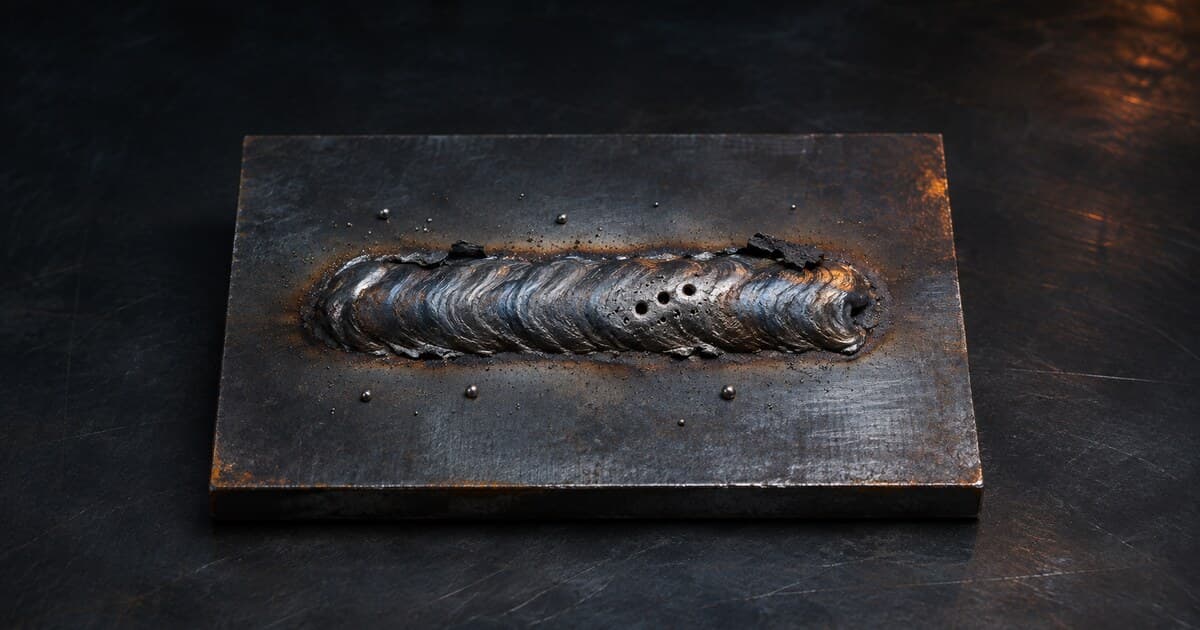
Flux-cored welding defects usually show up as porosity, slag inclusions, or spatter. Porosity is often caused by moisture, contaminants, or excessive wind, so those are the first things to check. A visible symptom is a clue, not a diagnosis, so confirm the process and wire type before you change any setting.
Confirm Whether the Wire Is Self-Shielded or Gas-Shielded
Start with the process. Self-shielded FCAW (FCAW-S) gets its shielding from the flux inside the wire. Gas-shielded FCAW (FCAW-G) adds an external shielding gas on top of the flux core, and it is often preferred in fabrication shops. Standards classify tubular cored wires both with and without a gas shield, so do not assume every flux-cored wire is gasless. The two processes need different checks, so read the wire's classification before you adjust anything.
| Item | FCAW-S (self-shielded) | FCAW-G (gas-shielded) |
|---|---|---|
| Shielding source | Flux core only | Flux core plus external gas |
| Gas equipment | None | Gas supply, regulator, and flow check |
| Main checks | Clean surface, wire storage, stick-out, drag angle | Gas flow and wind, plus the same surface and wire checks |
FCAW Porosity Causes and Fixes
In flux-cored welding, the joint, the wire, and the work area can each introduce pores. Start with the base metal. Clean the joint and keep it dry before you strike an arc, because contaminants and moisture are a common cause of porosity.
Wire condition matters too. Store flux-cored wire properly, and treat moisture as a possible cause when porosity appears after the wire has been left out. Gas-flow checks apply only where a shielding gas is used. A pore tells you porosity is present, not which cause is responsible, so work through the checks in order. The table below links common symptoms to causes and a first check.
| Symptom | Possible causes | First check |
|---|---|---|
| Pores or holes in the bead | Moisture or contamination on the joint | Clean and dry the joint; review wire storage |
| Pores when the shop has drafts | Excessive wind; reduced gas coverage on FCAW-G | Reduce drafts; check gas flow on FCAW-G |
| Pores after wire sat out | Moisture on or in the wire | Check storage; compare with fresh wire |
Slag Inclusions Between Passes
Slag is the residue that forms over each pass. In multipass flux-cored welding, remove it thoroughly after every pass. Slag inclusions can occur with insufficient cleaning between passes or an improper travel angle, so use the correct gun angle and a steady travel speed on each pass.
Use these steps between passes:
- Finish the pass and let the bead cool enough to handle.
- Chip off all slag with a chipping hammer before you weld over the bead.
- Check the bead edges for remaining slag, then start the next pass on clean metal.
Spatter, Stick-Out, and Wire Feed
Spatter is often linked to too much voltage or an incorrect stick-out. Keep stick-out inside the range listed on the wire's data sheet and in the WPS.
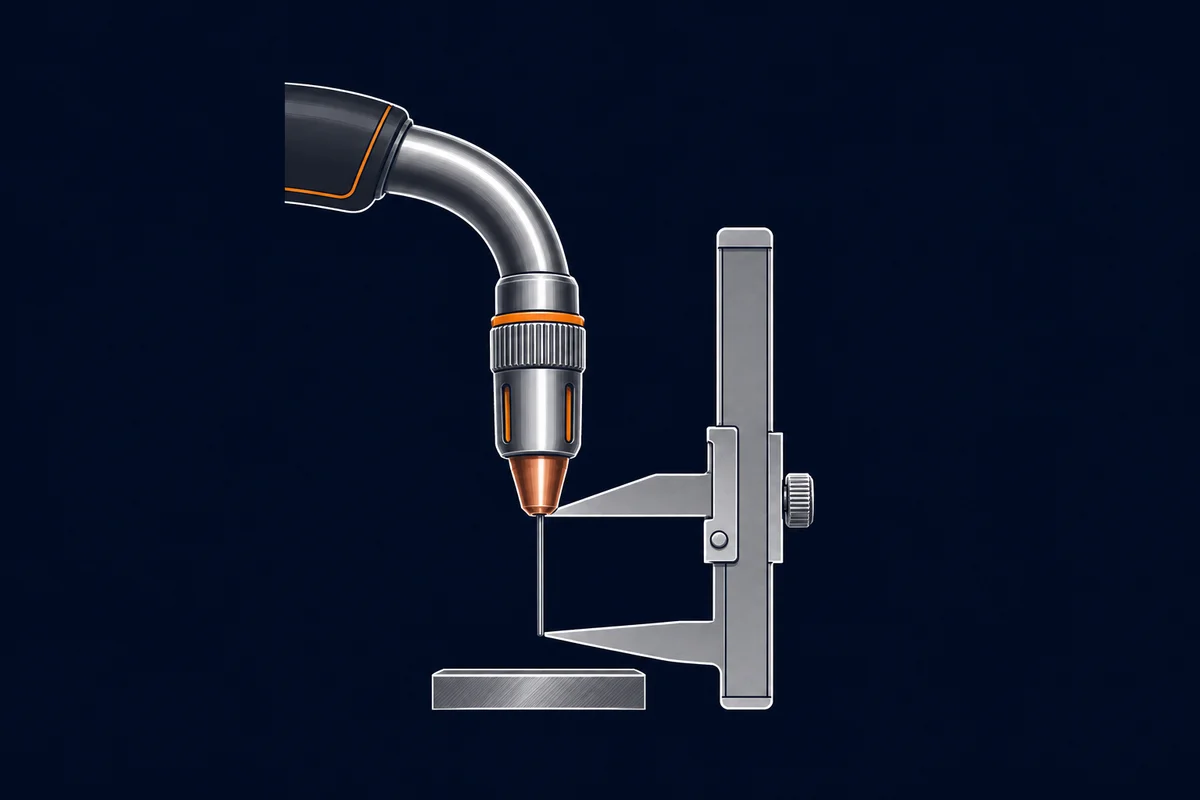
Stick-out and wire feed also work together. When stick-out is too short or wire feed is too slow, the wire can fuse to the contact tip. This condition is called burnback. If you see the wire sticking to the tip, check both the stick-out and the feed speed before changing anything else.
Balance voltage, wire feed, and travel speed as a set, and do not raise voltage to chase a feed problem. FCAW-G is associated with cleaner welds and less spatter than self-shielded work.
Polarity, Contact Tip Distance, and Drag Angle
Set polarity from the wire's data sheet and the WPS. Contact tip-to-work distance (CTWD) is a separate setting from stick-out. On a constant-voltage power supply, the type used for FCAW, changing CTWD has a large effect on amperage, so monitor it as you weld. For self-shielded flux-cored welding, keep a steady drag angle of 10 to 20 degrees, with the torch pointing back along the weld.
Wind and Shielding Gas Flow
Excessive wind is linked to porosity, so reduce drafts at the work area before you adjust the machine. Move fans, open doors, and other air sources away from the joint where you can. On FCAW-G, also check shielding gas flow as part of troubleshooting, and set the flow from the WPS and the manufacturer's wire documentation.
Fume Control and Breathing Protection
Flux-cored welding produces fume. Keep fume hoods, extractor guns, and vacuum nozzles close to the plume to remove the most fume and gases; local exhaust works best near the source.
Local exhaust ventilation comes first. If it cannot control exposure adequately, provide suitable respiratory protective equipment. If you feel dizzy or nauseated, or notice irritation, stop welding, leave for fresh air, and get medical attention right away.
A Test Sequence for Isolating the Cause
When a weld shows more than one defect, test on scrap in this order and change one variable per run:
- Process and wire classification.
- Joint cleanliness and wire storage.
- Wind and, on FCAW-G, shielding gas flow.
- Polarity, stick-out, CTWD, and drag angle.
- Voltage or wire feed, checked on a test coupon.
Record the setting and the result for each run, so you can see which change made the difference.
Inspection and Acceptance
Acceptance depends on the welding procedure and the inspection method it calls for. If the same defect returns after you have worked through the checks above, stop welding that joint and consult a qualified welding engineer or inspector.
Frequently asked questions
What stick-out should I start with?
A commonly cited starting range is 3/4 to 1 1/4 inch (19 to 32 mm). Treat it as a starting check; the wire's data sheet and the WPS set the value for your procedure.
Does moisture in flux-cored wire cause hydrogen cracking?
Moisture can add hydrogen to the weld metal. In one test with E71T-1 flux-cored wire, diffusible hydrogen rose as welding current increased. That test varied current, not moisture.
Does a clean-looking bead prove the weld is sound?
No. Surface appearance alone does not show internal soundness.
References
- Controlling Hazardous Fume and Gases during Welding - OSHA
- Welding fume: protect your workers - HSE
- Flux Cored Arc Welding: Principles, Applications, and Common Challenges - American Welding Society
- Flux Cored Arc Welding: What It Is, How It Works, and How to Fix Common Issues - American Welding Society
- Anatomy of a Welded Repair - American Welding Society
- Welding current effect on diffusible hydrogen content in flux cored arc weld metal - Journal of the Brazilian Society of Mechanical Sciences
- Arc Welding Reference - Kansas State University
- ISO 17632:2015 Welding consumables - Tubular cored electrodes - ISO