
Pulse MIG Welding Explained: When It's Worth It
Pulse MIG welding can help on thicker and out-of-position joints and where spray runs too hot. Learn when its cost and setup load are justified.

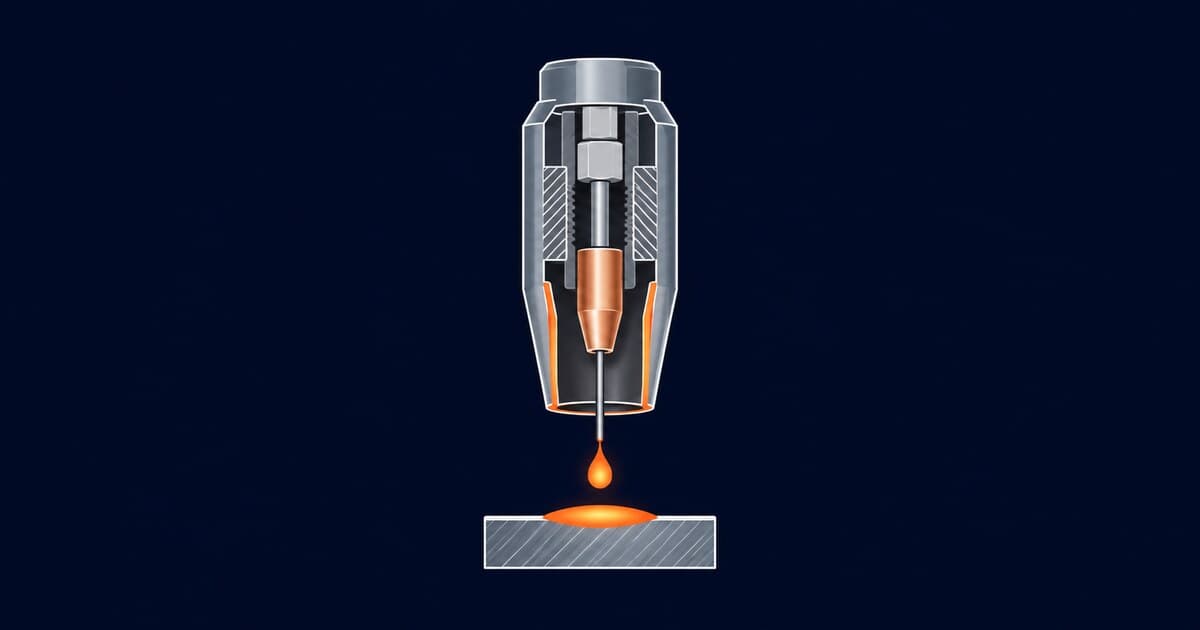
Pulse MIG welding can be worth the extra cost when the job needs lower arc energy than spray transfer, tighter control of spatter, or good deposition out of position. Aluminum needs its own test before you commit. On flat, high-current spray work, a spray-capable machine may already do the job, and the pulse feature adds cost without a clear gain.
How pulse MIG changes the arc
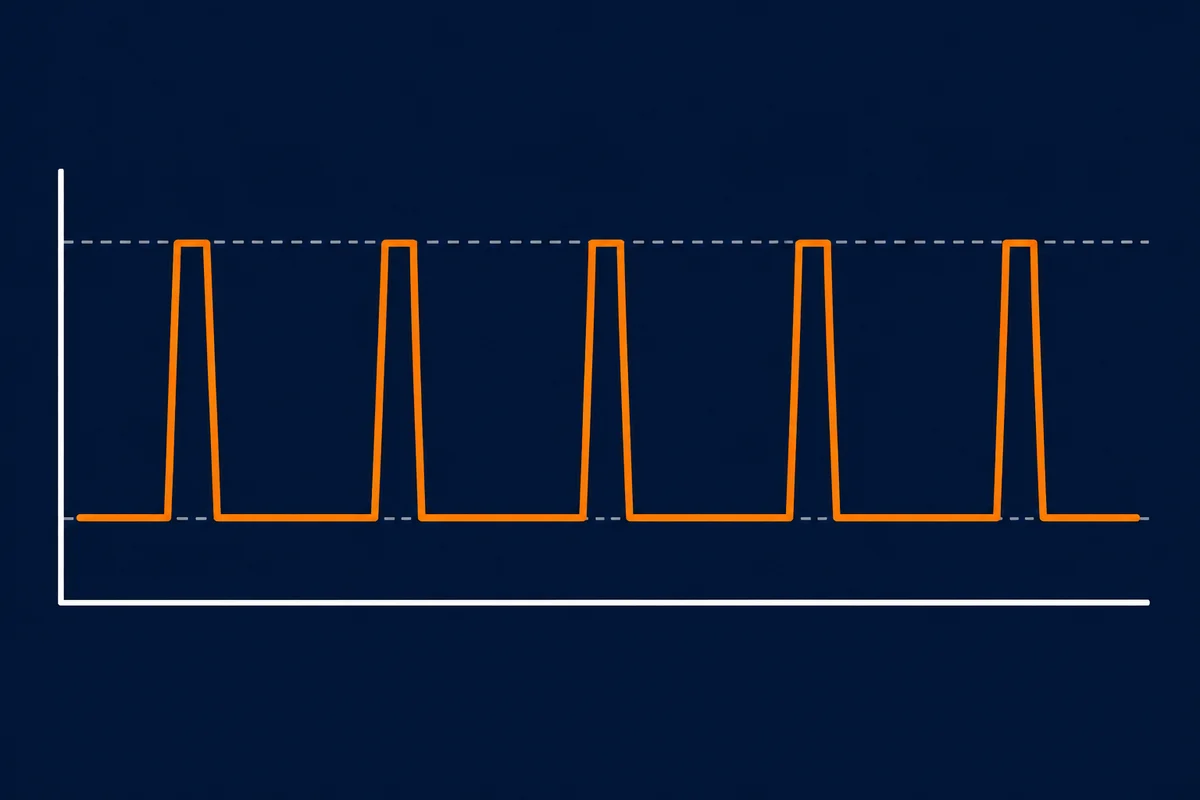
Pulse MIG, also called pulsed GMAW, switches the welding current between a high peak and a low base level. When the peak and base are set correctly, the process moves one droplet per pulse at a low average current. This one-drop-per-pulse mode gives stable, controllable droplet generation and reduced spatter.
The gain is most useful at average currents that are too low for spray transfer. At those currents, a pulsed arc produces smooth, low-spatter welding. Dip transfer at the same current is irregular and spatters.
The base current also matters. The droplet transfer frequency at the base current sets the lower limit of the one-drop-per-pulse region, and that limit applies to the pulse frequency. If the pulse frequency falls below it, droplets detach irregularly and the clean one-drop-per-pulse pattern is lost.
When pulse MIG welding is worth it: decision guide
| Situation | Decision | Details |
|---|---|---|
| Distortion-prone joint that spray overheats | Candidate; test first | Heat input and arc energy |
| Thicker section: needs more heat than dip gives, but spray runs too hot | Good candidate | Thicker sections and out-of-position work |
| Out-of-position joint | Good candidate; check deposition needs | Thicker sections and out-of-position work |
| Aluminum | Test on coupons before buying | Aluminum: test before you commit |
| Spatter-sensitive finish | Possible benefit; depends on voltage | Settings that decide the outcome |
| Flat, high-current spray work | Extra pulse feature may add little | Equipment cost and training load |
| Mixed shop with few pulse jobs | Weigh cost against use | Equipment cost and training load |
Heat input and arc energy
The average arc energy of a pulsed process is significantly lower than conventional axial spray transfer. That makes pulse worth a look on joints where spray puts in too much heat. For a first test, weld a coupon of the same material and thickness as the real joint, measure distortion across the seam, and compare it with the spray setting you would otherwise use.
Thicker sections and out-of-position work
Pulsed transfer is well suited to thicker sections where more heat is needed, but spray transfer is still too hot for the joint. Pulsed MIG also allows higher deposition rates in positions where dip or spray transfer cannot be used. Pulsed spray can be used in any position. Higher deposition rate does not mean faster travel on every joint, so judge the benefit on your own joint and bead size.
Aluminum: test before you commit
Pulse behavior on aluminum depends on the joint and on the production conditions. Judge it on test coupons made from your alloy, with your wire, gas and power source, and keep any result specific to that combination. Do not assume that a pulse setting that works on steel or stainless will carry over.
Settings that decide the outcome
Modern welding machines allow a wide range of pulse amplitudes, durations and waveforms, at frequencies from a few hertz to a few hundred hertz. More settings mean more to get right. Record the peak, base, frequency and voltage for each test so you can repeat a good result.
Voltage strongly affects both spatter and fume in pulsed welding, so it must be set to an optimum value. Voltage that is too low causes spatter, and voltage that is too high increases fume generation.
Equipment manufacturers claim significant reductions in spatter from improved control of the current profile. These are manufacturer claims, not independent measurements, so check them on your own joints before you count on them. The low-heat benefit reported for modern transfer modes also concerns developments of the short-circuit modes, not pulse alone.
Equipment cost and training load
Equipment cost rises from SMAW to GMAW and FCAW, and then to pulsed GMAW. The pulse feature is therefore a real cost step above standard GMAW, not a small add-on.
A major factor in choosing a MIG power source is the mode of metal transfer: dip, spray or pulsed. Check the machine's mode list before you plan pulse work.
Waveform, frequency and voltage all shape the result. Plan practice time on test coupons before you use pulse on production parts. If your current process already meets quality and output needs, the pulse feature has to earn its cost on a specific job.
Common mistakes
- Choosing pulse for every job. Keep conventional settings where spray or dip already meets quality and output needs.
- Treating pulse as a zero-spatter switch. Low voltage still causes spatter, and a pulse frequency below the one-drop limit brings back irregular transfer.
- Buying a machine without checking its mode list. A spray-only source cannot run a pulsed mode, however it is set.
Frequently asked questions
Can I run pulse MIG on a machine that only has a spray mode?
Not as a pulse. The machine needs a pulsed mode of its own, so check its mode list for dip, spray and pulsed before you plan pulse work. A major factor in choosing a MIG power source is the mode of metal transfer.
Is pulse MIG worth the price for a small shop?
It depends on how often the shop meets jobs where spray runs too hot or position limits deposition. Cost figures put pulsed GMAW above standard GMAW, so tie the purchase to specific jobs and get quotes for the machines you are considering.
References
- Effects of current on droplet generation and arc plasma in gas metal arc welding - Journal of Applied Physics
- Metal Transfer in Pulsed Current Gas Metal Arc Welding - Welding Research Supplement, American Welding Society
- Pulsed Power Welding to Reduce Welding Fumes - CDC/NIOSH
- Profiling Mild Steel Welding Processes to Reduce Fume Emissions and Costs in the Workplace - PubMed Central
- Advantages of pulsed MIG/MAG welds over conventional MIG/MAG - TWI
- How do I choose a suitable power source for MIG welding? - TWI
- MIG/MAG - Developments in Low Heat Input Transfer Modes - TWI