
Welding Respirators and Fume Extraction: What Works and When
Learn why fume extraction comes first, how N95 and P100 filters differ, when PAPRs apply, and which exposure limits matter to welders on the job.

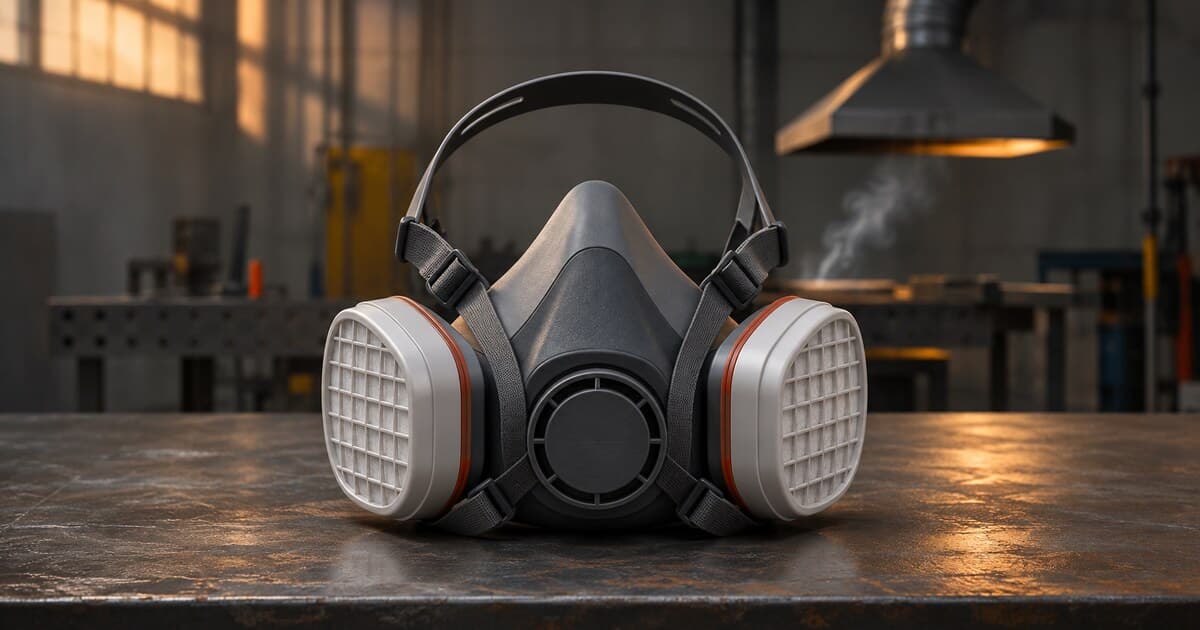
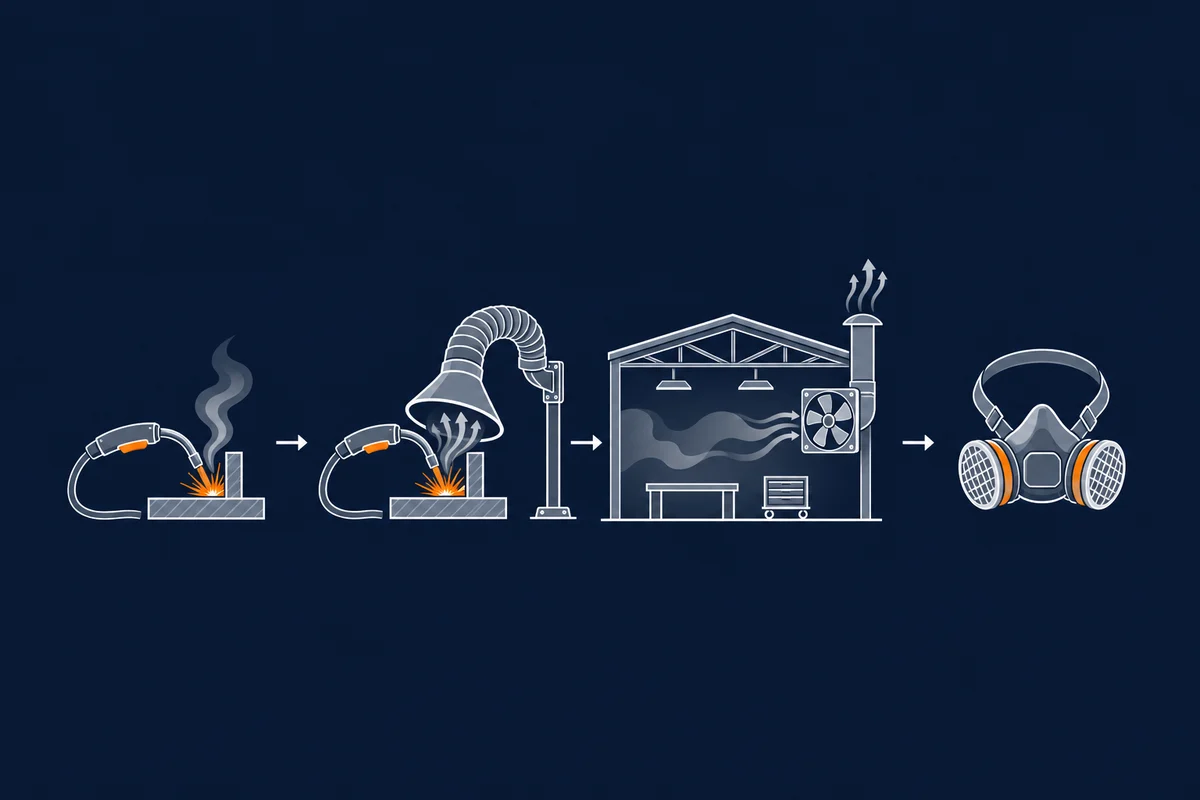
Welding respirators and fume extraction work together, but they are not equal. Fume should be captured at the source first, with local exhaust or on-torch extraction. A respirator is the backup for when those controls are not enough, and it has to match the hazard. Which controls you need also depends on the process, the base metal, and the space you work in, so the same respirator is not right for every job.
Welding Respirators and Fume Extraction: Controls Come First
Respirators are not the preferred way to lower exposure. Engineering and work practice controls are more reliable, so a respirator is not the first choice when a welder needs to get below an occupational exposure limit. The respirator covers the gap that remains.
Short, infrequent jobs are the exception. UK guidance says engineered fume controls are not normally expected for occasional welding that is done less than once a week and lasts less than an hour. In that narrow case it calls for respiratory protective equipment (RPE) together with good general ventilation.
Use this order when you plan a job:
- Identify the process, the base metal, any coatings, and the workspace.
- Put local exhaust or on-torch extraction as close to the arc as the work allows.
- Add general ventilation to handle what the local system does not capture.
- Choose a respirator for the hazard that is still left after steps 2 and 3.
Local Exhaust: Capturing Fume at the Source
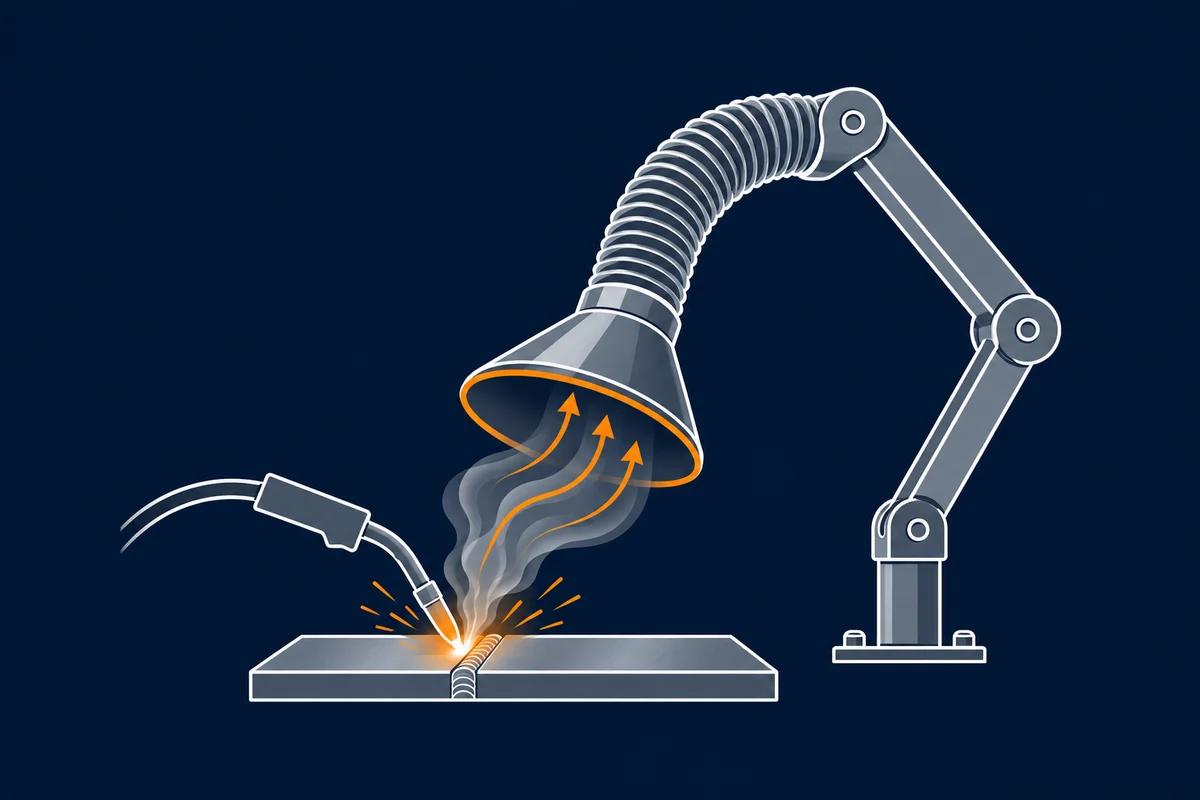
Local exhaust ventilation removes welding fume from the breathing zone at the source. The aim is to pull fume away before it reaches the welder's face. Portable or flexible exhaust hoods follow the same idea: they can be positioned so that fume and gases are drawn away from the welder.
Movable Hoods
A freely movable hood is one the welder places by hand. The U.S. welding standard calls for placing it as near as practicable to the work. It also calls for enough airflow to keep 100 linear feet per minute toward the hood in the welding zone, with the hood at its most remote distance from the point of welding. That figure belongs to movable hoods in that standard. It is not a general setting for every extraction system, and it does not transfer to on-torch or downdraft setups.
On-Torch Extraction and Downdraft Tables
Each setup is judged differently, so compare them side by side before you choose one.
| Setup | What the guidance says | Note |
|---|---|---|
| On-torch extraction | UK guidance calls it the most effective fume control for MIG welding when set up and used correctly. | Check total volumetric flow against the manufacturer's recommendations. |
| Downdraft welding table | One university shop-safety instruction specifies 150 cubic feet per minute per square foot of table surface area. | That is one institution's rule, not a universal design figure. |
| Movable hood | Place it as near the work as practicable, with airflow toward the hood. | See Movable Hoods. |
Downdraft tables are popular in Europe, but the same university instruction describes them as used to a limited degree in North America. Because the airflow figure scales with surface area, work out the total required flow for your own table before you assume it captures enough.
Keeping Extraction Working
Extraction needs regular checks, not only a good setup. UK rules require local exhaust ventilation to be thoroughly examined and tested at least every 14 months. That interval comes from UK rules and does not apply automatically in the U.S.
The test method depends on the system. Capture velocity measurement is not appropriate for testing on-torch extraction, which is why total volumetric flow can be checked against the manufacturer's recommendations instead.
Respirator Types: Particles Versus Gases
The first question about a respirator is not the brand or the price. It is whether the hazard is particles, gases, vapors, or both. A filtering facepiece respirator protects against particles, but not gases or vapors. Using one against a gas hazard leaves the welder unprotected even if the fit is perfect.
N95 and P100 Filters
N95 and P100 are particle filter classes. The number is the minimum share of airborne particles the filter must capture.
| Class | Minimum particle filtration | Gas or vapor protection |
|---|---|---|
| N95 | At least 95% | None |
| P100 | At least 99.97% | None |
| Filtering facepiece respirator (any class) | Particles only | None |
A higher number means a higher particle filtration level, nothing more. It does not tell you whether the mask suits your job, so confirm the gas side separately.
Powered Air-Purifying Respirators
A powered air-purifying respirator, or PAPR, uses a battery-powered blower to pull air through attached filters or cartridges. The cleaned air is then delivered to the wearer's breathing zone. Filters handle particles, and cartridges handle gases or vapors.
The blower alone does not solve the problem. The filter or cartridge you attach still has to match the hazard, and the powered design does not change which class of contaminant it removes.
Checking the Approval
A respirator's approval number can be checked against the NIOSH Certified Equipment List. Look up the number before you buy or sign off on a respirator, and confirm the model, not just the brand name on the box.
Fume Hazards by Process and Metal
The fume you breathe depends on what you weld and what the metal is coated with. Process, base metal, and coatings each change the hazard, so treat them as separate questions.
MIG and TIG: Ozone, Especially on Aluminum
MIG and TIG welding produce the most ozone among the common processes, and the amount rises most when aluminum is welded. Ozone is a gas, so it belongs on the gas side of respirator selection. Local exhaust that removes fume at the arc is the first control to check on aluminum work.
Stainless Steel and Hexavalent Chromium
Stainless steel welding can release hexavalent chromium, or Cr(VI). In one study, Cr(VI) was measured during shielded metal arc welding (SMAW), flux-cored arc welding, and gas metal arc welding (GMAW) of stainless steel. Fume generation was highest for SMAW, and all the GMAW modes tested substantially reduced fume, Cr(VI), and manganese relative to SMAW. Those are results under the tested conditions, not a safety rating for every setup.
Galvanized Metal
Welding galvanized metal can create a different fume. When the coating is heated enough to vaporize the zinc, the fume is high in zinc oxide. Inhaling that fume can cause metal fume fever, so treat galvanized work as a separate hazard even when the process is one you already know.
Confined Spaces and Manganese
Confined space welding can significantly increase exposure to manganese fumes. Plan extraction and respiratory protection for the space itself.
Exposure Limits: Table Z-1, Cr(VI), and Manganese
Exposure limits set the target that controls and respirators have to meet. In the U.S. Table Z-1 system, a limit with a "C" in front of it is a ceiling value. A limit without a "C" is an 8-hour time-weighted average, calculated over a shift of a 40-hour work week.
The specific limits you will see most often in welding work are these:
| Substance | Limit | Basis |
|---|---|---|
| Hexavalent chromium (Cr(VI)) | Permissible exposure limit of 5 µg/m³ | 8-hour time-weighted average |
| Cr(VI) action level | 2.5 µg/m³ | 8-hour time-weighted average |
| Manganese | Recommended exposure limit of 1 mg/m³ | 8-hour time-weighted average |
| Manganese | Recommended short-term limit of 3 mg/m³ | Short-term (STEL) |
The Cr(VI) figures are enforceable limits in U.S. general industry. The manganese figures are recommended limits, so they set a target for good practice rather than a legal ceiling. Check which kind applies to your job before you compare a measurement against the table.
Fit Testing and the Written Respiratory Program
Where respirators are required, U.S. rules require a written, worksite-specific respiratory protection program. The program states how respirators are chosen, how workers are trained, and how the equipment is maintained. Without it, nothing keeps the protection working from one shift to the next.
A fit test is a separate check. It confirms that a particular respirator seals against a particular worker's face. The program should name who performs fit tests and how often, using the testing methods the rules allow. A respirator that looks like it fits is not a substitute for the test.
Common Mistakes
Each of these errors leaves a welder less protected than they think.
- Changing a cartridge by smell. Odor thresholds and other warning properties cannot be the main basis for deciding when a gas or vapor cartridge or canister must be replaced. A welder who waits until they smell fumes may already be past the cartridge's useful life.
- Treating a seal check as a fit test. A user seal check helps the wearer confirm the mask is sealed, but it does not replace a qualitative or quantitative fit test. Both are needed; the seal check is only a quick check during use.
- Applying the 100 feet per minute figure to every hood. Using the flow figure from one hood type for another gives a false sense of capture.
When to Consult a Specialist
Get a qualified safety professional involved when the job falls outside a simple open-bay setup. That includes confined spaces, work with Cr(VI) or manganese where you need to know the actual exposure, and any question about whether a local exhaust system is working. A professional can also help you set up the written respiratory program and the fit testing that go with it.
If a welder develops breathing problems or other symptoms after welding, stop the work and seek medical advice. Tell the clinician that you weld and which metals and coatings you work with, because that history changes what they look for.
References
- Welding (OSHA Fact Sheet FS-3647) - Occupational Safety and Health Administration
- Filtering Facepiece Respirators - CDC NIOSH
- NIOSH Publication No. 2018-176 - CDC NIOSH
- 29 CFR 1910.134 Respiratory protection - Occupational Safety and Health Administration
- 29 CFR 1910.134 Appendix B - Occupational Safety and Health Administration
- 29 CFR 1910.1000 Air contaminants - Occupational Safety and Health Administration
- 29 CFR 1910.1026 Chromium (VI) - Occupational Safety and Health Administration
- Welding Fumes and Manganese - CDC NIOSH
- Profiling stainless steel welding processes to reduce fume emissions, hexavalent chromium emissions and operating costs in the workplace - PubMed Central
- Welding Fumes and Gases: Hazard Alert - CDC
- Health Effects of Welding - CDC NIOSH, 2003
- 29 CFR 1910.252 Welding, cutting and brazing - Occupational Safety and Health Administration
- Controlling the risks from welding - Health and Safety Executive
- Shop Safety Instructions - University of Washington
- Guidance document WL3 (welding fume controls) - Health and Safety Executive
- Maintenance, examination and testing of LEV and RPE - Health and Safety Executive
- Respiratory Protection eTool - Occupational Safety and Health Administration
- OSHA Technical Manual (OTM) Section VIII: Chapter 2 - Occupational Safety and Health Administration