
Preheating and Interpass Temperature Control Guide
Learn how preheat and interpass temperature welding limits work: why steel is preheated, how minimums are set, where maximums apply, and how to measure them.

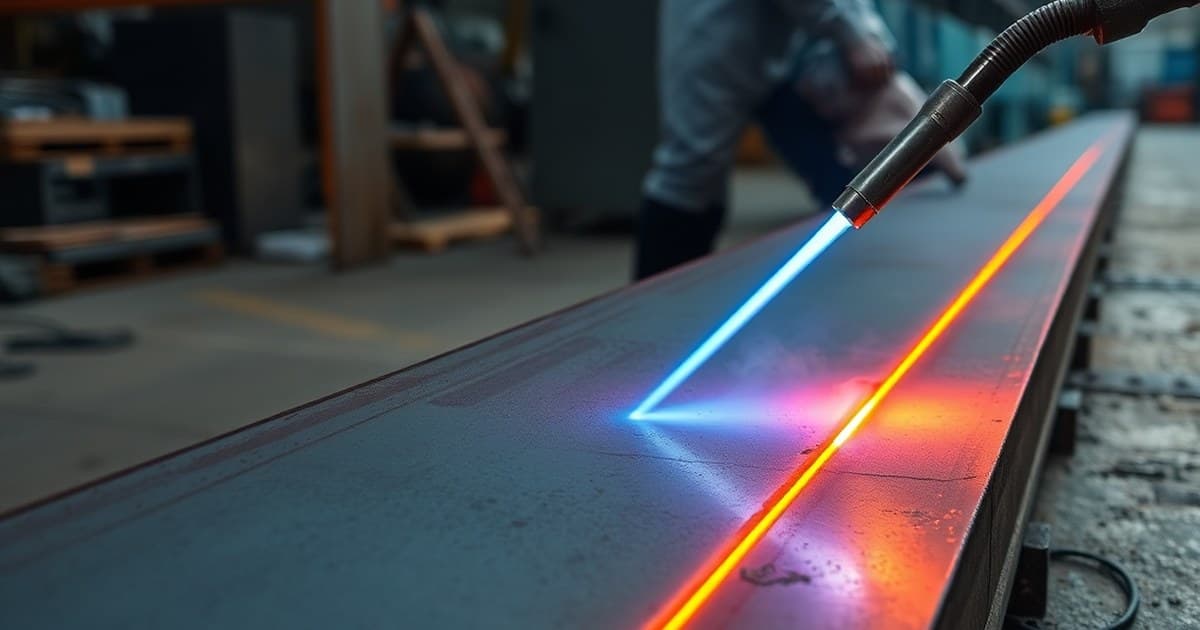
Two numbers on a welding procedure decide whether a thick or hardenable joint comes out sound or cracks a day later: the temperature the metal must reach before the arc starts, and the temperature it must not exceed between passes. Getting preheat interpass temperature welding rules right is less about memorising a table and more about understanding what the heat is doing to the joint. Once that logic is clear, the numbers on a procedure stop looking arbitrary.
This guide explains why preheat exists, how a minimum value is chosen, why a maximum interpass limit matters just as much for stainless steels and tough structural steels, and how to measure and hold temperatures on the shop floor. It builds on the ideas in welding metallurgy and on the thermal cycle that shapes the heat-affected zone (HAZ), so a quick look at those topics helps if the terminology is new.
Preheat vs interpass temperature: the basic definitions
The two terms are often used interchangeably on the shop floor, but they describe different moments in the weld.
- Preheat temperature is the temperature of the base metal in the zone around the joint immediately before welding starts.
- Interpass temperature is the temperature of the weld area (weld metal and adjacent base metal) immediately before the next pass is laid over the previous one.
- Minimum interpass temperature is commonly set equal to the minimum preheat, so the joint never cools below the preheat level during welding.
- Maximum interpass temperature is a separate upper limit, used to protect toughness or corrosion resistance.
Both are normally written into the welding procedure specification, so the welder and inspector can check them against a defined value rather than a feeling. A short way to remember it: preheat and minimum interpass guard against cracking, while maximum interpass guards against degraded properties.
Why preheating works
Welding puts a very concentrated heat source on a large cold mass of steel. The surrounding metal pulls heat away fast, so the weld and the HAZ cool quickly. In steels that can harden, a fast cooling rate produces hard, brittle microstructures in the HAZ. Preheating raises the starting temperature of the whole region, which slows the cooling rate and softens that outcome.
Slower cooling means a less brittle HAZ
When the HAZ cools more slowly, less of it transforms into hard, crack-prone constituents. This is the same reasoning that applies to high heat input: more heat per unit length also slows cooling. Preheat and heat input are therefore partly interchangeable levers, though they are not equivalent, and procedures usually set both.
More time for hydrogen to escape
The second benefit is arguably more important in practice. Hydrogen enters the weld pool from moisture, contamination and some consumables, then diffuses into the HAZ as the joint cools. In a hard microstructure under residual stress, that hydrogen can produce cold cracking, sometimes called hydrogen-assisted or delayed cracking.
Three conditions have to coincide for it to happen:
- A susceptible, hardened microstructure.
- Enough diffusible hydrogen.
- Tensile stress, from restraint and cooling shrinkage.
Remove any one of the three and the risk falls sharply. Preheat helps with the first and with the second, because a warmer joint lets hydrogen diffuse out rather than concentrate in a hard zone. Technical guidance from TWI notes that preheat can need to be as high as 200°C for thick sections of steel with a high carbon equivalent, and that holding heat for roughly two to four hours after welding may be advised depending on crack sensitivity.
Drying the joint
Preheat also drives off surface moisture and condensation. This is a modest effect compared with the metallurgical ones, but on cold, damp days in the field it is real, and it is one reason some procedures call for warming even thin material when it is below a certain ambient temperature.
Which materials usually need preheat
Preheat is most associated with carbon, carbon-manganese and low-alloy steels, but whether a given joint needs it depends on several factors acting together rather than on the material name alone.
| Factor | Higher preheat tendency | Lower preheat tendency |
|---|---|---|
| Steel composition (carbon equivalent) | High carbon, alloy content | Low carbon, clean steels |
| Thickness | Thick or combined thickness large | Thin sections |
| Filler diffusible hydrogen | Higher hydrogen consumables | Low-hydrogen consumables |
| Restraint | Rigid, heavily restrained joint | Free-moving joint |
| Heat input | Low heat input, fast cooling | High heat input, slower cooling |
| Ambient temperature | Cold, damp conditions | Warm, dry conditions |
Typical candidates for preheating include:
- Structural steels at larger thicknesses
- Quenched and tempered steels
- Chromium-molybdenum steels used in pressure equipment
- Tool steels and some cast irons
- Repair welds on heavily restrained components
Thin mild steel sheet normally needs none, while austenitic stainless steels are generally not preheated, for reasons covered below.
How preheat requirements are determined
There is no single universal preheat temperature. The value on a procedure comes from one of a small number of approaches.
Prequalified tables
For structural steel work in North America, many fabricators use the prequalified minimum preheat and interpass table in AWS D1.1 (Table 5.8). It groups common structural steels into categories, with the lower categories used with non-low-hydrogen electrodes and the higher-strength categories requiring low-hydrogen consumables. The advantage is simplicity: a fabricator following the table can use prequalified procedures and avoid separate procedure qualification testing.
The cost of simplicity is conservatism. The table is built around a worst-case view of composition, hydrogen level and other variables, so it can demand more preheat than a specific joint truly needs.
Calculated methods
The alternative is to calculate preheat from the actual conditions. AWS D1.1 Annex B provides guidelines for this, offering a hydrogen control method and a HAZ hardness control method limited to fillet welds. AWS D14.8M, which is identical to ISO/TR 17844, sets out four methods for avoiding cold cracks, three of them based on European and Japanese approaches and one based on the D1.1 annex.
These methods generally take into account:
- Steel composition, expressed through a carbon equivalent or a similar index
- Combined joint thickness or plate thickness
- Diffusible hydrogen level of the filler metal, such as the H4, H8 and H16 designations
- Heat input
- An assumed level of restraint
Used with modern, cleaner low-carbon steels and low-hydrogen filler metals, calculated methods can give meaningfully lower preheat than a table, which saves fuel, labour and time. The catch is that using values below the prequalified table generally means the procedure must be supported by qualification testing under the applicable code.
Carbon equivalent in plain terms
Carbon equivalent (CE) condenses the effect of alloying elements on hardenability into a single number. One widely used form is the IIW formula:
CE = C + Mn/6 + (Cr + Mo + V)/5 + (Ni + Cu)/15
A higher CE means the steel hardens more readily and tolerates less aggressive cooling. It is a screening index, not a complete answer: different standards use different formulas, and the numerical thresholds differ between methods. Always use the formula specified by the code or procedure you are following.
Heat input and efficiency
Heat input is calculated from arc voltage, current and travel speed. When applying cold-cracking methods, an arc efficiency factor is often applied. AWS guidance cites 0.8 for SMAW, FCAW and GMAW, 0.6 for gas tungsten and plasma arc welding, and 1.0 for submerged arc welding, referring to EN 1011-1 for background. Using the wrong factor shifts the calculated preheat, so confirm which convention the method you use expects.
Interpass temperature: minimum and maximum
The minimum
Minimum interpass temperature keeps the benefits of preheat alive through a multipass weld. If a thick joint is allowed to cool below the preheat level between passes, the earlier hydrogen-protection logic is lost. On long welds with many passes, especially when work stops overnight, the joint should be re-heated to the required level before welding resumes.
The maximum
A maximum is set because heat accumulates. If passes are laid too quickly, the joint gets progressively hotter, and the weld metal and HAZ experience slower cooling and longer time at high temperature. Depending on the material, that can cause:
- Loss of notch toughness in structural and low-alloy steels, through coarser microstructure
- Loss of strength in quenched and tempered steels, which depend on controlled cooling to keep their properties
- Sensitization in austenitic stainless steels
- Unwanted phase balance and brittle phases in duplex grades
The maximum is the reason an apparently harmless habit, welding continuously to "keep the joint warm", can quietly undermine a procedure.
Stainless steels: why the logic flips
For austenitic stainless steels, preheating is generally not used, and the interpass limit is a maximum. The reason is sensitization. Chromium carbides tend to precipitate at grain boundaries when the steel spends time in roughly the 950 to 1450°F range (about 510 to 790°C), leaving chromium-depleted zones that corrode preferentially. Welding, stress relief and hot forming can all expose the steel to that range.
Three practical defences are widely recognised:
- Solution annealing after fabrication, followed by rapid cooling, which dissolves the carbides.
- Low-carbon grades such as 304L and 316L, with carbon below about 0.03%, which are designed to resist sensitization during typical welding but not during long service exposure in the critical range.
- Stabilised grades such as 321 and 347, in which titanium or niobium ties up the carbon.
Controlling heat input and keeping interpass temperature down limits the time the HAZ spends in the sensitizing range. A commonly quoted general limit for austenitic grades is around 150°C, but the actual value should come from the procedure or the material supplier's data for the specific alloy.
Duplex stainless steels add another constraint. Their properties rely on a balanced mix of ferrite and austenite, and excessive heat build-up can upset that balance or encourage brittle phases. As a general guideline, the International Molybdenum Association gives a maximum interpass temperature of 150°C for lean and standard duplex grades, with the point that heat buildup affects HAZ cooling. Super duplex and other highly alloyed grades are often held to stricter limits, so the producer's guidance for the specific alloy must be followed.
Measuring and controlling temperature in practice
A value on paper is useless unless someone can verify it. Three questions matter: where to measure, with what, and when.
Where to measure
Measure on the base metal at the position specified by the procedure or the governing standard, usually at a defined distance from the joint edge and often on the face opposite the heat source for thick sections, so the through-thickness temperature has equalised. Measuring right at the weld edge gives a misleadingly high reading because the surface heats faster than the interior.
Measurement tools
- Temperature-indicating crayons and paints melt or change at a calibrated temperature. They are cheap and give a clear pass/fail at a specific value, but they only indicate that a threshold was crossed.
- Contact pyrometers and surface thermocouples give a direct reading and are suitable for most shop work.
- Infrared thermometers are fast, but readings depend on surface emissivity, so bright or oxidised surfaces can read incorrectly. Calibrate or verify against a contact method before relying on them for acceptance.
- Attached thermocouples with recorders are used on critical or long-duration heat treatments where a continuous record is required.
Heating methods
Preheat is applied by fuel-gas torches or burners, electrical resistance heating blankets, or induction heating. Each has trade-offs.
| Method | Strengths | Watch-outs |
|---|---|---|
| Torches and burners | Portable, quick for small jobs | Uneven heating, local overheating, combustion moisture on cold surfaces |
| Resistance heating | Controlled, repeatable, suited to long holds | Setup time, needs insulation |
| Induction | Fast and efficient on thick sections | Equipment cost, coil placement |
Whatever the method, heat the part gradually and evenly, then allow time for the temperature to soak through the thickness before welding. Heating only the surface and starting immediately is a classic way to meet the number on the gauge while missing the intent.
Holding temperature and slow cooling
For susceptible materials, procedures may require holding the joint at temperature after welding (a hydrogen release or soak) or insulating it for slow cooling. This extends the time hydrogen has to diffuse out and avoids a sudden thermal shock. Where heavy sections or high-strength steels are involved, this step is not optional decoration; it is part of the cracking-avoidance strategy.
A hypothetical example
The following is a hypothetical illustration of the reasoning, not a recommended procedure and not a real case.
Imagine a thick, restrained joint in a medium-strength structural steel. Welded with a high-hydrogen electrode on a cold morning, the joint combines a hard HAZ, plenty of diffusible hydrogen and high restraint. All three crack conditions are present. The fabricator could reduce risk by switching to a low-hydrogen consumable, storing and handling it correctly, applying preheat at the level the procedure specifies, maintaining it as the minimum interpass temperature, and allowing a post-weld hold.
Notice that no single measure is the "fix". Each one removes part of the risk, and together they push the joint out of the cracking zone. Specific temperatures would come from the code and the qualified procedure, not from an example like this.
Common mistakes
- Treating a single number as universal. Preheat depends on steel, thickness, hydrogen, restraint and heat input together.
- Measuring in the wrong place. Reading the surface right next to the torch overstates the through-thickness temperature.
- Letting the joint cool between passes or overnight without re-establishing the minimum.
- Ignoring the maximum. Hot joints on stainless and tough structural steels can lose the properties the procedure was designed to protect.
- Forgetting consumable condition. Damp or poorly stored low-hydrogen electrodes undo much of the protection preheat provides.
- Trusting uncalibrated instruments, especially infrared readers on reflective surfaces.
- Copying a preheat from a different job without checking composition, thickness and process.
- Skipping the delay before inspection on susceptible steels, since hydrogen cracks can appear well after welding.
Safety considerations
Preheated material is a burn hazard long after the arc stops. Mark hot parts clearly, use appropriate gloves and heat-resistant clothing, and keep flammable materials away from torches and heating equipment. Fuel-gas heating adds its own risks, including leaks, flashback and combustion products in confined spaces, so ventilation and gas-handling rules apply. Follow your employer's procedures and the equipment manufacturer's instructions.
Practical checklist before welding
- Procedure states minimum preheat, minimum interpass and, where relevant, maximum interpass
- Steel grade, thickness and filler match the qualified procedure
- Low-hydrogen consumables stored and handled as required
- Heating method chosen and temperature-measuring device verified
- Measurement position defined and understood by the welder
- Plan in place for interruptions, overnight holds and post-weld hold or slow cooling
- Inspection delay observed for susceptible steels
Conclusion
Preheat and interpass temperature control is a form of thermal management: slow the cooling where the steel is crack-prone, give hydrogen time to leave, and avoid letting heat accumulate where it would damage toughness or corrosion resistance. The right numbers come from the code, the material and a qualified procedure, not from rules of thumb.
If you remember one thing, make it this: minimum values protect against cracking, maximum values protect the properties you paid for. Read both on the procedure, measure them where the procedure says, and treat deviations as a reason to stop and ask rather than to improvise.
Frequently asked questions
What is the difference between preheat and interpass temperature?
Preheat is the base-metal temperature immediately before welding begins. Interpass temperature is the temperature of the weld area immediately before the next pass is deposited. Procedures usually set a minimum for both and sometimes a maximum interpass limit.
Why is preheating necessary when welding steel?
Preheating slows the cooling rate, which reduces the formation of hard, brittle structures in the heat-affected zone, and it gives diffusible hydrogen more time to escape. Both effects lower the risk of cold cracking in susceptible steels.
Do all steels need preheating?
No. Thin sections of low-carbon steel often need none, while thick, high-carbon-equivalent or highly restrained joints may need significant preheat. Whether preheat is required depends on composition, thickness, hydrogen level, restraint and heat input together.
How do I know what preheat temperature to use?
Use the temperature given in your qualified welding procedure. That value normally comes from a code table such as the prequalified table in AWS D1.1, or from a calculated method such as AWS D1.1 Annex B or AWS D14.8M, supported by qualification where required.
Is a higher preheat always safer?
Not necessarily. Excessive preheat or heat build-up can reduce toughness, soften heat-treated steels, make the work uncomfortable and unsafe to handle, and in some alloys trigger unwanted metallurgical changes. Use the value the procedure specifies, not the highest value you can reach.
Do stainless steels need preheating?
Austenitic stainless steels are generally not preheated, and a maximum interpass temperature is used instead to limit time in the sensitizing range. Duplex grades also have a maximum interpass limit. Follow the procedure and the material producer's guidance.
What maximum interpass temperature applies to duplex stainless steel?
The International Molybdenum Association gives 150°C as a general maximum for lean and standard duplex grades. Highly alloyed duplex grades are often held to stricter limits, so check the guidance for the specific alloy.
Where should I measure preheat temperature?
Measure on the base metal at the location the procedure or standard specifies, usually a set distance from the joint. For thick sections, allow time for the temperature to equalise through the thickness before welding, rather than trusting a reading taken straight after heating.
Can I use an infrared thermometer to check preheat?
You can, but with care. Infrared readings depend on surface emissivity, so shiny or oxidised surfaces may read wrongly. Verify the instrument against a contact method or crayon before using it for acceptance checks.
What happens if the joint cools below the minimum between passes?
The cracking protection that preheat provides is reduced. The joint should be reheated to the required temperature before welding continues, and the interruption should be handled according to the procedure and quality system.
How long should I wait before inspecting a weld on crack-sensitive steel?
Hydrogen cracking can be delayed, so many codes and specifications require a hold time before final non-destructive testing of susceptible materials. The required delay depends on the steel grade and thickness and is set by the applicable code or specification.
References
- Alternative Methods for Determining Preheat and Interpass Temperatures - American Welding Society, Welding Digest, June 2025. AWS D1.1 Table 5.8 and Annex B, AWS D14.8M methods, arc efficiency factors.
- Defects / Hydrogen Cracks in Steels - Prevention and Best Practice - TWI Global, accessed 2026-10-21. Preheat levels for high carbon equivalent thick sections and post-weld heat retention.
- Defects / Hydrogen Cracks in Steels - Identification - TWI Global, accessed 2026-10-21. Hydrogen cracks in the heat-affected zone of steels.
- Intergranular Corrosion - Specialty Steel Industry of North America, accessed 2026-10-21. Sensitization range, low-carbon and stabilised austenitic grades.
- Welding parameters for duplex stainless steels - International Molybdenum Association, accessed 2026-10-21. General interpass temperature guideline for lean and standard duplex grades.