
Welding Metallurgy Basics
Learn welding metallurgy basics: heat input, the heat-affected zone, phase changes, hydrogen cracking, preheat, and how to control weld quality.

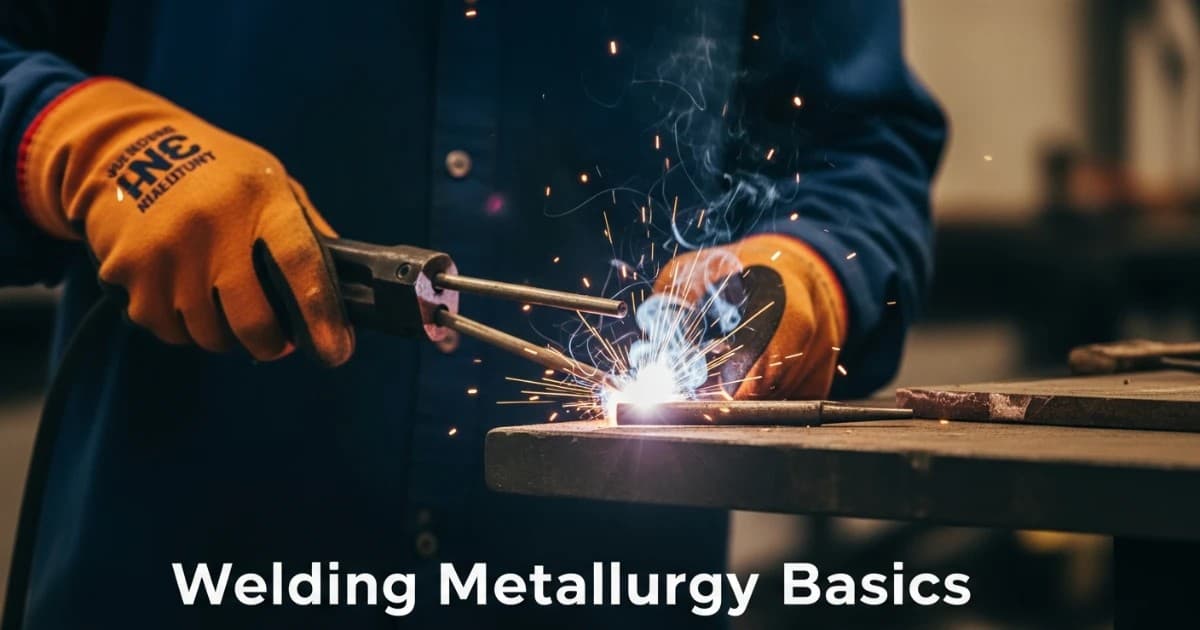
Every weld you make is a small, fast, and violent metallurgical experiment. In a few seconds, you melt metal, mix it with filler, and cool it hundreds of times faster than any steel mill would dare. Understanding welding metallurgy — what actually happens inside the metal during that process — is what separates a welder who can pass a bend test from one who understands why the test passed, and can predict when it won't.
You don't need a materials science degree to weld well. But you do need a working grasp of a handful of ideas: heat input, the heat-affected zone, cooling rate, hardness versus toughness, and the main cracking mechanisms. Those few concepts explain most weld failures you will ever see, and they explain almost every rule in a welding procedure specification. This guide covers them in practical terms, focused on what changes your day-to-day decisions at the machine.
What Welding Metallurgy Is, and Why It Matters
Welding metallurgy is the study of how the heat of welding changes the structure and properties of metal — in the weld itself and in the surrounding base material. The chemistry of a plate doesn't change much when you weld it, but its microstructure (the internal arrangement of grains and phases) can change dramatically. And microstructure, not chemistry alone, determines strength, hardness, toughness, and cracking resistance.
This matters for a simple reason: most weld failures are metallurgical failures. Cold cracks, hot cracks, brittle fracture in the heat-affected zone, softened aluminum joints that fail beside a perfect-looking bead — none of these are caused by poor bead appearance. They are caused by what happened inside the metal while it was heating and cooling. A welder who understands the mechanisms can prevent them; one who doesn't can only follow rules without knowing which rules are safe to bend.
There's a second, more practical payoff. Every line in a welding procedure — the preheat temperature, the maximum interpass temperature, the required electrode class, the heat input limits — exists because of a metallurgical mechanism. When you know the mechanism, procedures stop feeling arbitrary and start making sense.
The Three Zones of Every Weld
Every fusion weld has three distinct regions, and each behaves differently.
- The fusion zone (weld metal) is the material that actually melted — a mixture of filler metal and melted base metal. It solidifies like a tiny casting, growing crystals inward from the colder edges toward the center of the pool.
- The heat-affected zone (HAZ) is base metal that never melted but got hot enough for its microstructure to change. This is where many of the worst problems live.
- The unaffected base metal stayed cool enough to keep its original structure and properties. The fusion zone gets the attention because you can see it. The HAZ deserves at least as much, because you can't. It is invisible to the eye, its properties can differ sharply from both the weld and the base plate, and it is the preferred home of hydrogen cracking, brittleness, and softening.
How the weld pool solidifies
Weld metal solidifies fast and directionally. Crystals nucleate on the partially melted grains at the fusion boundary and grow toward the centerline of the bead. As they grow, elements that don't fit well in the solidifying crystal — sulfur and phosphorus in steel, certain alloy combinations in aluminum — get pushed ahead of the solidification front and concentrate in the last liquid to freeze, right at the centerline.
That segregation is why centerline cracking exists, and it's why weld bead shape matters metallurgically, not just cosmetically. A deep, narrow bead makes the growing crystals meet head-on at the centerline where the impurity-rich liquid is trapped, which raises cracking risk. A width-to-depth ratio somewhere around 1:1 to 1.4:1 is a common rule of thumb for crack-resistant beads in susceptible materials.
Heat Input: The Master Variable
If you remember one equation from welding metallurgy, make it this one:
Heat input (kJ/mm) = (Volts × Amps × 60) / (Travel speed in mm/min × 1000)
Heat input controls the cooling rate of the weld and HAZ, and cooling rate controls the microstructure. That single chain — parameters → heat input → cooling rate → microstructure → properties — is the backbone of practical welding metallurgy.
Both extremes cause trouble:
- Too much heat input slows cooling and lets grains in the HAZ grow large. Coarse grains reduce toughness, especially at low service temperatures. High heat input also widens the HAZ and increases distortion. Quenched-and-tempered and thermo-mechanically rolled steels are particularly sensitive, because excess heat effectively undoes the careful processing that gave them their properties.
- Too little heat input speeds cooling. In hardenable steels, fast cooling produces hard, brittle microstructures (more on martensite below) and raises cracking risk. Very low heat input can also cause lack-of-fusion defects because there simply isn't enough energy to melt the joint properly. The thickness of the part matters as much as the parameters. Thick plate is a huge heat sink: it pulls heat out of the weld area quickly, so the same amps and volts that run fine on 6 mm plate can produce a dangerously fast quench on 50 mm plate. This is one of the main reasons preheat requirements increase with thickness.
What Happens Inside Steel: Phase Transformations
Steel is the most common material welders work with, and it has a personality quirk that dominates its welding behavior: it changes its crystal structure with temperature.
At high temperature (above roughly 725–900 °C depending on composition), steel transforms into a phase called austenite. On cooling, austenite must transform back — and what it transforms into depends almost entirely on how fast it cools:
- Slow cooling gives ferrite and pearlite: soft, ductile, tough. This is what most structural steel looks like as-delivered.
- Moderate cooling gives bainite: stronger, still reasonably tough.
- Fast cooling gives martensite: very hard, very strong, and brittle in its untempered state. Martensite forms because the cooling was too fast for carbon atoms to move out of the way, trapping them in a strained, distorted crystal structure. Metallurgists map this behavior on continuous cooling transformation (CCT) diagrams, which plot which phases form at which cooling rates. You don't need to read CCT diagrams to weld, but you should internalize what they say: every hardenable steel has a critical cooling rate, and if your weld cools faster than that, you will make martensite in the HAZ whether you wanted it or not.
The practical variable engineers use for this is the t8/5 time — the seconds the weld takes to cool from 800 °C to 500 °C, the range where these transformations are decided. Preheat, heat input, and plate thickness all act on the microstructure by changing t8/5.
Why hardness is the enemy of the HAZ
A hard HAZ sounds like a good thing — hard means strong, right? In welds, hardness is mostly a warning sign. High HAZ hardness means martensite formed, and untempered martensite is brittle and highly susceptible to hydrogen cracking. Many codes and procedures limit HAZ hardness (a common ceiling is around 350 HV for carbon-manganese steels, lower for sour service) precisely because hardness is a reliable proxy for crack susceptibility.
Carbon Equivalent: Predicting Weldability Before You Strike an Arc
Not all steels harden equally when quenched. Carbon is the strongest hardening element, and other alloying elements (manganese, chromium, molybdenum, nickel, and others) add to the effect. The carbon equivalent (CE) formula rolls them into one number, most commonly using the IIW formula:
CE = C + Mn/6 + (Cr + Mo + V)/5 + (Ni + Cu)/15
As a rough field guide for carbon and carbon-manganese steels:
- CE below about 0.40 — generally good weldability; preheat rarely needed for thin sections
- CE around 0.40–0.45 — increasing hardenability; preheat likely for thicker sections and higher restraint
- CE above about 0.45 — hardenable and crack-susceptible; preheat, controlled heat input, and low-hydrogen practice are typically required These bands are guidance, not law — thickness, restraint, and hydrogen level move the boundaries, and welding codes such as AWS D1.1 and EN 1011-2 provide detailed preheat selection methods built on exactly this logic. The point for a welder is simpler: when you're handed an unfamiliar steel, its mill certificate and CE value tell you a great deal about how carefully it must be welded before you ever strike an arc.
Hydrogen Cracking: The Most Preventable Weld Failure
Hydrogen-induced cold cracking (also called delayed cracking or underbead cracking) is the classic metallurgical weld failure in steel, and every welder should know its mechanism cold, because every part of the prevention strategy follows from it.
Hydrogen cracking requires four conditions at the same time:
- Hydrogen in the weld — from moisture in electrode coatings or flux, rust, oil, paint, or condensation on the joint
- A susceptible (hard) microstructure — typically martensite in the HAZ or weld metal
- Tensile stress — from weld shrinkage, restraint, or external load
- Low temperature — the cracking mechanism operates near ambient temperature, roughly below 150 °C Remove any one of the four and the crack cannot form. That is the entire prevention strategy, and it explains the standard countermeasures:
- Low-hydrogen consumables (E7018-class electrodes, properly baked and stored in heated ovens, not left in a damp toolbox) attack condition 1. So does cleaning the joint of rust, oil, and moisture.
- Preheat attacks conditions 2 and 1 simultaneously: it slows the cooling rate so hard microstructures don't form, and it keeps the joint warm longer so hydrogen — a tiny, mobile atom — has time to diffuse out harmlessly. Typical preheats for susceptible steels run from 100 to 200 °C or more depending on CE and thickness.
- Post-heating (holding the joint at elevated temperature immediately after welding) extends the hydrogen escape time for critical work.
- Reducing restraint through joint design and welding sequence attacks condition 3. The word "delayed" matters. Hydrogen cracks can form hours or even days after welding, which is why critical fabrications are often inspected 48 hours after completion rather than immediately. A weld that looked perfect on Friday can be cracked by Monday.
Hot Cracking: Failure at Solidification
Hot cracking (solidification cracking) is the other major cracking family, and its mechanism is completely different — which means its cures are different too, and mixing up the two cracking types leads to wrong fixes.
Hot cracks form during solidification, while a thin film of low-melting-point liquid still exists between the solidifying grains. Shrinkage stress pulls the semi-solid weld apart along these weak liquid films, typically right down the bead centerline or in the crater at the end of a weld.
The drivers are:
- Composition — sulfur and phosphorus in steel form low-melting films; certain aluminum compositions (notably around 0.5–2 % Si or Mg-Si combinations like partially diluted 6061) are highly crack-sensitive
- Bead shape — deep, narrow beads concentrate segregated liquid at the centerline
- Restraint and crater handling — abrupt arc breaks leave shrinkage-cracked craters The fixes follow: control dilution so the weld composition stays out of the crack-sensitive range (this is why 6061 is welded with 4043 or 5356 filler, never autogenously where avoidable), keep width-to-depth ratios healthy, fill craters before breaking the arc, and manage restraint. Preheat — the hero of cold cracking — does little for hot cracking and can even make it slightly worse. Same word "cracking," opposite logic.
Preheat, Interpass, and PWHT: The Temperature Toolkit
Three temperature controls appear in nearly every welding procedure, and each has a distinct metallurgical job.
Preheat is heat applied before welding. Its main jobs are slowing the cooling rate (preventing hard microstructures), driving off moisture, and extending hydrogen escape time. Preheat must soak through the thickness, not just warm the surface — a quick pass with a torch on heavy plate achieves very little.
Interpass temperature is the temperature of the joint when the next pass begins, and procedures specify it as a minimum (usually equal to preheat, to keep cold-cracking protection alive through the whole weld) and often a maximum. The maximum exists because multipass welding continuously reheats the joint: if it gets too hot, grains grow, toughness drops, and in some alloys strength falls. Carbon steels commonly tolerate interpass up to around 300 °C (roughly 575 °F), while quenched-and-tempered steels like A514 need tighter limits — commonly capped near 200 °C (400 °F). Stainless steels often carry low interpass maximums (around 150 °C) for corrosion and hot-cracking reasons.
Post-weld heat treatment (PWHT), typically a stress-relief soak around 550–650 °C for carbon steels, does two things: it relaxes residual stresses and it tempers any hard microstructures, restoring toughness. PWHT is common on pressure vessels, thick sections, and sour service equipment. It is not free insurance — wrong temperatures can damage some steels — so it's applied per code, not by instinct.
Beyond Carbon Steel: Stainless and Aluminum
The concepts above translate to other materials, but each family has its own signature failure modes.
Stainless steel: sensitization
Austenitic stainless steels (304, 316) don't harden like carbon steel — no martensite worries in the common grades. Their metallurgical trap is sensitization: hold the steel in the range of roughly 425–850 °C and chromium combines with carbon to form chromium carbides at grain boundaries. Each carbide robs chromium from the metal right next to it, leaving a chromium-depleted line along every grain boundary with almost no corrosion resistance. In aggressive service the steel then corrodes intergranularly along the HAZ — the classic "weld decay."
Normal weld cooling is usually fast enough through the danger zone to avoid trouble, but slow multipass work on thick sections raises the risk. The standard defenses are low-carbon grades (304L, 316L — less carbon means fewer carbides), stabilized grades (321, 347), and keeping heat input and interpass temperature modest.
Aluminum: HAZ softening and hot cracking
Aluminum flips several steel instincts on their head. Heat-treatable alloys like 6061-T6 get their strength from fine strengthening precipitates created by careful heat treatment — and the heat of welding dissolves or coarsens those precipitates in the HAZ. The result is a permanently softened band beside the weld: a 6061-T6 joint typically loses a substantial fraction of its strength in the HAZ, behaving locally more like the annealed condition. No amount of welder skill prevents this; it's physics. Designers must account for it, and full strength can only be restored by re-heat-treating the entire welded part, which is rarely practical.
Aluminum is also strongly hot-crack-sensitive in certain composition ranges, which is why filler selection (4043 vs 5356) is a metallurgical decision, not a preference. And because aluminum shows no color change as it heats and conducts heat several times faster than steel, controlling heat is harder exactly where it matters more.
Residual Stress and Distortion: The Invisible Load
Weld metal shrinks as it cools, but the cold plate around it refuses to move. The result is residual stress — locked-in stress that exists before the part ever sees a service load, and which can reach the yield strength of the material near the weld.
Residual stress matters because it adds to service stresses, drives distortion, accelerates fatigue crack growth, feeds stress-corrosion cracking, and supplies condition 3 of the hydrogen cracking recipe. You can't eliminate it, but you can manage it: balanced welding sequences, minimal overwelding (a 8 mm fillet where 6 mm is specified adds shrinkage for nothing), sensible joint design, and PWHT where the code requires it.
Distortion is the visible symptom of the same mechanism. The most effective distortion control is metallurgical thinking applied early: less weld metal, balanced heat, and sequences that let shrinkage work against itself.
Common Metallurgical Mistakes Welders Make
A few errors account for a large share of preventable weld failures:
- Leaving low-hydrogen electrodes out in the air. An E7018 that has absorbed moisture is no longer a low-hydrogen electrode. Rod ovens exist for a metallurgical reason.
- Skipping or faking preheat. Warming the surface until a temperature stick barely melts, then welding on a cold core, gives the cooling rate of unpreheated plate.
- Treating all steels alike. The parameters that work on mild steel can crack a quenched-and-tempered or high-carbon steel. Always ask what the material is before welding it.
- Welding over rust, paint, oil, or moisture. Every one of these is a hydrogen source.
- Chasing maximum penetration. Deep, narrow beads invite centerline cracking; penetration beyond what the joint needs buys risk, not quality.
- Ignoring interpass maximums on "tough" jobs. Stacking hot passes on quenched-and-tempered steel or stainless quietly destroys the properties you were hired to preserve.
- Assuming a good-looking weld is a good weld. Hydrogen cracks are delayed and often subsurface. Appearance tells you almost nothing about HAZ microstructure.
What Matters Most in Practice
If the theory above compresses into a working mindset, it's this: you are not just joining metal, you are heat-treating it — usually without meaning to. Every choice you make at the machine (amps, volts, travel speed, preheat, sequence) is a heat-treatment decision with consequences for hardness, toughness, and cracking.
A practical checklist worth internalizing:
- Know the material before you weld it — grade, condition, and (for steel) carbon equivalent if available.
- Follow preheat and interpass requirements as written; they encode the metallurgy you can't see.
- Keep hydrogen out: dry consumables, clean joints, dry surfaces.
- Match heat input to the material — enough for fusion, not enough to cook the HAZ.
- Fill your craters and mind your bead shape in crack-sensitive materials.
- Respect delay: critical steel welds deserve inspection after 48 hours, not just at the end of the shift. Welders who work this way stop being surprised by cracks. The procedures they follow become explanations rather than orders, and when something unusual comes up — a new alloy, a repair on old steel, a weld that cracked for no apparent reason — they have the mental model to reason about it instead of guessing.
Frequently asked questions
What is welding metallurgy in simple terms?
Welding metallurgy is the study of how welding heat changes the internal structure of metal, and how those changes affect strength, hardness, toughness, and cracking. It explains what happens inside the weld and the surrounding metal during heating and cooling.
What is the heat-affected zone (HAZ)?
The HAZ is the band of base metal next to the weld that never melted but got hot enough for its microstructure to change. Its properties can differ sharply from both the weld metal and the untouched base metal, and it is where many weld failures start.
Why does fast cooling make steel welds brittle?
Fast cooling can transform steel into martensite, a very hard, brittle phase that forms when carbon atoms get trapped in the crystal structure. Hardenable steels that cool too quickly after welding develop martensite in the HAZ, which raises cracking risk.
What is carbon equivalent and why does it matter?
Carbon equivalent (CE) is a single number that combines the hardening effects of carbon and other alloying elements in steel. Higher CE means the steel hardens more easily when welded and needs more precautions. As rough guidance:
- CE below ~0.40: generally easy to weld
- CE 0.40–0.45: preheat likely on thicker sections
- CE above ~0.45: preheat and low-hydrogen practice typically required
What causes hydrogen cracking in welds?
Hydrogen cracking needs four things at once: hydrogen in the weld, a hard microstructure, tensile stress, and near-ambient temperature. Removing any one prevents it — which is why dry low-hydrogen electrodes, clean joints, and preheat are standard practice on susceptible steels.
Why is preheat required on some steels?
Preheat slows the cooling rate so hard, brittle microstructures don't form, and it keeps the joint warm longer so hydrogen can escape. Requirements rise with carbon equivalent, plate thickness, and joint restraint.
What is the difference between hot cracking and cold cracking?
Hot cracks form during solidification, while liquid films still exist between grains, and usually run along the weld centerline. Cold (hydrogen) cracks form after the weld has cooled, sometimes hours or days later, usually in the HAZ. They have different causes and different cures: composition and bead shape control hot cracking, while hydrogen control and preheat prevent cold cracking.
Why do aluminum welds lose strength next to the weld?
Heat-treatable aluminum alloys such as 6061-T6 are strengthened by fine precipitates created during heat treatment. Welding heat dissolves or coarsens these precipitates in the HAZ, permanently softening that band. Only re-heat-treating the entire part restores full strength.
What is sensitization in stainless steel?
Sensitization happens when stainless steel spends time between roughly 425 and 850 °C, causing chromium carbides to form at grain boundaries and depleting chromium beside them. The depleted zones lose corrosion resistance, leading to intergranular corrosion near welds. Low-carbon grades (304L, 316L) and controlled heat input prevent it.
Does post-weld heat treatment always improve a weld?
No. PWHT relieves residual stress and tempers hard microstructures in materials that need it, but wrong temperatures can damage quenched-and-tempered steels or heat-treatable aluminum. Apply PWHT according to the applicable code and material specification, not by habit.
Why are welds inspected 48 hours after welding on some jobs?
Hydrogen cracking is delayed: cracks can form hours or days after the weld cools as hydrogen slowly migrates to stressed areas. Waiting 48 hours before final inspection catches delayed cracks that an immediate inspection would miss.
Is a harder weld a stronger, better weld?
Not in the HAZ. High hardness there usually means martensite formed, which raises brittleness and hydrogen cracking risk. Many codes limit HAZ hardness (commonly around 350 HV for carbon-manganese steels) precisely because hardness signals crack susceptibility.
References
- Defects - hydrogen cracks in steels - identification - TWI, accessed 2026-07-15. Mechanism and identification of hydrogen-induced cold cracking.
- Weldability of materials - carbon manganese and low alloy steels - TWI, accessed 2026-07-15. Carbon equivalent, preheat, and HAZ hardening guidance.
- Microstructure and Properties of Heat Affected Zone in High-Carbon Steel after Welding with Fast Cooling in Water - Materials (MDPI), 2020. Peer-reviewed study of cooling-rate effects on HAZ microstructure and hardness.
- Hot-Cracking Mechanism of Laser Welding of Aluminum Alloy 6061 in Lap Joint Configuration - Materials (MDPI), 2023. Peer-reviewed analysis of solidification cracking in 6061.
- A comprehensive review of residual stresses in carbon steel welding: formation mechanisms, mitigation strategies, and advanced post-weld heat treatment techniques - The International Journal of Advanced Manufacturing Technology, 2025. Review of residual stress formation and PWHT.
- Continuous Cooling Transformation (CCT) Diagrams - University of Cambridge Phase Transformations Group, accessed 2026-07-15. Lecture material on cooling-rate-dependent phase transformations.
- Effect of preheat & post-weld heat treatment on the microstructure and mechanical properties of 6061-T6 aluminum alloy welded sheets - Materials Science and Engineering: A, 2022. Peer-reviewed study of HAZ softening and property recovery in 6061-T6.