
How to Become a Certified Welder
Learn how to become a certified welder: training options, AWS certification tests, costs, timelines, and tips to pass your first weld test.

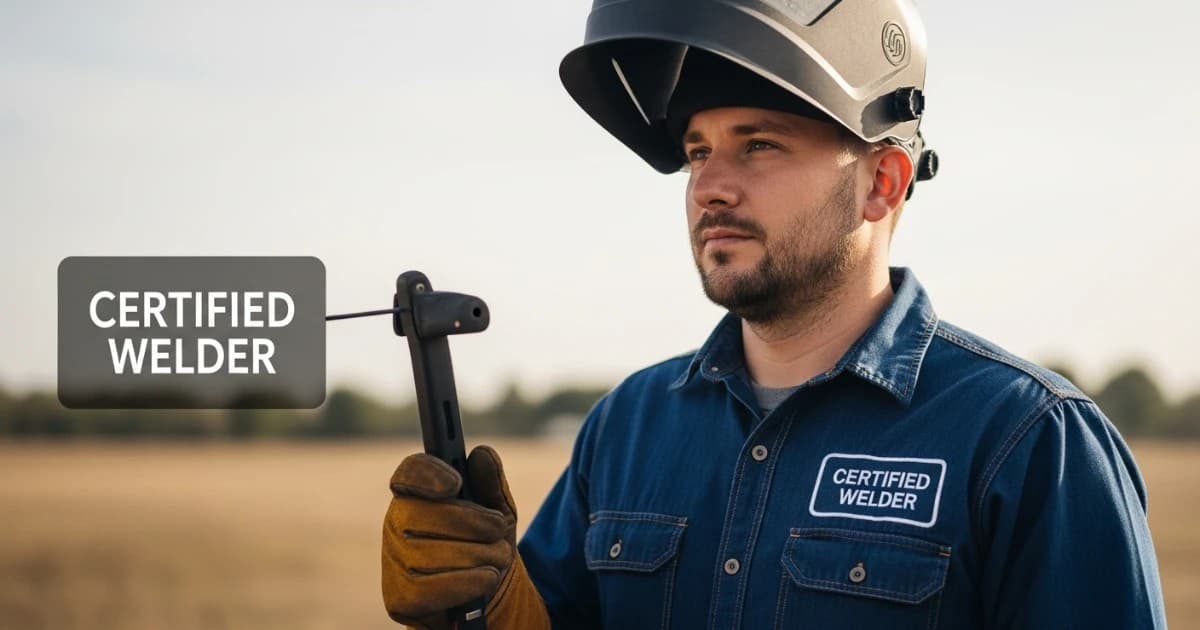
Welding is one of the few skilled trades where a single test — not a degree — can change what you earn. If you want to know how to become a certified welder, the path is more direct than most careers: learn the craft, practice a specific weld under a specific code, and prove it in front of an inspector. There is no mandatory college degree, no years-long licensing gauntlet, and the entry cost can be surprisingly low.
That said, the certification world is full of confusing terminology. AWS, ASME, API, 3G, 6G, WPS, ATF — the alphabet soup stops many people before they start. This guide walks through the entire path step by step: what certification actually means, the training routes available, what the tests involve, what everything costs, how long it takes, and the mistakes that cause first-time test failures.
What "Certified Welder" Actually Means
A certified welder is someone who has passed a welding performance qualification test: a hands-on weld, made to a written procedure, evaluated against a published code. The test proves one narrow thing — that you can produce a sound weld with a specific process, on a specific material, in a specific position.
This is the first big thing beginners misunderstand. There is no single, universal "welder's license." Certification is granular. A welder certified for stick welding on structural plate in the vertical position is not automatically certified for TIG on stainless pipe. Working welders typically hold several certifications and add more throughout their careers.
The three code bodies you will encounter most often in the United States:
- AWS (American Welding Society) — the D1.1 Structural Welding Code for steel is the most common qualification standard for buildings, bridges, and general fabrication.
- ASME Section IX — governs pressure vessels, boilers, and process piping. Qualifications are administered by employers, not by a central registry.
- API 1104 — covers cross-country pipelines and related facilities.
Certification vs. qualification: a distinction that matters
The industry uses two overlapping terms. Qualification means you passed a performance test for an employer under a code such as ASME Section IX; it generally belongs to that employer, and if you change companies you retest. Certification in the AWS sense means your test at an AWS Accredited Testing Facility is documented in the AWS national registry, which travels with you between employers.
Both are valuable. AWS certification is portable proof of skill you can show any hiring manager. Employer qualification is what legally lets you weld on a given job. Many welders carry AWS certifications to get hired, then take the employer's qualification test during their first week.
Why Certification Is Worth Pursuing
Plenty of people weld without certification — on farms, in hobby shops, in small fabrication businesses. So why bother?
The practical answer is access. Structural steel, pressure piping, shipbuilding, aerospace, and pipeline work all require code-qualified welders, and those are the sectors that pay the most. Certification is the ticket that gets your hood into those shops.
The economics support it. According to the U.S. Bureau of Labor Statistics, the median annual wage for welders, cutters, solderers, and brazers was $51,000 as of May 2024, with the top ten percent earning more than $75,850. Certified pipe welders, traveling industrial welders, and welders with multiple process certifications routinely land in that upper band. The BLS also projects roughly 45,600 job openings per year over the coming decade, driven largely by retirements — meaning steady demand for newly certified welders even though total employment growth is modest.
There is also a quieter benefit: the discipline of certification makes you a better welder. Preparing for a bend test forces you to fix habits that field work lets you get away with.
Step 1: Meet the Basic Requirements
The entry requirements are minimal:
- A high school diploma or GED is expected by most employers and training programs, though the AWS Certified Welder program itself has no education, experience, or prerequisite requirements.
- Good hand-eye coordination, reasonable vision (corrected is fine), and the physical ability to work in awkward positions.
- Comfort with basic math — fractions, angles, and reading measurements off drawings. If you are still in high school, take shop, metalworking, and any welding electives available. Some high schools participate in AWS SENSE-aligned programs that give you a running start.
Age matters less than people assume. Career changers in their 30s and 40s complete welding programs and certify all the time; the test evaluates the weld, not the welder's birth date.
Step 2: Choose Your Training Path
This is the biggest decision on the path, and there is no single right answer. Three routes dominate.
Trade school or community college
The fastest structured route. Certificate programs run roughly 6 to 18 months and teach the core processes — SMAW (stick), GMAW (MIG), FCAW (flux-core), and GTAW (TIG) — along with blueprint reading, metallurgy basics, and safety.
Costs vary widely. In-state community college certificate programs typically run $2,000 to $10,000, while private welding schools charge $5,000 to $15,000 or more for accelerated programs. Budget an additional $500 to $3,000 for a helmet, jacket, gloves, boots, and hand tools. Community college programs often cost less than the maximum federal Pell Grant, which means eligible students can train at little or no out-of-pocket cost.
Choose this route if you want to be job-ready quickly, you can cover tuition, or your area lacks apprenticeship openings.
Registered apprenticeship
The earn-while-you-learn route. Union programs — the United Association (pipefitters/steamfitters), Ironworkers, and Boilermakers among them — combine paid on-the-job training with classroom instruction. A UA apprenticeship runs five years, with 1,700 to 2,000 hours of on-the-job training plus at least 246 hours of classroom instruction per year, and the program pays you: starting wages are typically 40 to 50 percent of journeyman scale and rise on a fixed schedule, with healthcare and retirement benefits included. Training, books, and welding certifications are usually covered.
The catch is competitiveness and time. Openings are limited, application windows can be narrow, and five years is a real commitment.
Choose this route if you can get in. Financially, it is the strongest option: you graduate debt-free with years of documented experience and a journeyman wage waiting.
Employer-sponsored on-the-job training
Some fabrication shops hire helpers and train them up, eventually sponsoring their qualification tests. This costs you nothing but takes longer, and the skills you learn are only as broad as the shop's work. It works best as a supplement — many welders start as helpers while attending night classes at a community college.
A quick comparison
| Factor | Trade school | Apprenticeship | On-the-job |
|---|---|---|---|
| Time to first certification | 6–18 months | 1–2 years (within program) | 1–3 years |
| Cost to you | $2,500–$18,000 | Paid to learn | Free, lower wages initially |
| Breadth of skills | Broad, multi-process | Deep, trade-specific | Narrow, shop-specific |
| Job placement | Varies by school | Built in | Already employed |
Step 3: Learn the Processes and Positions
Certifications are defined by process, position, material, and thickness. Understanding this framework early helps you plan which tests to pursue.
The four core processes
- SMAW (stick) — the workhorse of structural steel and field work. Most welders certify here first.
- GMAW (MIG) — fast and common in production fabrication shops.
- FCAW (flux-core) — high deposition rates; widely used in structural and shipyard work.
- GTAW (TIG) — precise and clean; essential for pipe root passes, stainless, and aluminum.
Positions: the number-letter code
Plate positions run 1G through 4G: flat, horizontal, vertical, and overhead groove welds. Pipe adds 1G and 2G (rotated and fixed vertical), 5G (fixed horizontal), and 6G — pipe fixed at a 45-degree incline, which forces you to weld flat, vertical, horizontal, and overhead in a single joint.
Two useful rules of thumb. First, harder positions qualify easier ones: pass a 3G vertical test and you are typically qualified for flat and horizontal too; pass a 6G and you cover essentially all pipe positions. Second, difficulty maps to pay. A 6G combo certification (TIG root, stick fill and cap) is the gateway to the best-paying pipe work in refineries, power plants, and shipyards.
Realistic skill timelines for a beginner practicing consistently: a 3G plate test takes roughly 6 weeks to 3 months of preparation, a 3G/4G combo takes 6 to 9 months, and a 6G pipe test takes 12 to 18 months. Rushing to a 6G test before your hood time supports it is one of the most common — and most expensive — beginner mistakes.
Step 4: Take Your First Certification Test
When your instructor or supervisor says your welds are consistently sound, it is time to test. Here is how the AWS Certified Welder process works.
Find an AWS Accredited Testing Facility (ATF). These are welding schools, union halls, and independent labs authorized to administer the test. Many training programs are themselves ATFs, so you may test where you trained.
Test to a Welding Procedure Specification (WPS). The WPS dictates everything: process, filler metal, amperage range, joint prep, positions. Deviating from it is grounds for failure regardless of how the weld looks.
Weld the test coupon. For a typical D1.1 structural test, you weld a grooved plate with backing in your chosen position while the test supervisor observes.
Pass inspection. The weld is evaluated visually first — profile, undercut, porosity — and then by guided bend test, in which strips cut from your coupon are bent 180 degrees around a die. Sound welds stretch; defective welds crack open. Some tests use radiographic (X-ray) or ultrasonic examination instead.
Submit your paperwork. The AWS certification application fee is modest (currently $35), though the ATF charges its own facility and material fees, which vary — commonly a few hundred dollars per test. Once processed, you are listed in the AWS National Registry of Certified Welders.
Note: Some states and cities layer licensing on top of certification. New York City, Los Angeles, and several jurisdictions require a separate welder license for structural work within their limits. Check your local building department before assuming AWS certification alone is sufficient.
Step 5: Keep Your Certification Current
Certification is not one-and-done. AWS certifications require a maintenance form every six months, signed by a supervisor or other qualified party, verifying you have continued welding with the qualified process. ASME Section IX works similarly: qualification remains valid indefinitely unless you go more than six months without using the process, at which point you must requalify.
The practical takeaway: keep records. Maintain a personal continuity log with dates, processes, and supervisor signatures. Welders who let certifications lapse through sloppy paperwork pay for retests that a five-minute form would have avoided.
Common Reasons First-Time Testers Fail
Test failures cluster around a handful of preventable causes:
- Porosity — gas pockets in the weld, usually from mill scale, oil, moisture, or inadequate shielding gas coverage. Grind and clean the coupon thoroughly; check gas flow before striking an arc.
- Lack of fusion — the weld metal fails to bond with the base metal or the previous pass, typically from insufficient heat, wrong electrode angle, or excessive travel speed. This is the defect the bend test exposes most brutally.
- Incomplete penetration — the root pass fails to reach through the joint. Verify fit-up gap and amperage against the WPS.
- Undercut — a groove melted into the base metal at the weld toe from too much amperage or a rushed pass.
- Ignoring the WPS — welders with field experience often assume their habits will carry them, then run parameters outside the procedure. The test rewards discipline, not improvisation.
- Test-day nerves — welding is fine motor control, and adrenaline degrades it. Arrive early, do practice beads on scrap if permitted, and treat the test like a normal day in the booth. If you fail, ask exactly which defect caused it, drill that specific weakness, and retest. Most facilities allow retests after additional practice, and a failed first attempt is common enough that no one in the trade holds it against you.
Building a Career After Your First Certification
Your first certificate is a floor, not a ceiling. The typical progression looks like this: certify in SMAW on plate, get hired into structural or fabrication work, add FCAW and GMAW certifications, then move to pipe — 2G, 5G, and eventually 6G — as your skills mature. Each added process and position widens the set of jobs you can bid.
Beyond production welding, certifications open adjacent paths. With years of experience, welders move into roles as Certified Welding Inspectors (CWI) — an AWS credential with its own exam that shifts you from making welds to judging them, often at a significant pay increase. Others become welding supervisors, educators at the programs that trained them, or specialized travelers who chase shutdown and turnaround work at premium rates.
Specialization pays too. Underwater welding, aerospace TIG work on exotic alloys, and nuclear-qualified pressure welding all demand additional credentials — and compensate accordingly.
How to Become a Certified Welder: The Bottom Line
Becoming a certified welder follows a clear sequence: meet the minimal entry requirements, pick the training route that fits your finances and timeline, build real hood time in the core processes, test at an accredited facility under a recognized code, and maintain continuity every six months. A motivated beginner can hold a first structural certification within a year, often for less than the cost of a single semester at a university, and the trade offers a rare thing — a documented, portable, testable proof of skill that employers trust on sight.
The best next step is concrete: visit a local community college welding program or union training center this month, ask which codes they test to, and get a date on the calendar. The test will still be hard. But the path to it is not complicated.
Frequently asked questions
How long does it take to become a certified welder?
A focused beginner can prepare for a basic structural plate certification in about 6 months to a year through a trade school program. Pipe certifications such as 6G typically take 12 to 18 months of training and practice.
How much does welding certification cost?
The AWS application fee is $35, but testing facilities charge their own fees for materials, booth time, and inspection — commonly a few hundred dollars per test. Training is the larger expense, ranging from roughly $2,000 at community colleges to $15,000 or more at private schools.
Do I need a college degree to become a certified welder?
No. A high school diploma or GED is the typical education requirement, and the AWS Certified Welder program itself has no education or experience prerequisites — you simply have to pass the performance test.
What is the difference between welder qualification and certification?
Qualification is passing a performance test for a specific employer under a code such as ASME Section IX, and it usually stays with that employer. AWS certification is documented in a national registry and travels with you between jobs.
What is a 6G welding certification?
A 6G test qualifies you on pipe fixed at a 45-degree angle, forcing you to weld in every position within one joint. It is considered the most difficult common test and qualifies you for essentially all pipe positions, which is why 6G welders command top pay.
Does welding certification expire?
AWS certifications remain valid as long as you submit a maintenance form every six months confirming continued use of the process. Under ASME Section IX, a gap of more than six months without using the process voids the qualification and requires a retest.
Which welding certification should I get first?
Most welders start with an SMAW (stick) certification on structural plate under AWS D1.1, typically in the 3G vertical position, since passing it also qualifies flat and horizontal welding and it matches the largest pool of entry-level jobs.
Is a welding apprenticeship better than trade school?
Financially, yes — apprenticeships pay wages and benefits while covering training costs, and graduates finish debt-free with years of experience. But slots are competitive and programs run three to five years, so trade school is often the faster and more accessible route.
Can I get certified without going to welding school?
Yes. The AWS Certified Welder test has no training prerequisites, so a self-taught welder or one trained on the job can walk into an accredited facility and test. In practice, most people need structured instruction to reach test-passing consistency.
How much do certified welders make?
The median wage for welders was $51,000 per year as of May 2024, with the top ten percent earning above $75,850. Certified pipe welders, travelers, and welders in industries like aerospace and energy commonly earn well above the median.
Do welders need a state license?
In most places, code certification is sufficient, but some states and cities — New York City and Los Angeles among them — require a separate welder license for structural work in their jurisdiction. Check with the local building department where you plan to work.
What happens if I fail the certification test?
Nothing permanent. Ask the inspector which defect caused the failure, practice that specific weakness, and schedule a retest — most facilities allow it after additional preparation. Failed first attempts are common and carry no lasting mark.
References
- Welders, Cutters, Solderers, and Brazers — Occupational Outlook Handbook - U.S. Bureau of Labor Statistics, 2025. Wage, outlook, and entry-requirement data.
- Certified Welder Program - American Welding Society, accessed 2026-07-15. Official program requirements and testing structure.
- AWS Certification and Education Price List - American Welding Society, accessed 2026-07-15. Current certification fees.
- How to Become a Certified Welder - TWI, accessed 2026-07-15. Overview of certification pathways and code bodies.
- Apprenticeship - United Association, accessed 2026-07-15. Apprenticeship structure, hours, and earn-while-you-learn model.
- How to Pass a Weld Test: Pro Tips - American Welding Society Welding Digest, 2023. Test preparation and common failure causes.